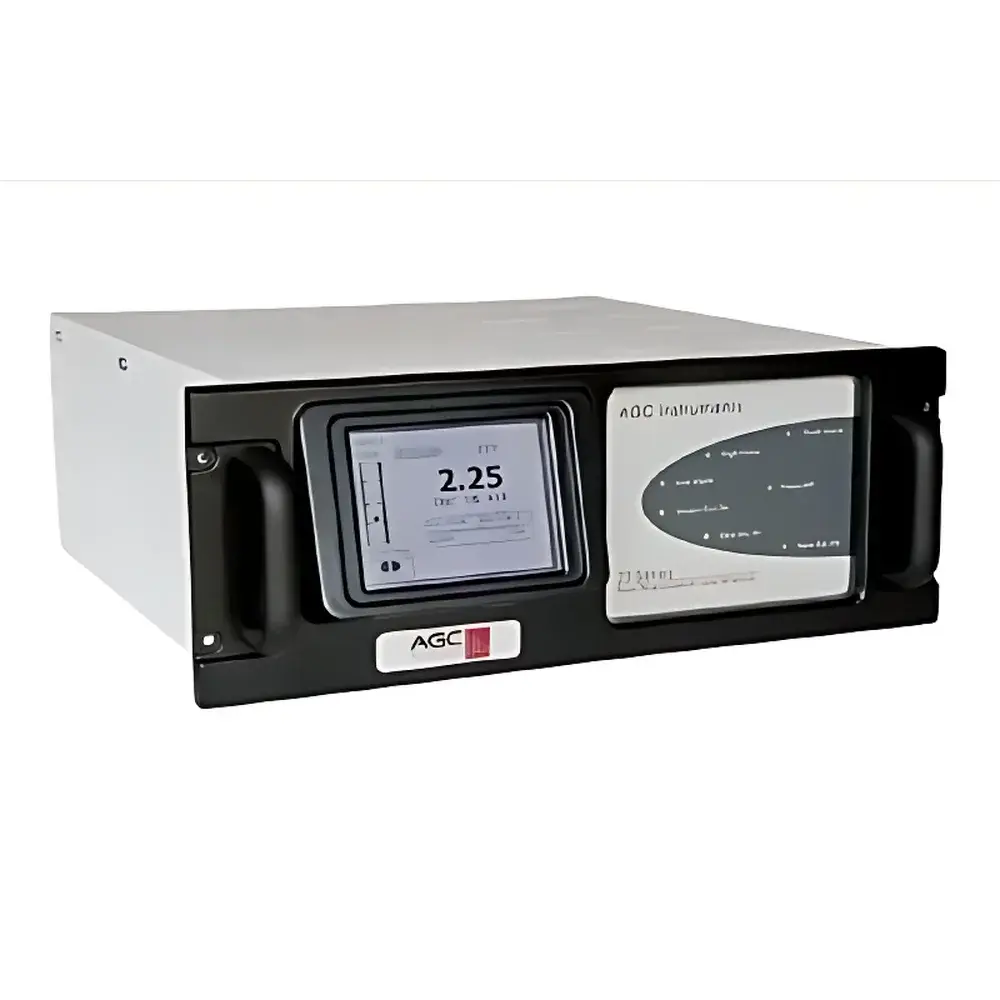
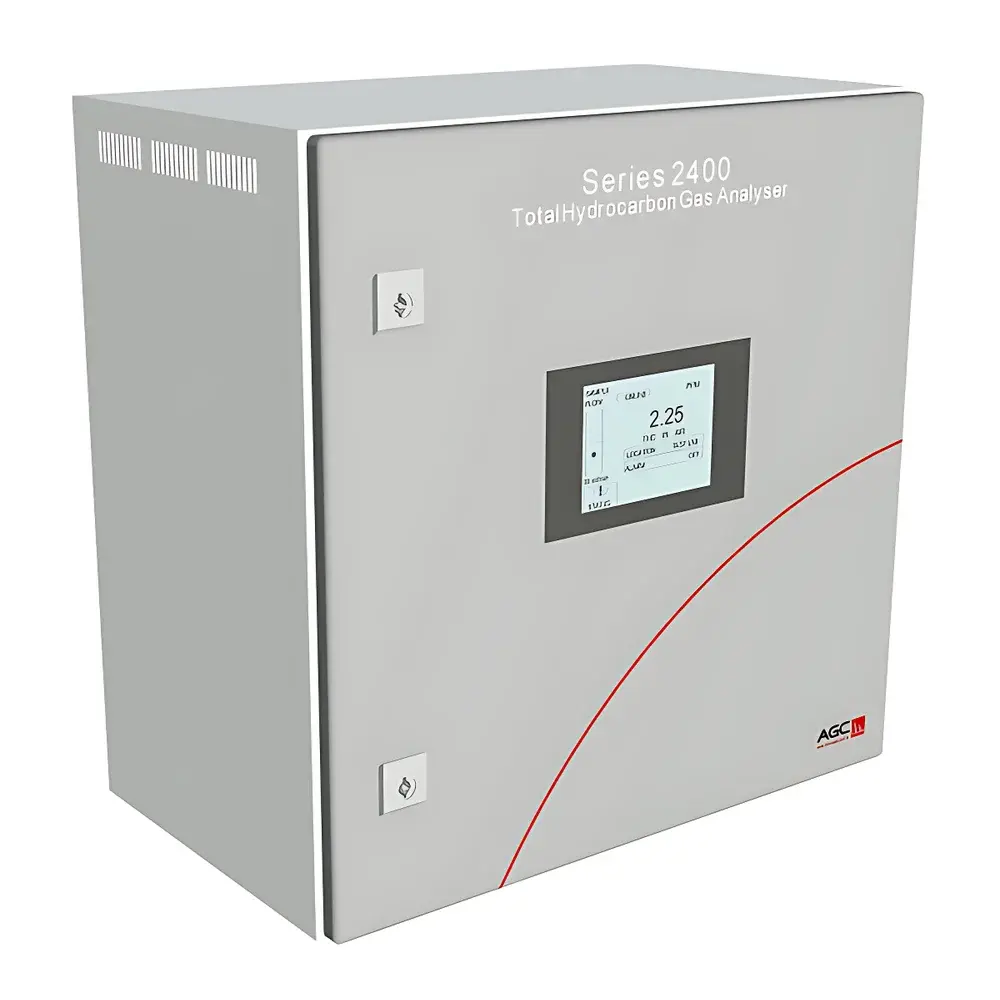
AGC AGC23 Total Hydrocarbon (THC) Analyzer
| Brand | AGC |
|---|---|
| Origin | Ireland |
| Model | AGC23 THC Analyzer |
| Detection Principle | Catalytic Combustion + Methane Conversion + Flame Ionization Detection (FID) |
| Display | 5.7″ QVGA Touchscreen |
| Calibration | Automated Zero/Range Calibration via Internal Solenoid Valves |
| Flow Control | Digital Electronic Mass Flow Controllers (MFCs) |
| Sample Flow Monitoring | Real-time Digital Flow Visualization & Alarm |
| Output Signals | 2 × Isolated, Passive 4–20 mA Outputs |
| Communication | RS-232 Serial Interface |
| Range Selection | 3 Auto-ranging Full-Scale Ranges |
| Compliance Support | Designed for ISO 8573-5, ASTM D6245, EPA Method 25A, and EN 15409-compliant installations |
| Safety Certification | ATEX / IECEx Zone 2 (optional), CE Marked |
Overview
The AGC AGC23 Total Hydrocarbon (THC) Analyzer is an industrial-grade online gas chromatograph engineered for continuous, high-stability measurement of total hydrocarbon concentration in process gas streams. Utilizing a dual-stage detection architecture—catalytic combustion for broad-spectrum hydrocarbon oxidation followed by methane-selective conversion and flame ionization detection (FID)—the system delivers trace-level sensitivity (sub-ppm detection limit) with long-term baseline stability. Its design targets applications where regulatory compliance, process safety, and emission accountability converge: air separation units, cryogenic gas production lines, compressed air systems, biogas upgrading facilities, and refinery off-gas monitoring. Unlike laboratory-based GC systems, the AGC23 integrates real-time flow regulation, on-board calibration logic, and embedded diagnostics to sustain operation under fluctuating pressure, temperature, and matrix composition—without requiring manual intervention or external calibration gas cylinders during routine operation.
Key Features
- Automated zero and span calibration via integrated solenoid valve manifold—eliminates manual valve switching and reduces operator dependency.
- Digital electronic mass flow controllers (MFCs) ensure sample and carrier gas flow stability within ±0.5% of setpoint across ambient temperature variations (0–45 °C).
- Integrated methane conversion furnace enables quantification of CO and CO₂ as equivalent hydrocarbons—critical for landfill gas, syngas, and anaerobic digester monitoring where non-methane hydrocarbons coexist with carbon oxides.
- 5.7″ QVGA resistive touchscreen interface with intuitive navigation, multilingual support (English, German, French, Spanish), and contextual help overlays.
- Real-time digital visualization of all critical flow paths—including sample inlet, carrier gas, hydrogen fuel, and air oxidant—with configurable alarm thresholds and visual/relay-based fault indication.
- Three auto-ranging full-scale measurement spans (e.g., 0–10 ppm, 0–100 ppm, 0–10,000 ppm C₁-equivalent) selected dynamically based on signal amplitude and historical drift trends.
- Two isolated, passive 4–20 mA analog outputs—fully configurable per channel for THC concentration, status flag (e.g., “Calibrating”, “Fault”), or internal diagnostic parameter (e.g., detector bias voltage, oven temperature).
Sample Compatibility & Compliance
The AGC23 accepts gaseous samples with dew points ≤ −40 °C and particulate loading < 0.1 µm. It operates reliably in matrices containing N₂, O₂, Ar, He, CO, CO₂, H₂, CH₄, and light alkanes (C₂–C₅). Inert sample conditioning (stainless steel 316L or electropolished tubing) and heated sample lines (up to 180 °C optional) prevent condensation and adsorption losses. The analyzer meets CE marking requirements under the EU Machinery Directive 2006/42/EC and Electromagnetic Compatibility Directive 2014/30/EU. Optional ATEX/IECEx Zone 2 certification supports deployment in classified hazardous areas. Its measurement methodology aligns with ISO 8573-5 (compressed air purity), ASTM D6245 (ambient air THC), EPA Method 25A (stationary source emissions), and EN 15409 (biogas quality), supporting audit-ready data capture for GLP/GMP environments.
Software & Data Management
Data logging occurs locally via RS-232 serial output at user-defined intervals (1 s to 1 h), compatible with SCADA, DCS, and historian platforms (e.g., Siemens Desigo, Honeywell Experion, Emerson DeltaV). The onboard firmware supports timestamped event logging—including calibration initiation, alarm activation, range switching, and power cycle—with cyclic buffer storage (≥72 h of 1-second resolution data). No proprietary software is required for basic operation; however, AGC’s optional WebConfigurator utility (Windows-based) enables remote configuration, firmware updates, and diagnostic report export in CSV/PDF formats. All calibration actions are time-stamped and logged with operator ID (if configured via external authentication), satisfying FDA 21 CFR Part 11 requirements for electronic records and signatures when deployed in regulated manufacturing settings.
Applications
- Air separation plants: Continuous THC monitoring upstream of molecular sieves to prevent catalyst poisoning.
- Liquefied natural gas (LNG) and industrial gas production: Verification of hydrocarbon impurity removal prior to cryogenic distillation.
- Gas blending and cylinder filling stations: Batch certification of ultra-high-purity gases (e.g., medical O₂, semiconductor-grade N₂).
- Landfill and anaerobic digestion facilities: Real-time tracking of CH₄, NMHC, and CO/CO₂ ratios to optimize flare efficiency and carbon credit reporting.
- Internal combustion engine test cells: Exhaust THC quantification per ISO 8178 and EPA Tier 4 standards.
- Environmental air monitoring networks: Fixed-site compliance with national ambient air quality standards (NAAQS) for total volatile organic compounds (TVOC).
- QC/QA laboratories: Reference instrument for method validation, standard gas certification, and inter-laboratory comparison studies.
FAQ
Does the AGC23 require external hydrogen supply for FID operation?
Yes—the FID detector requires ultra-high-purity hydrogen (≥99.999%) as fuel gas, typically supplied from a cylinder or on-site generator. Air for combustion must also be oil-free and particle-filtered.
Can the AGC23 measure individual hydrocarbon species (e.g., benzene, toluene)?
No—it is optimized for total hydrocarbon quantification, not speciated VOC analysis. For compound-specific identification, a full-capability GC-FID or GC-MS system is recommended.
What maintenance intervals are recommended for routine operation?
Filter replacement every 3 months; FID jet cleaning every 6 months; annual verification of flow controllers and detector response using certified calibration gas standards.
Is remote firmware update supported over RS-232?
Yes—firmware upgrades can be performed via RS-232 using AGC’s signed binary package and WebConfigurator utility, with rollback capability and checksum validation.
How is calibration traceability maintained?
Each calibration event logs date/time, operator ID (if enabled), reference gas lot number, and measured deviation from expected value—supporting ISO/IEC 17025 documentation requirements for accredited laboratories.
Related Products