
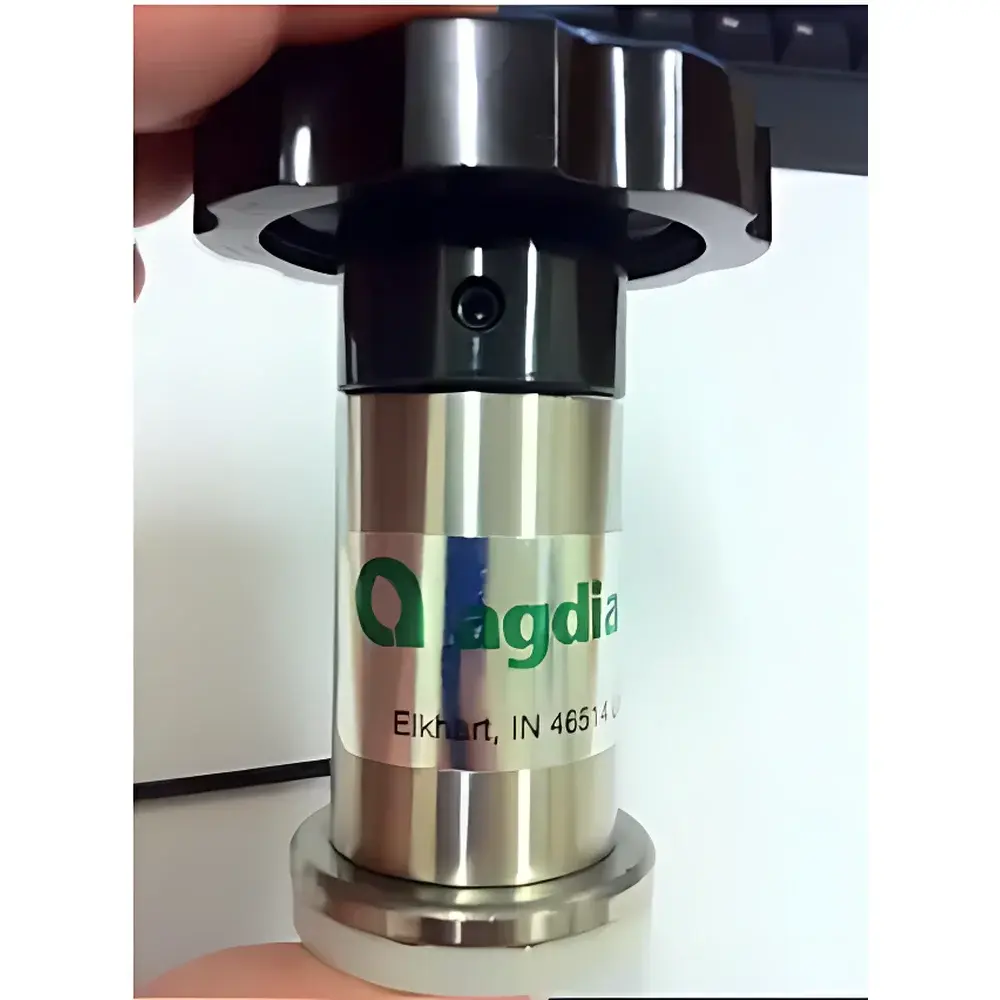
AGDIA Tissue Homogenizer Model TH-10
| Brand | AGDIA |
|---|---|
| Origin | USA |
| Manufacturer Type | Authorized Distributor |
| Product Category | Imported Equipment |
| Instrument Type | Tissue Homogenizer |
| Sample Type | Soft Biological Tissues (e.g., leaf, stem, root) |
| Output Particle Size | 0.01–0.5 mm |
| Final Homogenate Particle Size | <40 µm |
| Batch Capacity | 10 mL per cycle |
| Power Options | Manual and Electric Drive Configurations |
| Compatible Consumables | AGDIA Certified Sample Grinding Bags (Single-Use, Sterile, RNase/DNase-Free) |
Overview
The AGDIA Tissue Homogenizer Model TH-10 is a purpose-engineered mechanical homogenization system designed specifically for the rapid, reproducible disruption of soft plant tissues in diagnostic and research laboratories. It operates on the principle of high-shear mechanical grinding—utilizing controlled oscillatory motion combined with abrasive action inside proprietary AGDIA-certified grinding bags—to achieve uniform cell lysis without significant thermal denaturation or nucleic acid degradation. Unlike high-speed bead mills or rotor-stator systems, the TH-10 delivers consistent homogenization performance at ambient temperature, making it ideal for downstream immunoassay workflows such as ELISA, lateral flow assays, and antigen extraction where protein integrity and epitope preservation are critical. Its compact footprint and dual-mode operation (manual crank and electric motor) support both field-deployable and benchtop laboratory use, particularly in phytopathology labs conducting routine screening of viral, bacterial, and fungal pathogens in crop samples.
Key Features
- Optimized for soft plant matrices: Engineered to handle leaf tissue, young stems, petioles, and root tips with minimal clogging or sample adhesion.
- Dual-drive configuration: Switch between manual operation (for low-power or portable applications) and electric drive (for standardized throughput in high-volume testing).
- Single-use, certified grinding bags: Pre-sterilized AGDIA Sample Grinding Bags contain embedded ceramic beads and are validated for RNase/DNase-free performance—eliminating cross-contamination and cleaning validation burdens.
- Precision batch control: Fixed 10 mL working volume ensures repeatable shear exposure and minimizes inter-batch variability in extract concentration and viscosity.
- No external cooling required: Low-energy grinding profile maintains sample temperature below 25°C during standard 60-second cycles, preserving labile antigens and enzymatic activity.
- Compliance-ready design: Device housing meets IP54 ingress protection; all consumables carry lot-specific traceability documentation aligned with ISO 17025 reference material handling guidelines.
Sample Compatibility & Compliance
The TH-10 is validated for use with fresh, frozen, or lyophilized plant tissues exhibiting moisture content >60% and structural compliance (i.e., non-fibrous, non-lignified). It is not intended for woody tissues, seeds, or dried botanicals requiring cryogenic milling. All grinding bags comply with ASTM D6978-05 (standard practice for biological sampling bag integrity) and are supplied with CoA confirming absence of interfering substances (e.g., latex proteins, endotoxins <0.03 EU/mL). The system supports GLP-compliant workflow documentation when integrated with AGDIA’s LIMS-compatible assay kits—enabling full chain-of-custody tracking from homogenization to final ELISA readout.
Software & Data Management
While the TH-10 is a hardware-only platform with no embedded microcontroller or onboard software, its operational parameters are fully integrable into laboratory information management systems (LIMS) via configurable I/O triggers. Electric drive units feature TTL-level pulse output synchronized to homogenization duration and cycle count—enabling timestamped audit logs in compliant environments. AGDIA provides SOP templates aligned with FDA 21 CFR Part 11 requirements, including electronic signature protocols for homogenization step verification and raw data export (CSV) of operator ID, date/time stamp, and batch ID linked to associated ELISA plate IDs.
Applications
- Routine pathogen detection in agricultural diagnostics: Homogenization of tobacco, tomato, potato, and cereal leaf samples prior to Agdia ELISA test kit analysis.
- High-throughput screening in breeding programs: Parallel processing of 12–24 samples per hour under standardized torque and dwell-time conditions.
- Antigen preparation for polyclonal antibody development: Consistent release of membrane-bound and cytoplasmic antigens from host plant cells without detergent addition.
- Field-deployable surveillance: Manual mode enables battery-independent operation in mobile labs or greenhouse settings with limited infrastructure.
- Method transfer support: Validated equivalency to mortar-and-pestle and vortex-based protocols per AOAC Official Method 2019.01 for plant tissue homogenization.
FAQ
Is the TH-10 compatible with non-AGDIA grinding bags?
No. Only AGDIA-certified single-use grinding bags are validated for dimensional tolerance, bead composition, and chemical leachables—substitution may compromise assay sensitivity and reproducibility.
What maintenance is required for the electric drive unit?
Annual calibration of motor torque output and dwell-time accuracy is recommended; AGDIA offers certified service through authorized regional partners.
Can the TH-10 be used for RNA extraction workflows?
Yes—when operated within specified time limits (≤90 sec/cycle) and paired with RNase-inhibiting buffer systems, it yields intact total RNA suitable for RT-qPCR, as verified per MIQE guidelines.
Does the device meet CE or UKCA marking requirements?
The TH-10 is supplied as a Class I general-purpose laboratory instrument under EU Directive 2014/30/EU (EMC) and 2014/35/EU (LVD); CE declaration of conformity is available upon request.
How is homogenization efficiency verified?
AGDIA provides a standardized optical density (OD600) turbidity assay protocol using serial dilutions of homogenized turnip mosaic virus-infected tissue, with acceptance criteria defined in internal SOP-HM-07.



