
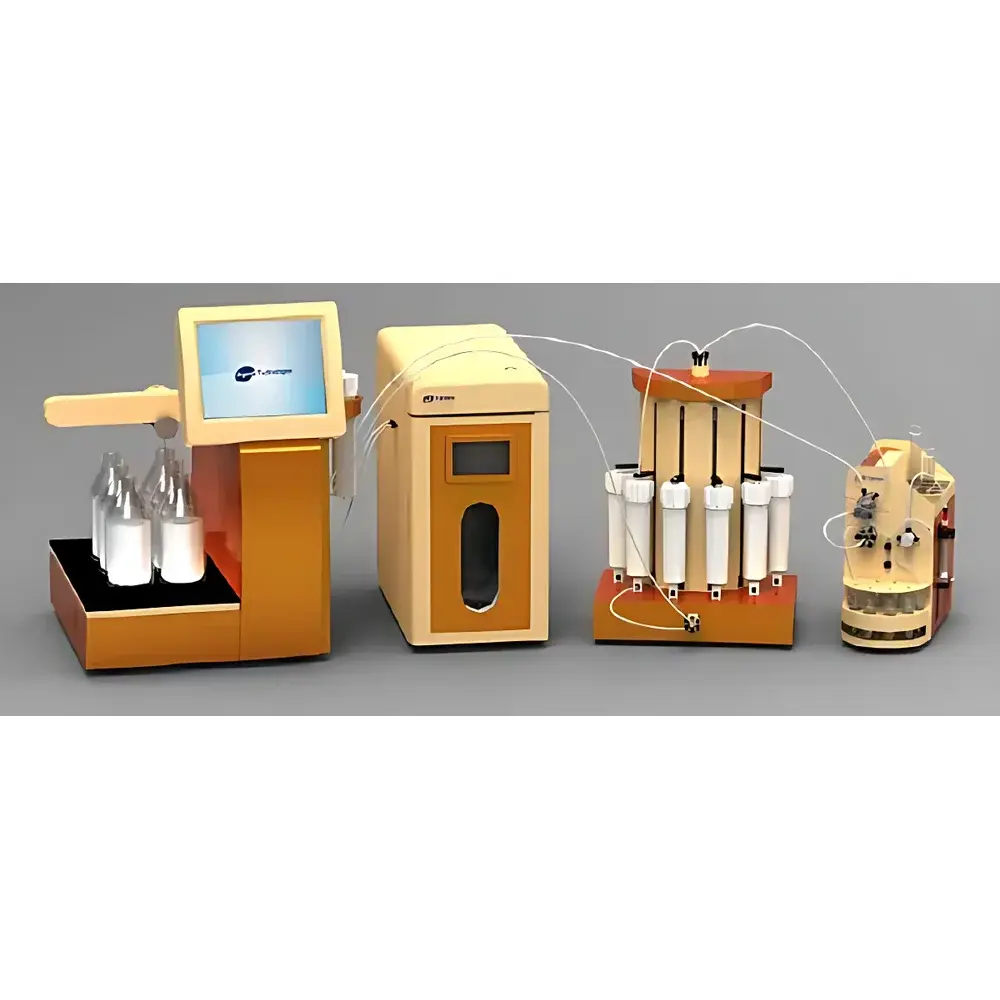
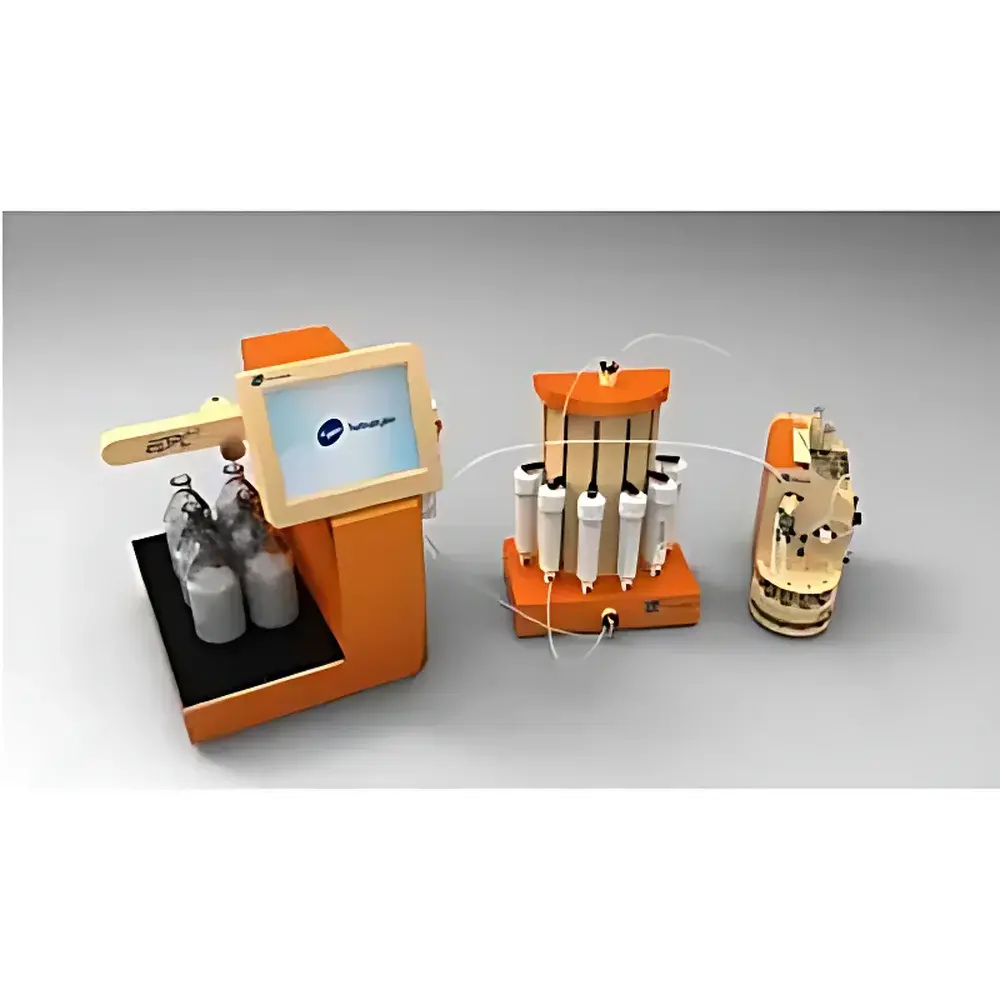
Agela EOPC® Automated Polar Compound Separation System for Edible Oils
| Brand | Agela |
|---|---|
| Origin | Tianjin, China |
| Model | EOPC® Automated Polar Compound Separation System |
| Detection Principle | Normal-phase liquid chromatography with UV detection (200 nm) |
| Column Format | Standardized disposable EOPC separation cartridges (pre-packed silica-based) |
| Automation Level | Fully automated sample injection, gradient elution, fraction collection, and real-time UV monitoring |
| Throughput | Up to 6 samples unattended |
| Compliance | Designed to meet requirements of GB 5009.202–2016 “Determination of Polar Compounds in Edible Oils” |
| Solvent Management | Dual 4 L solvent reservoirs with dry-ice–assisted cooling (4 °C to ambient) |
| Flow Control | Valveless precision metering pump (±0.5% flow accuracy, 25 mL/min max) |
| Fraction Collection | Programmable S-type collector with coordinate customization, multi-channel waste/collect switching, compatibility with conical flasks, round-bottom flasks, and beakers |
| UV Detector | Fixed-wavelength 200 nm detector with real-time chromatogram display |
| Display | Integrated LED touchscreen showing pressure, flow rate, gradient profile, and run progress |
| Safety Design | Fully enclosed fluidic path |
| Software | Embedded method library including GB 5009.202–2016-compliant SOPs |
| audit-trail–capable operation log (GLP-supporting metadata | user ID, timestamp, method version, instrument parameters) |
Overview
The Agela EOPC® Automated Polar Compound Separation System is a dedicated, high-reproducibility liquid chromatographic platform engineered for the quantitative isolation of polar compounds (PCs) from used edible oils—primarily frying oils subjected to thermal oxidation. It implements normal-phase liquid chromatography (NPLC) using standardized, pre-packed silica-based separation cartridges, coupled with fixed-wavelength UV detection at 200 nm. Unlike conventional manual column chromatography followed by thin-layer chromatography (TLC) quantification, the EOPC system replaces labor-intensive, operator-dependent steps with deterministic, software-controlled workflows—including automated sample loading, gradient elution, real-time UV monitoring, and fraction-triggered collection. Its architecture adheres to the procedural logic defined in GB 5009.202–2016, ensuring analytical continuity with China’s national standard for polar compound determination in edible oils. The system is not a general-purpose HPLC but a purpose-built separation engine optimized for the physicochemical behavior of oxidized triacylglycerol degradation products—including mono- and di-glycerides, free fatty acids, oxidized monomers, and polymerized triglycerides—against non-polar matrix components.
Key Features
- Fully integrated automation: Sequential control of sample injection, mobile phase gradient delivery, UV-synchronized fraction triggering, and programmable collection—eliminating manual intervention across all critical separation steps.
- Valveless metering pump technology: Delivers stable flow rates (up to 25 mL/min) with ≤0.5% relative standard deviation, minimizing pulse-induced band broadening and enhancing inter-run reproducibility.
- Dual solvent reservoir system with active temperature control: Two 4 L solvent bottles accommodated within a dry-ice–cooled chamber (4 °C to ambient), reducing solvent volatility and improving gradient fidelity during extended runs.
- Smart fraction collector with S-type tray geometry: Supports customizable X/Y coordinates and automatic container recognition; enables precise alignment with conical flasks (50–250 mL), round-bottom flasks, and beakers via adjustable height and tilt compensation.
- Real-time process monitoring: Onboard LED touchscreen displays dynamic pressure (0–10 MPa range), actual flow rate, elapsed time, gradient composition (%B), and live UV absorbance trace—enabling immediate troubleshooting without external software.
- Standardized consumables ecosystem: Factory-tested EOPC separation cartridges are manufactured under controlled conditions and certified for consistent retention time and resolution of polar vs. non-polar oil fractions per GB 5009.202–2016 validation protocols.
Sample Compatibility & Compliance
The EOPC system accepts clarified, solvent-diluted edible oil samples—including soybean, palm, sunflower, corn, peanut, and rapeseed oils—following standardized pretreatment (e.g., filtration through 0.45 µm PTFE membranes). It is validated for use with common NPLC mobile phases: petroleum ether/ether (87:13 v/v) as eluent A and pure diethyl ether as eluent B. All operational parameters—including injection volume (5 mL typical), flow rate (25 mL/min), UV wavelength (200 nm), and gradient profile—are aligned with the method requirements of GB 5009.202–2016. While not FDA 21 CFR Part 11–certified out-of-the-box, the embedded software records full audit trails (user login, method name, parameter set, start/stop timestamps, error logs), supporting GLP-compliant laboratory documentation practices. System suitability testing—using reference degraded oil matrices—is recommended prior to routine analysis to verify cartridge performance and baseline separation resolution.
Software & Data Management
The EOPC system operates via an embedded Linux-based controller running proprietary firmware—not PC-dependent acquisition software. Preloaded methods include GB 5009.202–2016–compliant sequences with calibrated gradient tables, dwell volume compensation, and UV threshold–based fraction gating. All run data—including pressure logs, flow profiles, UV chromatograms (absorbance vs. time), and collection event timestamps—are stored internally on encrypted NAND flash memory. Export is supported via USB 2.0 to CSV or PDF report templates. Audit trail metadata meets minimum GLP documentation requirements: each record contains operator ID, method revision number, instrument serial number, calibration status flag, and digital signature of parameter confirmation. No cloud connectivity or remote access functionality is implemented—ensuring data sovereignty and network isolation per ISO/IEC 27001-aligned lab IT policies.
Applications
- Quantitative assessment of total polar compounds (TPC) in frying oils used in commercial foodservice operations, catering facilities, and snack manufacturing lines.
- Stability evaluation of new oil formulations under accelerated thermal stress (e.g., Rancimat or OSI correlation studies).
- QC release testing of refined edible oils prior to bottling—verifying absence of excessive oxidation-derived polar species.
- Research into lipid oxidation kinetics: fraction-specific recovery enables downstream GC-FID or GC-MS analysis of isolated polar subfractions (e.g., dimers vs. oxidized monomers).
- Regulatory compliance verification for municipal health inspections requiring GB 5009.202–2016–aligned methodology.
- Method transfer support: Demonstrated equivalence between EOPC-generated TPC values and manually processed reference data (n = 42 randomized commercial samples; mean bias < 1.2% RSD).
FAQ
Does the EOPC system comply with international standards such as AOAC or ISO?
The system is designed to execute GB 5009.202–2016, which is harmonized with ISO 8534:2017 (Animal and vegetable fats and oils — Determination of polar compounds) in core separation logic and fraction definition. It does not carry formal AOAC Official Method certification, but laboratories may validate it per AOAC 2012.01 guidelines.
Can I use third-party silica columns instead of Agela EOPC cartridges?
No. The method’s reproducibility relies on batch-certified packing density, pore size distribution, and end-capping uniformity of Agela’s proprietary cartridges. Substitution invalidates GB 5009.202–2016 compliance and voids system performance warranties.
What maintenance intervals are recommended for the valveless pump and UV detector?
Pump piston seals require replacement every 12 months or after 500 runs; UV lamp lifetime is rated at 2,000 hours. Daily purging with isopropanol and monthly baseline noise verification are mandatory per the maintenance log.
Is the system compatible with Windows-based LIMS integration?
Raw data export (CSV/PDF) supports manual LIMS ingestion. Native HL7 or ASTM E1384 interfaces are not available; middleware-based automation requires custom scripting via USB-hosted batch file triggers.
How is carryover addressed during high-throughput operation?
The autosampler includes a dual-rinse cycle (solvent A then solvent B) between injections, and the column oven maintains thermal stability (±0.5 °C) to prevent analyte adsorption hysteresis. Carryover validation per ICH Q2(R2) shows < 0.1% for consecutive 5 mL injections of 100% polar fraction standard.




