
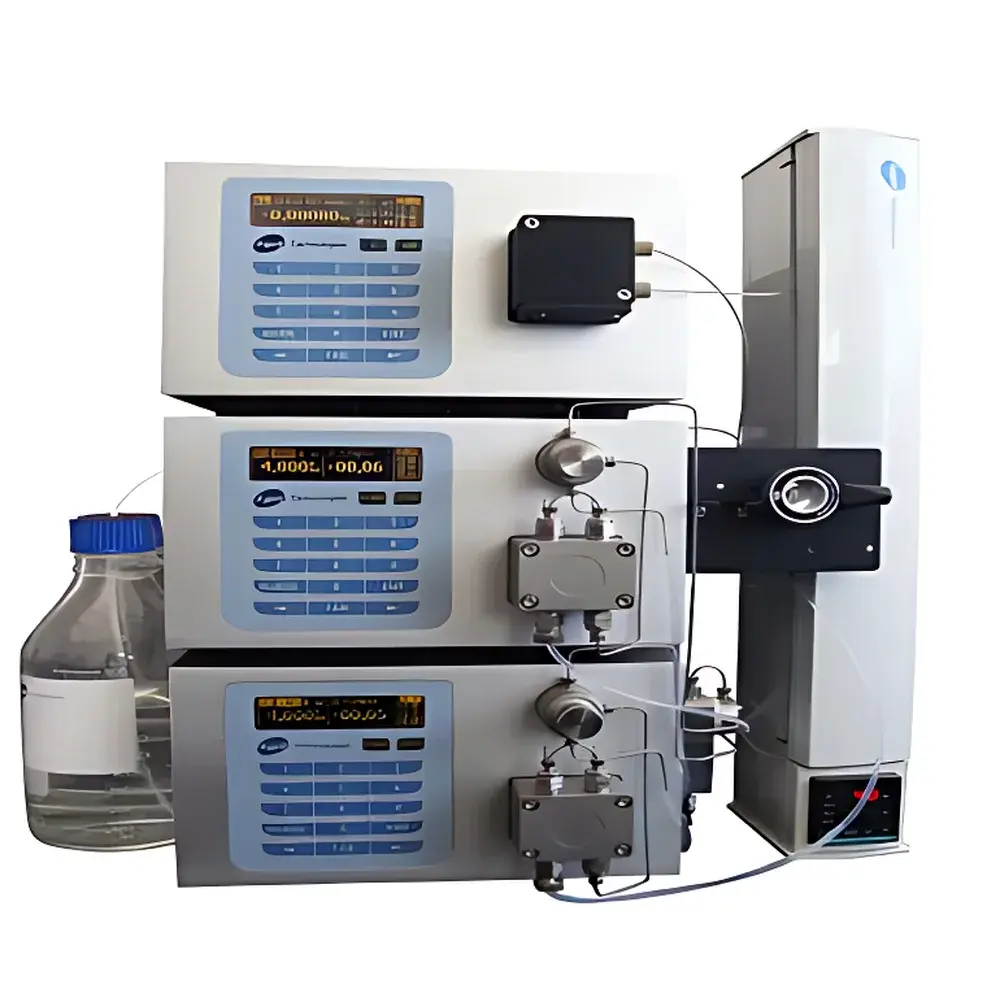
Agela LC-10F Analytical High-Performance Liquid Chromatograph
| Brand | Agela |
|---|---|
| Model | LC-10F |
| Origin | Tianjin, China |
| Instrument Type | Conventional HPLC System |
| Flow Rate Range | 0.001–9.999 mL/min (0.001 mL/min increment) |
| Max Operating Pressure | ≤ 42 MPa (316L stainless steel pump head) |
| Injection Capacity | Not specified |
| Column Oven Temperature Control | Not specified |
| UV-Vis Wavelength Range | 200–800 nm |
| Wavelength Accuracy | ±1 nm |
| Wavelength Repeatability | 0.2 nm |
| Baseline Noise | ±0.75 × 10⁻⁵ AU (254 nm, time constant = 1 s) |
| Baseline Drift | 1.5 × 10⁻⁴ AU/h (254 nm) |
| Flow Accuracy | ±0.5 % (at 1 mL/min, 10 MPa) |
| Flow Precision | RSD ≤ 0.1 % (at 1 mL/min, 10 MPa) |
| Pressure Pulsation | ≤ 0.5 % (at 1 mL/min, 10 MPa) |
| Detector Light Sources | Deuterium lamp (standard), Tungsten lamp (optional) |
Overview
The Agela LC-10F is a robust, entry-to-mid-tier analytical high-performance liquid chromatograph engineered for routine quantitative and qualitative analysis in pharmaceutical QC laboratories, academic research settings, and chemical manufacturing environments. Built upon a dual-piston series reciprocating pump architecture with floating piston design, the LC-10F delivers stable solvent delivery across its full flow range (0.001–9.999 mL/min) while maintaining pressure integrity up to 42 MPa—compatible with sub-2 µm particle-packed columns and standard 3–5 µm reversed-phase media. Its UV-Vis detector employs a dual-beam optical path with real-time reference beam compensation, minimizing baseline drift induced by lamp intensity fluctuation or thermal drift. Signal acquisition leverages fully digital signal processing (DSP), eliminating analog noise sources common in legacy systems and enabling reproducible absorbance measurements down to ±0.75 × 10⁻⁵ AU at 254 nm (1 s time constant). The system operates on fundamental principles of partition chromatography, where analyte retention is governed by differential solute distribution between mobile and stationary phases under precisely controlled gradient or isocratic elution conditions.
Key Features
- Dual-piston series high-pressure pump with electronic damping control (EDC) to suppress flow pulsation and reduce baseline noise
- Multi-point volumetric flow calibration algorithm ensuring traceable accuracy across the entire flow range (0.001–9.999 mL/min)
- UV-Vis detector with deuterium lamp (standard) and optional tungsten lamp for extended spectral coverage (200–800 nm)
- Dual-beam optical design with real-time reference channel correction to mitigate baseline drift from lamp aging or ambient temperature variation
- Fully digital signal processing architecture minimizing electrical interference and improving signal-to-noise ratio
- 316L stainless steel pump heads rated for continuous operation up to 42 MPa, supporting UHPLC-capable column backpressures
- Wavelength accuracy of ±1 nm and repeatability of 0.2 nm—meeting ASTM E275 and ISO 17025 requirements for photometric verification
Sample Compatibility & Compliance
The LC-10F supports standard 4.6 mm ID analytical columns (100–250 mm length) and is compatible with common reversed-phase (C18, C8), normal-phase (silica), ion-exchange, and HILIC stationary phases. It accommodates aqueous-organic mobile phases (e.g., water/acetonitrile, water/methanol) with or without volatile buffers (e.g., ammonium formate, ammonium acetate), making it suitable for small-molecule analysis per USP , EP 2.2.46, and ICH Q2(R2) guidelines. While the system does not include integrated autosampler or column oven hardware, its modular architecture allows seamless integration with third-party accessories compliant with ANSI/SLAS standards. All detector output signals are timestamped and digitally logged, supporting audit-trail-enabled data handling required under FDA 21 CFR Part 11 when deployed with validated LIMS or chromatography data systems (CDS).
Software & Data Management
The LC-10F operates via Agela’s proprietary ChromSight™ control software (Windows-based), providing method development tools including gradient programming, peak integration with customizable baselines, and retention time locking. Raw chromatograms are saved in vendor-neutral .cdf format (based on NetCDF 4.0 specification), ensuring long-term archival integrity and compatibility with third-party analysis platforms such as OpenChrom or commercial CDS solutions. Software supports user-level access control, electronic signatures, and configurable audit trails—including parameter changes, run start/stop events, and detector calibration logs—enabling alignment with GLP and GMP documentation practices. Data export options include CSV, PDF reports, and XML metadata embedding for regulatory submissions.
Applications
- Pharmaceutical assay and impurity profiling per ICH Q3B and USP monographs
- Quality control of raw materials, intermediates, and finished dosage forms
- Environmental analysis of pesticides, PAHs, and pharmaceutical residues in water matrices
- Food safety testing for preservatives (e.g., benzoic acid, sorbic acid), artificial colors, and mycotoxins
- Academic research in natural product isolation, polymer additive quantification, and synthetic reaction monitoring
- Method transfer from R&D to QC labs due to consistent retention time reproducibility (RSD < 0.2 % over 24 h)
FAQ
Does the LC-10F support gradient elution?
Yes—the dual-piston pump enables precise binary gradient formation with programmable solvent composition profiles and dwell volume compensation.
Is the system compliant with 21 CFR Part 11?
Out-of-the-box compliance requires deployment with validated ChromSight™ software configured with role-based permissions, electronic signatures, and immutable audit trails.
What maintenance intervals are recommended for the UV lamp?
Deuterium lamps should be replaced every 1,000–1,500 hours of operation; tungsten lamps typically last 5,000+ hours. Lamp usage time is automatically tracked and logged.
Can the LC-10F be integrated with an external autosampler?
Yes—it features standard TTL and RS-232 interfaces for synchronization with commercially available autosamplers meeting ANSI/SLAS footprint specifications.
What column dimensions and particle sizes are supported?
The system is optimized for 4.6 mm × 150 mm or 250 mm columns packed with 3–5 µm particles; with appropriate pressure management, it also supports 2.1 mm ID columns and sub-2 µm particles up to 42 MPa.
Related Products






