
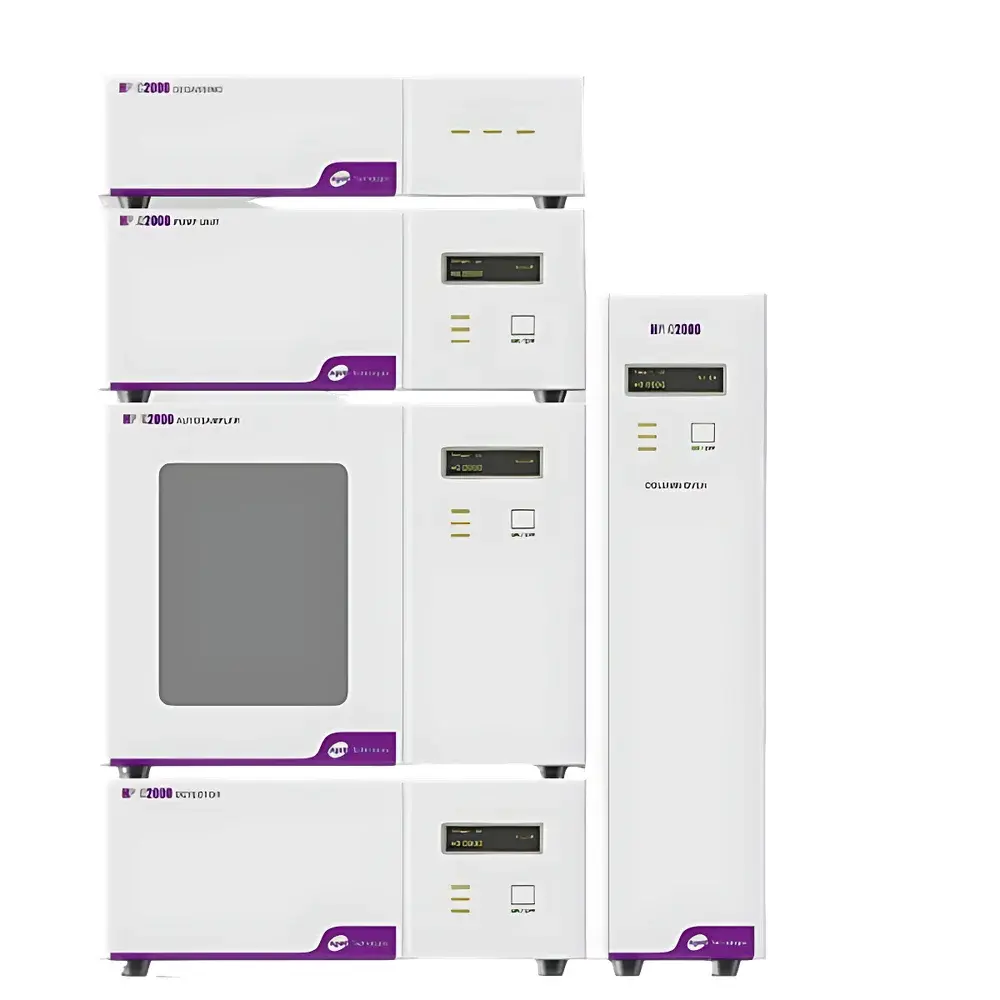
Agela LC2000 Series High-Performance Liquid Chromatography System
| Brand | Agela |
|---|---|
| Origin | Tianjin, China |
| Model | LC2000 |
| Instrument Type | Conventional HPLC System |
| Flow Rate Range | 0.001–10.000 mL/min |
| Max Operating Pressure | ≤70 MPa |
| Flow Accuracy | ±1% |
| Injection Volume Range | 0–100 µL (standard) |
| Sample Capacity | Vial tray & 96-well plate compatibility |
| Column Oven Temperature Range | 4–90 °C |
| UV-Vis Wavelength Range | 190–800 nm |
| Data Acquisition Rate | 100 Hz |
| Flow Precision (RSD) | ≤0.075% |
| Pressure Pulsation | ≤0.2 MPa or ≤1% |
| Wavelength Accuracy | ±1 nm |
| Wavelength Repeatability | ±0.1 nm |
| Baseline Noise (UVD) | ±5 µAU |
| Baseline Drift (UVD) | 1×10⁻⁴ AU/h |
| Flow Cell Volume | 2.5 µL (5 mm path) / 13 µL (10 mm path) |
| Injection Carryover | <0.002% |
| Temperature Stability | ±0.1 °C |
| Column Compatibility | up to 300 mm length |
Overview
The Agela LC2000 Series High-Performance Liquid Chromatography (HPLC) System is an engineered platform designed for robust, reproducible, and regulatory-compliant chromatographic analysis in pharmaceutical QC, academic research, environmental testing, and food safety laboratories. Built on classical reversed-phase and normal-phase separation principles, the system employs high-precision dual-piston parallel pumping architecture with integrated degassing, enabling stable gradient delivery across the full flow range of 0.001–10.000 mL/min. Its maximum operating pressure of ≤70 MPa supports conventional HPLC applications—including method transfer from legacy systems—while maintaining compatibility with sub-2 µm particle columns under optimized conditions. The system’s core architecture adheres to fundamental chromatographic performance criteria defined in USP , ISO 17025, and ICH Q2(R2), emphasizing retention time stability, peak area precision, and baseline integrity over extended run sequences.
Key Features
- Dual-cam-driven, parallel dual-piston pump with real-time multi-point flow calibration and active pressure pulsation suppression (≤0.2 MPa), ensuring consistent mobile phase delivery and low baseline noise.
- UV-Vis variable-wavelength detector (UVD) featuring a dual-beam optical path, deuterium/tungsten lamp source, and automatic wavelength calibration; delivers ±1 nm wavelength accuracy and ±0.1 nm repeatability across 190–800 nm.
- Diode array detector (DAD) option with 1024-element photodiode array and holographic concave grating (0.5 nm average resolution), supporting spectral acquisition at 100 Hz for peak purity assessment and library matching.
- Autosampler with FTN (Full-Loop, No-Transfer) injection technology, <0.002% carryover, and programmable wash protocols across multiple solvent paths—validated for micro-volume injections (RSD ≤0.25% at 5–50 µL).
- Column oven with Peltier-based heating/cooling, precise temperature control from 4–90 °C (±0.1 °C stability), condensation-resistant design for low-temperature operation, and configurable column switching capability.
- Integrated safety architecture: real-time leak detection, over-pressure shutdown, over-temperature cutoff, fan stall monitoring, and auto-purge of pump seals to prevent salt crystallization damage.
Sample Compatibility & Compliance
The LC2000 accommodates standard 12×32 mm vials and ANSI/SLAS-compliant 96-well microplates, supporting unattended batch analysis of diverse sample matrices—including biological fluids, small-molecule APIs, natural product extracts, and polymer degradation products. Its fluidic pathway materials (e.g., stainless steel, PEEK, sapphire) are inert toward common organic modifiers (acetonitrile, methanol), aqueous buffers (phosphate, acetate, formate), and low-pH mobile phases. The system meets essential requirements for GLP and GMP environments: audit trail functionality, electronic signature support, user access levels, and method/version control—all implemented in accordance with FDA 21 CFR Part 11 principles. All detectors comply with ICH Q2(R2) specificity and linearity validation guidelines, with demonstrated R² >0.9999 across five orders of magnitude.
Software & Data Management
The Agela ChromaLink™ software suite provides sequence-driven acquisition, real-time chromatogram visualization, and integrated CDS (Chromatography Data System) tools for peak integration, calibration curve generation, and report export (PDF, CSV, XML). It features drag-and-drop queue management, intelligent parameter auto-fill based on column and method templates, and synchronized multi-view display linking raw data, integration events, calibration models, and instrument logs. Audit trails record all user actions—including method edits, reprocessing, and report generation—with immutable timestamps and operator IDs. Software updates are delivered via secure remote channels, and custom module development (e.g., specialized calculation engines, LIMS interfacing, or instrument-specific macros) is supported through Agela’s local engineering team in Tianjin and PhenoLogix (USA).
Applications
The LC2000 system has been validated for quantitative analysis of nucleotide derivatives (e.g., NAD⁺, ATP, NMN, NR) using Luna® Omega Polar C18 columns (5 µm, 4.6 × 250 mm) under isocratic or gradient conditions. Typical methods employ potassium dihydrogen phosphate buffer (pH 6.0), flow rates of 0.8 mL/min, column temperature at 37 °C, and UV detection at 254 nm. Retention time RSDs <0.15% and peak area RSDs <0.8% (n = 6) demonstrate method ruggedness suitable for release testing per USP monographs. Additional documented applications include residual solvent analysis (ICH Q3C), pesticide screening in crops (AOAC 2012.01), and impurity profiling of synthetic intermediates per ICH Q3B. Method transfer kits—including column selection guidance, mobile phase optimization workflows, and system suitability templates—are available through Agela’s Accelerator Service.
FAQ
Is the LC2000 compliant with 21 CFR Part 11?
Yes—the ChromaLink™ software includes role-based access control, electronic signatures, full audit trail logging, and data integrity safeguards aligned with FDA expectations for regulated environments.
Can the system operate with sub-2 µm columns?
While rated for ≤70 MPa, optimal use with sub-2 µm particles requires careful optimization of dwell volume, extra-column dispersion, and detector response time; UHPLC-grade performance is achievable within specified flow and pressure constraints.
What column dimensions does the oven support?
The standard configuration accommodates up to six columns ≤100 mm or three columns up to 300 mm in length; optional multi-position valve modules enable automated column selection and heart-cutting applications.
Does the autosampler support low-volume injections below 1 µL?
Yes—RSD ≤1.0% is verified for injections between 0.5–1.9 µL using the optional low-volume syringe kit and optimized rinse protocol.
How is temperature stability maintained during rapid cooling cycles?
The Peltier module employs predictive thermal modeling and adaptive power modulation to maintain ±0.1 °C stability even during 50 → 20 °C transitions completed in ≤15 minutes, without condensation-induced sensor faults.
Related Products




