
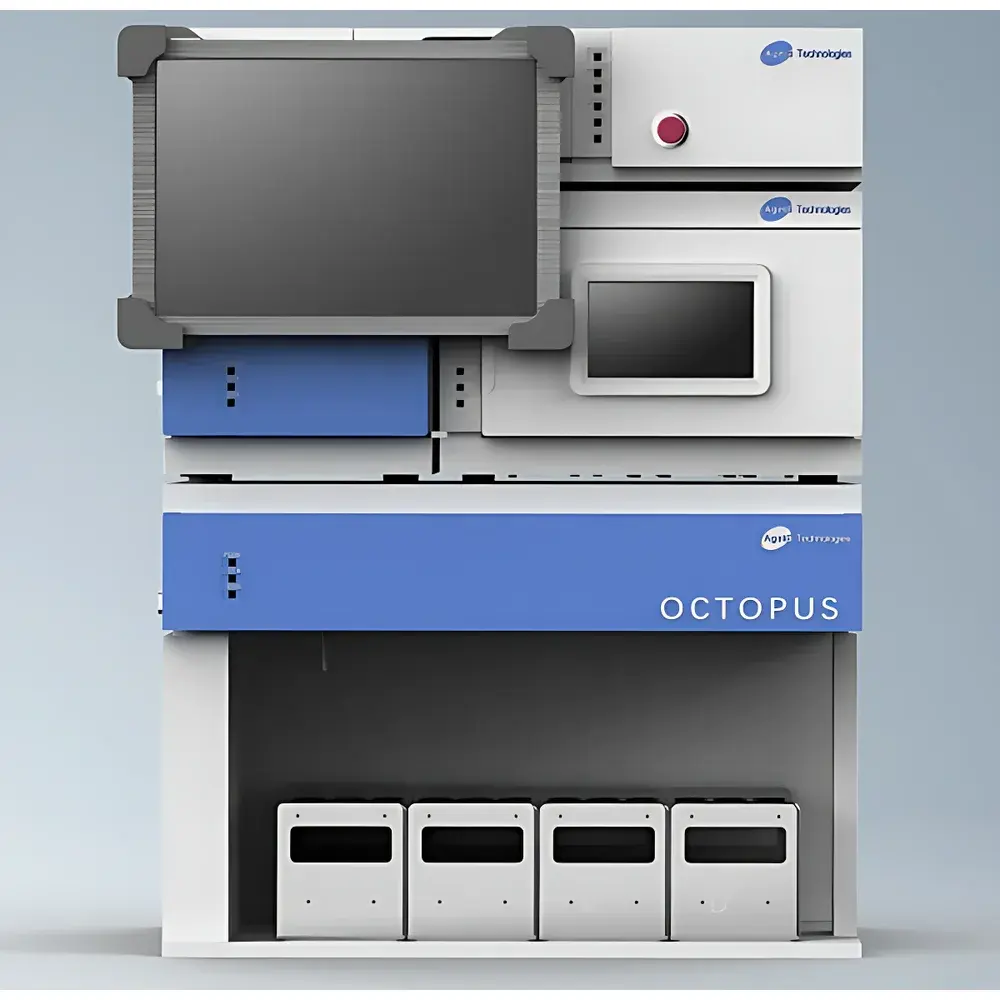
Agela OCTOPUS Preparative Liquid Chromatography System
| Brand | Agela |
|---|---|
| Origin | Tianjin, China |
| Model | OCTOPUS |
| Application Level | Laboratory-grade |
| Instrument Type | Medium- to Low-Pressure Preparative LC System |
| Flow Rate Range | 1–200 mL/min |
| Flow Accuracy | ±1% |
| Flow Precision (RSD) | ≤2% |
| Maximum Pressure | 20 MPa |
| Wavelength Accuracy | ±1 nm |
| Wavelength Repeatability | 1 nm |
| Baseline Noise | ±5 × 10⁻⁵ AU |
| Data Acquisition Frequency | Not Specified |
| Gradient Configuration | Binary or Quaternary Pump Options |
| Compatible Detectors | PDA, ELSD, RI |
| Automation Features | Auto-sampler, Column Switcher, Intelligent Fraction Collector with Vial Rack ID Recognition and Solvent/Waste Level Sensing |
| Column Compatibility | Flash cartridges, medium-pressure glass columns, high-pressure stainless-steel columns |
Overview
The Agela OCTOPUS Preparative Liquid Chromatography System is an integrated, laboratory-grade platform engineered for synthetic chemists and process development scientists requiring scalable, reproducible purification across diverse compound classes. It operates on the fundamental principle of liquid chromatographic separation—utilizing differential partitioning of analytes between a mobile phase (eluent) and stationary phase (packed column)—optimized for preparative-scale recovery rather than analytical detection. Unlike analytical HPLC systems focused on resolution and sensitivity, the OCTOPUS prioritizes robust flow delivery, pressure stability, column versatility, and automated fraction handling to support iterative purification workflows in medicinal chemistry, natural product isolation, and impurity enrichment studies. Its modular architecture supports both medium-pressure (≤20 MPa / ~2900 psi) and low-pressure flash chromatography regimes, enabling seamless method translation from analytical scouting to gram-to-multi-gram isolation without hardware reconfiguration.
Key Features
- Multi-Pressure Regime Operation: Configurable pump modules deliver stable flow from 1 to 200 mL/min at pressures up to 20 MPa, supporting flash cartridges (≤4 bar), medium-pressure glass columns (up to 10 MPa), and high-pressure stainless-steel columns (up to 20 MPa) — facilitating method scalability and retention time transfer.
- Gradient Flexibility: Choice of binary or quaternary gradient pumping enables precise solvent composition control for complex separations, including pH-sensitive or multi-solvent systems (e.g., water/acetonitrile/methanol/THF gradients).
- Automated Sample Introduction & Column Management: Integrated auto-sampler accommodates standard vial racks with barcode or position-based recognition; column switcher allows sequential or parallel column use for multi-step purification or orthogonal separation strategies.
- Intelligent Fraction Collection: Equipped with real-time solvent reservoir and waste container level monitoring via capacitive sensors; tube rack identification ensures accurate fraction mapping and traceability — critical for GLP-compliant sample archiving.
- Multi-Detector Readiness: Native compatibility with PDA (photodiode array), ELSD (evaporative light scattering), and RI (refractive index) detectors expands detection capability beyond UV-absorbing compounds, supporting non-chromophoric or semi-volatile species.
Sample Compatibility & Compliance
The OCTOPUS system accommodates a broad range of sample types—including small-molecule APIs, peptides, oligonucleotides, natural extracts, and polymer fractions—without requiring derivatization. Its fluidic path is constructed from chemically inert materials (e.g., PEEK, stainless steel, sapphire components) compatible with aggressive solvents (e.g., DCM, DMF, TFA, HFIP). The system meets essential design criteria for laboratory instrumentation under ISO/IEC 17025:2017 for testing and calibration laboratories. While not certified as 21 CFR Part 11-compliant out-of-the-box, its software architecture supports audit trail configuration, electronic signature integration, and data integrity controls when deployed with validated third-party LIMS or chromatography data systems (CDS) meeting FDA requirements.
Software & Data Management
Control and data acquisition are managed through Agela’s proprietary chromatography software, offering intuitive method building, real-time chromatogram visualization, peak integration with customizable thresholds, and fraction triggering logic (time-, peak-, or threshold-based). Raw data files adhere to open formats (e.g., .cdf or vendor-neutral ASCII exports) to ensure long-term accessibility. Software logs all user actions, instrument events, and system parameters with timestamps, supporting retrospective review and regulatory documentation. Optional add-ons include batch processing templates, report generation modules compliant with internal SOPs, and export functions compatible with ChemDraw, KNIME, and electronic lab notebook (ELN) platforms.
Applications
- Purification of reaction mixtures post-Suzuki coupling, amidation, or reduction steps in drug discovery.
- Isolation of minor alkaloids or flavonoids from plant extracts using gradient elution and PDA-guided fraction pooling.
- Desalting and buffer exchange of synthetic peptides prior to lyophilization or bioassay.
- Preparative chiral separations using polysaccharide-based columns under medium-pressure conditions.
- Impurity spiking studies and reference standard preparation per ICH Q5 guidelines.
FAQ
What column formats are supported by the OCTOPUS system?
It accepts standard flash cartridges (e.g., 10–340 g), medium-pressure glass columns (ID 15–50 mm), and high-pressure stainless-steel columns (ID 10–30 mm, up to 20 MPa rating).
Can the system be used for method development at analytical scale?
While optimized for preparative throughput, its flow and pressure control allow analytical-scale scouting (e.g., 1–5 mL/min on 10 mm ID columns) with appropriate detector settings and fraction collection resolution.
Is remote monitoring or network connectivity available?
Yes — the system supports Ethernet-based communication and can be integrated into local lab networks for centralized status monitoring and scheduled run initiation via secure client access.
Does the software support compliance with FDA 21 CFR Part 11?
The base software provides audit trail logging and user authentication; full Part 11 compliance requires deployment with a validated CDS or LIMS implementing electronic signatures, role-based access control, and data backup protocols.
What maintenance intervals are recommended for pump seals and detector lamps?
Pump seal replacement is advised every 6–12 months depending on solvent aggressiveness and daily usage; PDA lamp lifetime is typically ≥2000 hours, with built-in intensity monitoring to alert users prior to degradation.
Related Products





