
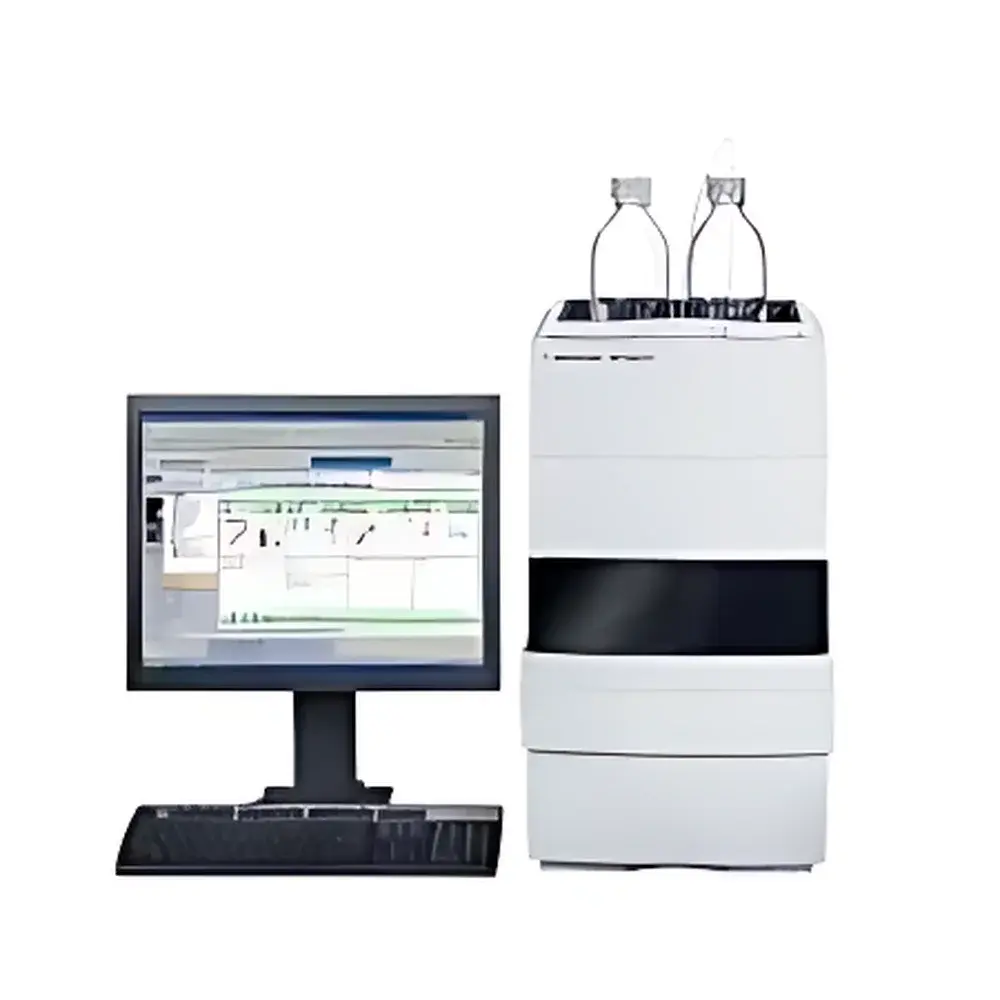
Agilent 1120 Compact LC System
| Brand | Agilent |
|---|---|
| Model | 1120 |
| Type | Compact Liquid Chromatograph (HPLC) |
| Pump Flow Rate Range | 0.001–10.0 mL/min (0.001 mL/min increments) |
| Flow Precision | ≤0.07% RSD |
| Autosampler Injection Volume | 0.1–100 µL (0.1 µL increments) |
| Injection Precision | <0.25% RSD (5–100 µL), <1% RSD (1–5 µL) |
| Sample Capacity | 100 × 2 mL vials or 2 × 40-position half-trays or 15 × 6 mL vials |
| Column Oven Temperature Range | 10 °C above ambient to 60 °C |
| Temperature Stability | ±0.15 °C |
| VWD Wavelength Range | 190–600 nm |
| VWD Noise | ±0.75 × 10⁻⁵ AU |
| Detector Compatibility | RID, FLD, ELSD |
| Software | EZChrom Elite Compact (English/Chinese/Japanese UI), LMD predictive diagnostics |
| Regulatory Support | FDA 21 CFR Part 11-ready audit trail, GLP/GMP-compliant operation |
Overview
The Agilent 1120 Compact LC System is a purpose-engineered, entry-level high-performance liquid chromatograph designed for routine analytical laboratories requiring robustness, regulatory readiness, and operational simplicity. Built on Agilent’s legacy of HPLC platform reliability, the 1120 integrates a precision quaternary pump, variable wavelength detector (VWD), optional autosampler (ALS), and column oven into a space-efficient, modular architecture. Its measurement principle is based on reversed-phase, normal-phase, or ion-exchange liquid chromatography—where analytes are separated on a packed column under controlled mobile phase composition and flow dynamics, with UV-Vis absorbance detection at user-selectable wavelengths (190–600 nm). The system supports both isocratic and gradient elution methods, making it suitable for QC testing, stability studies, raw material verification, and method transfer in pharmaceutical, food, environmental, and academic settings.
Key Features
- Modular configuration flexibility: Five pre-integrated system variants available—including isocratic/gradient pump options, manual injection or ALS, column oven, and VWD—to match specific workflow requirements without custom integration overhead.
- High-precision binary or quaternary pumping: Delivers flow accuracy ≤0.07% RSD across 0.001–10.0 mL/min range with 0.001 mL/min resolution, ensuring reproducible retention times and peak shape integrity.
- Low-noise VWD detection: Baseline noise specification of ±0.75 × 10⁻⁵ AU enables reliable quantitation of low-abundance compounds in complex matrices, particularly critical for pharmacopeial assays and impurity profiling.
- Intelligent predictive diagnostics via LMD (Liquid Monitoring Diagnostics): Monitors pressure profiles, flow consistency, and detector baseline drift in real time; alerts operators prior to system failure or performance deviation—reducing unplanned downtime and supporting proactive maintenance planning.
- Thermostatically controlled column compartment: Maintains temperature stability within ±0.15 °C from 10 °C above ambient to 60 °C, minimizing retention time drift and improving inter-day reproducibility—essential for validated methods per ICH Q2(R2) and USP <621>.
Sample Compatibility & Compliance
The Agilent 1120 accommodates standard 2 mL and 6 mL vials, as well as 40-position half-trays, enabling unattended analysis of up to 100 samples per run. It interfaces seamlessly with third-party detectors—including refractive index (RID), fluorescence (FLD), and evaporative light scattering (ELSD)—expanding its applicability to non-UV-absorbing analytes such as carbohydrates, lipids, and polymers. All hardware and software components comply with ISO 9001 manufacturing standards and support full traceability under GLP and GMP environments. EZChrom Elite Compact includes configurable audit trails, electronic signatures, and user access controls aligned with FDA 21 CFR Part 11 requirements. Method validation documentation packages are available upon request to support laboratory qualification (IQ/OQ/PQ) and regulatory submissions.
Software & Data Management
EZChrom Elite Compact provides a streamlined, browser-based interface with multilingual support (English, Chinese, Japanese), eliminating language barriers in multinational labs. The software handles instrument control, sequence management, data acquisition, peak integration, calibration curve generation, and report export (PDF, CSV, XML). All raw data files are stored in vendor-neutral formats compliant with ASTM E1957 and ISO/IEC 17025 metadata requirements. Audit trail logs record every user action—including method edits, parameter changes, and result approvals—with timestamps and operator IDs. Optional LMD modules integrate directly into the software dashboard, visualizing system health metrics alongside chromatographic data—enabling correlation between hardware behavior and analytical output.
Applications
- Pharmaceutical QC release testing: Assay, related substances, dissolution, and content uniformity per USP/EP monographs.
- Food and beverage analysis: Quantification of preservatives (e.g., benzoic acid, sorbic acid), sweeteners (aspartame, sucralose), vitamins (B-complex, C), and mycotoxins.
- Environmental monitoring: Detection of PAHs, phenols, pesticides, and endocrine disruptors in water and soil extracts.
- Academic research: Teaching chromatography fundamentals, method development training, and small-molecule separation optimization.
- Contract testing labs: High-throughput batch analysis where cost-per-analysis, uptime, and compliance scalability are critical success factors.
FAQ
Is the Agilent 1120 compatible with modern LIMS and ELN systems?
Yes—the system supports standard ASCII and AIA/ANDI data export protocols and can be integrated into enterprise informatics platforms via OPC UA or RESTful API extensions (available through Agilent OpenLab Enterprise Edition).
What level of service support is provided for refurbished units?
Refurbished Agilent 1120 systems undergo full functional recalibration, leak testing, and firmware validation at certified Agilent Service Centers. They include a 12-month limited warranty covering parts and labor, with optional extended service contracts available.
Can this system run UHPLC columns?
No—the 1120 is rated for maximum operating pressure of 400 bar and is optimized for conventional HPLC columns (3–5 µm particle size, 4.6 mm ID). It is not designed for sub-2 µm UHPLC media requiring >600 bar pressure capability.
Does the EZChrom software support 21 CFR Part 11 compliance out-of-the-box?
Yes—audit trail, electronic signature, and role-based access control features are enabled by default and fully configurable during installation. Full validation documentation (IQ/OQ templates, test scripts) is supplied with the software license.
How does the LMD system predict failures?
LMD continuously analyzes real-time pressure transients, flow pulsation patterns, baseline noise trends, and solvent degassing efficiency. Statistical deviations beyond three-sigma thresholds trigger actionable alerts—not generic error codes—allowing technicians to intervene before chromatographic integrity is compromised.






