
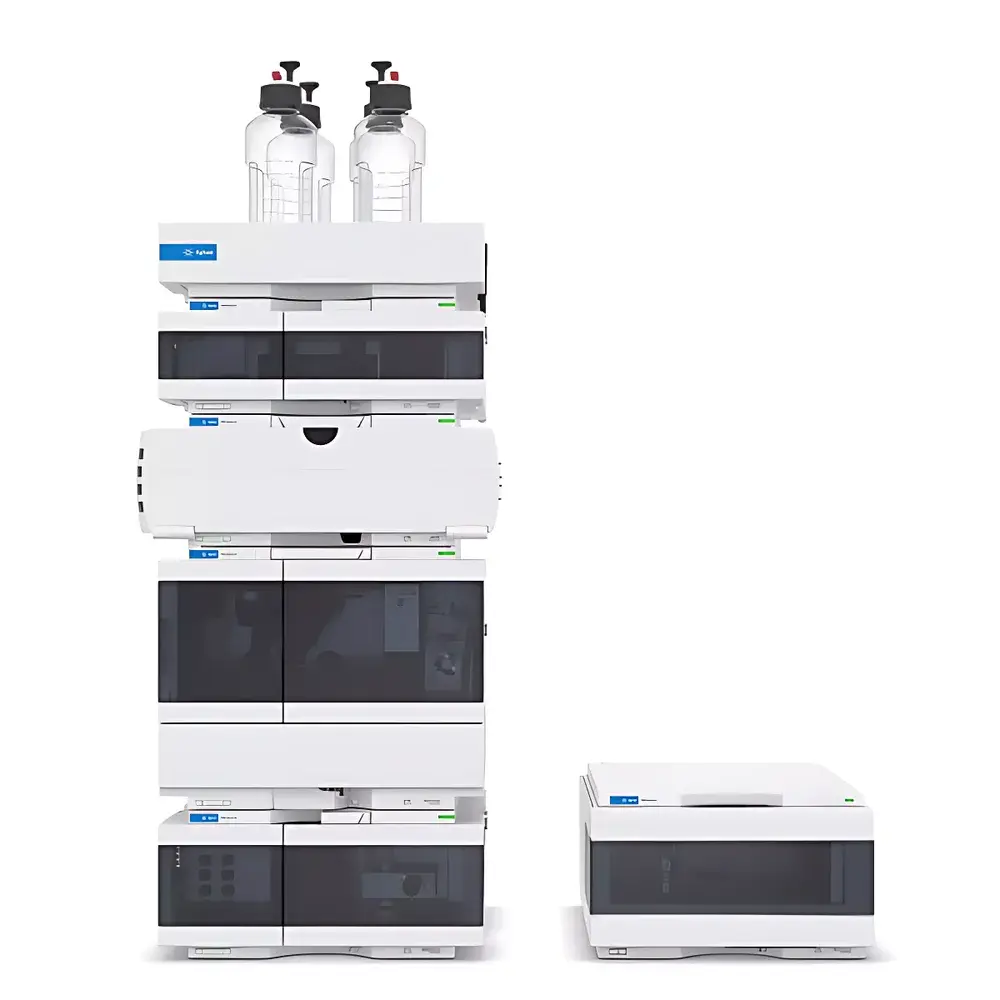
Agilent 1260 Infinity II Analytical-Scale Purification LC System
| Brand | Agilent Technologies |
|---|---|
| Origin | Germany |
| Manufacturer Type | Original Equipment Manufacturer (OEM) |
| Product Origin | Imported |
| Model | 1260 Infinity II Analytical-Scale Purification |
| Application Level | Laboratory Grade |
| Instrument Type | High-Pressure Preparative Liquid Chromatography |
| Flow Rate Range | 0.05–5 mL/min (with G7112B Pump) |
| Maximum Operating Pressure | 600 bar |
Overview
The Agilent 1260 Infinity II Analytical-Scale Purification LC System is a modular, high-pressure liquid chromatography platform engineered for reproducible isolation and purification of milligram-scale compounds in research and development laboratories. Built upon the InfinityLab architecture, it implements conventional reversed-phase, normal-phase, and HILIC separation principles under precisely controlled gradient elution conditions. Its core design integrates a low-dead-volume binary or quaternary pump, thermostatted column compartment, variable-wavelength UV/Vis detector (G7117A), and an intelligent fraction collector with real-time delay calibration—enabling accurate synchronization between detection signal and physical collection. Unlike preparative systems optimized for gram-scale throughput, this platform prioritizes resolution, peak fidelity, and compound integrity at analytical-to-semi-preparative scale, making it suitable for hit-to-lead chemistry, natural product isolation, metabolite purification, and reference standard preparation.
Key Features
- High-pressure capability up to 600 bar ensures compatibility with sub-2 µm particle-packed columns for enhanced resolution and faster method development.
- Low-diffusion flow path architecture minimizes band broadening, preserving chromatographic efficiency across flow rates from 0.05 to 5 mL/min (expandable to 10 mL/min with optional G7120A pump module).
- Integrated fraction delay sensor automatically compensates for system dwell volume, enabling precise alignment of UV peaks with collected fractions—even during complex multi-gradient runs.
- Modular detector expansion support: compatible with Agilent Infinity II Refractive Index (G7168B), Fluorescence (G7121B), Evaporative Light Scattering (G7161A), and single-quadrupole LC/MSD (6120/6130) detectors for orthogonal compound characterization.
- Flexible fraction collection: supports microtiter plate formats (4 × 96-well plates) and glass/tube-based collection (up to 216 tubes using four selectable outer diameters), with programmable trigger logic based on time, UV threshold, or peak apex.
- Robust hardware architecture includes active solvent preheating, pulse-dampened pumping, and thermally stabilized detector flow cells—ensuring baseline stability and long-term retention time reproducibility (RSD < 0.15% over 24 h).
Sample Compatibility & Compliance
The system accommodates standard analytical and narrow-bore columns (2.1 mm i.d. to 10.0 mm i.d.), supporting both volatile and non-volatile mobile phases including aqueous buffers, acetonitrile, methanol, and THF. It complies with ISO/IEC 17025 requirements for testing laboratories and supports audit-trail-enabled operation under FDA 21 CFR Part 11 when deployed with Agilent OpenLab CDS ChemStation v2.4 or later. All firmware and control logic are validated per ICH Q2(R2) guidelines for analytical instrument qualification (AIQ), and electronic records meet GLP/GMP data integrity expectations for regulated environments.
Software & Data Management
Agilent OpenLab CDS ChemStation provides a unified, intuitive interface for method development, sequence definition, real-time monitoring, and post-run fraction mapping. Its fraction-centric workflow allows users to define collection windows directly on chromatograms, assign custom naming conventions, and export structured metadata (e.g., retention time, UV λmax, fraction number) to LIMS or ELN systems via XML or CSV. The software supports electronic signatures, role-based access control, and full audit trail logging—including parameter changes, user actions, and instrument status events. Optional integration with Agilent MassHunter enables direct MS-triggered collection and molecular weight–guided fraction selection.
Applications
- Purification of synthetic intermediates and final APIs in medicinal chemistry workflows.
- Isolation of bioactive natural products from crude extracts with minimal degradation.
- Preparative separation of diastereomers and regioisomers requiring high selectivity.
- Generation of high-purity reference standards for quantitative LC-MS calibration and method validation.
- Offline coupling with NMR: collection of discrete, solvent-exchanged fractions for structural elucidation.
- Supporting QC/QA labs in pharmaceutical and agrochemical industries where trace-level impurity profiling precedes isolation.
FAQ
Can this system be used for both analytical analysis and purification?
Yes—the 1260 Infinity II Analytical-Scale Purification system operates seamlessly in analytical mode (e.g., method scouting, purity assessment) and transitions to purification mode without hardware reconfiguration.
What is the minimum detectable mass for UV-triggered collection?
Detection sensitivity depends on analyte molar absorptivity and path length; typical LOD for UV-active compounds is ~10–50 ng on-column when using a 10-mm flow cell and 2.1-mm i.d. column.
Is method transfer possible from other Agilent LC platforms?
Yes—method portability is ensured through consistent dwell volume management, pressure-rated component compatibility, and shared ChemStation method file structure across Infinity and 1200/1260 series instruments.
Does the system support automated method optimization?
While not equipped with AI-driven optimization out-of-the-box, it fully supports scripting via OpenLab’s Python API and third-party tools like DryLab for gradient modeling and robustness testing.
How is system suitability verified during purification runs?
Built-in system suitability tests include retention time precision, peak symmetry (tailing factor), resolution between critical pairs, and fraction recovery accuracy—all reportable within ChemStation’s customizable templates.




