
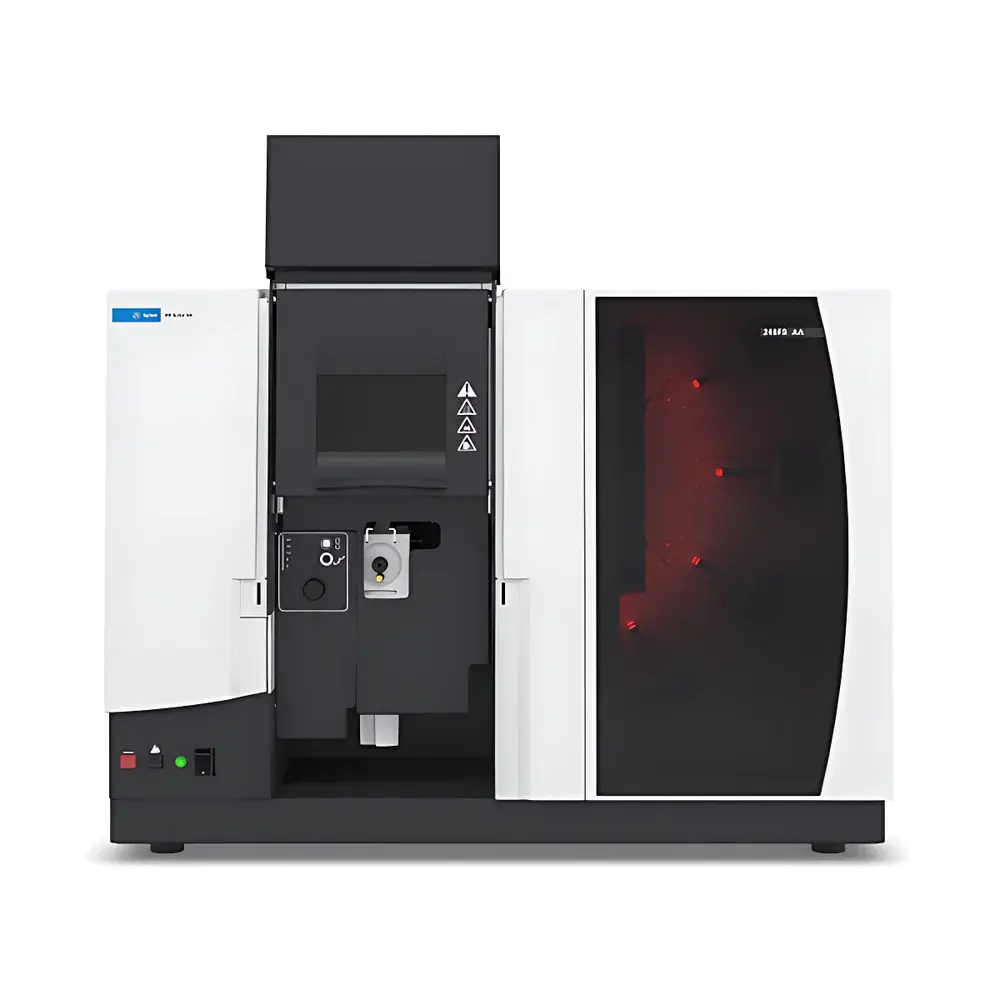
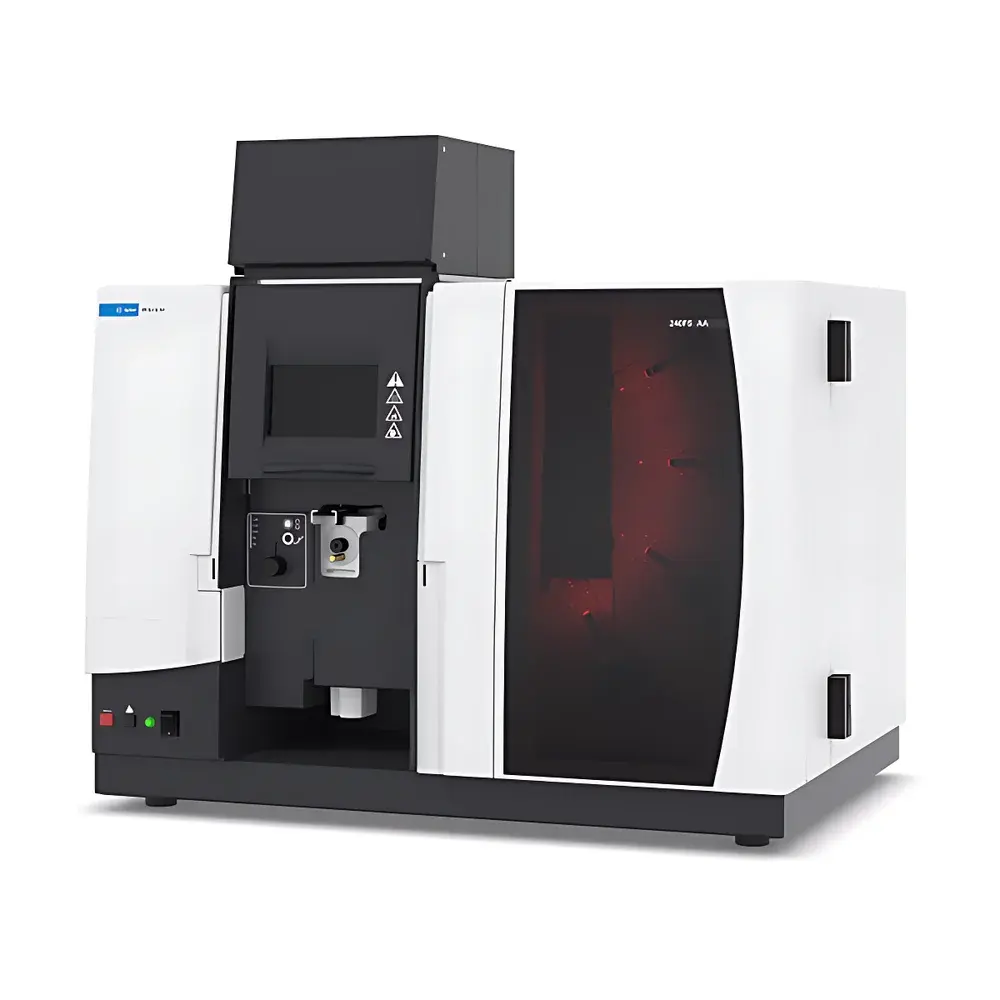
Agilent 240FS Fast-Sequence Flame Atomic Absorption Spectrometer
| Brand | Agilent Technologies |
|---|---|
| Origin | Malaysia |
| Manufacturer Type | Original Equipment Manufacturer (OEM) |
| Import Status | Imported |
| Model | 240FS AA |
| Instrument Type | Flame AAS |
| Monochromator | Plane Grating |
| Optical System | Single-Beam |
| Detector | Photomultiplier Tube (PMT) |
| Background Correction | Deuterium Lamp (D₂) |
| Sensitivity | Mark 7 Atomization System — Cu 5 mg/L typically yields >0.9 Abs |
Overview
The Agilent 240FS Fast-Sequence Flame Atomic Absorption Spectrometer is a high-throughput, single-beam atomic absorption instrument engineered for precision elemental quantification in routine laboratory environments. It operates on the fundamental principle of atomic absorption spectroscopy: ground-state free atoms in a flame absorb characteristic wavelengths of light emitted by hollow cathode lamps, with absorbance proportional to analyte concentration per Beer–Lambert law. The 240FS implements Agilent’s proprietary Fast-Sequence (FS) acquisition mode—eliminating sequential lamp changes and mechanical monochromator repositioning between elements. Instead, it rapidly switches between element-specific wavelengths *within a single aspiration cycle*, enabling multi-element analysis from one sample aliquot without physical reconfiguration. This architecture reduces analysis time, minimizes acetylene and air consumption, and maintains optical path stability across measurements—critical for reproducible calibration and long-term method robustness.
Key Features
- Fast-Sequence (FS) acquisition mode: Measures up to 10 elements from a single 10 mL sample in under 2 minutes, with no manual lamp or grating adjustments required.
- Mark 7 flame atomization system: Optimized burner head geometry, nebulizer design, and gas flow control deliver enhanced nebulization efficiency and residence time, achieving high sensitivity—e.g., >0.9 absorbance units for 5 mg/L copper standard under standardized conditions.
- Automatic hollow cathode lamp selection: Integrated 8-lamp turret with auto-alignment ensures rapid, repeatable spectral source switching without operator intervention.
- D₂ background correction: Deuterium arc lamp provides broadband continuum correction for structured molecular absorption and scattering effects, particularly effective at wavelengths below 350 nm.
- Programmable gas control module: Precisely regulates fuel/oxidant ratios and flow rates per method step, supporting flame optimization for diverse element classes (e.g., alkali metals vs. refractory elements).
- Single-beam optical path with plane grating monochromator: Delivers high wavelength accuracy (< ±0.1 nm), low stray light (< 0.01% at 220 nm), and stable baseline performance over extended operation.
Sample Compatibility & Compliance
The 240FS AA is validated for aqueous and dilute acid-digested samples (e.g., HNO₃, HCl matrices) commonly encountered in environmental water testing (EPA Methods 200.7, 200.9), food safety (AOAC 972.33, ISO 11047), and agricultural soil extract analysis (ISO 11047, ASTM D5688). Its flame-based atomization supports quantification of ~30 elements—including Ca, Mg, Fe, Cu, Zn, Mn, Na, K, Pb, Cd—at µg/L to mg/L concentration ranges. The system complies with ISO/IEC 17025 requirements for analytical instrument qualification and supports GLP/GMP workflows through audit-trail-enabled software (see Software section). All firmware and hardware configurations adhere to IEC 61010-1 safety standards for laboratory electrical equipment.
Software & Data Management
Controlled via Agilent’s SpectrAA software, the 240FS AA provides a comprehensive, method-driven interface compliant with FDA 21 CFR Part 11 requirements when configured with electronic signatures and audit trail activation. SpectrAA includes pre-validated method templates aligned with EPA, ISO, and AOAC protocols; automated calibration curve generation with forced zero and multi-point linear/non-linear fitting; real-time drift monitoring with optional internal standard correction (e.g., Sc or Y addition); and full data traceability—including lamp identification, gas flow logs, wavelength verification timestamps, and raw absorbance/time profiles. Raw data exports to CSV, XML, or LIMS-compatible formats (ASTM E1384, HL7) are supported without proprietary codec dependencies.
Applications
The 240FS AA serves as a primary quantitative tool in regulated and high-volume laboratories requiring reliable, cost-effective elemental analysis. Key use cases include: monitoring trace metal contaminants (As, Cd, Pb, Cr) in drinking water per WHO and EU Directive 98/83/EC; verifying mineral fortification levels (Fe, Zn, Ca) in infant formula and dietary supplements per USP ; assessing heavy metal accumulation in rice, leafy vegetables, and animal feed per Codex Alimentarius standards; and performing routine cation profiling (Na⁺, K⁺, Ca²⁺, Mg²⁺) in clinical serum or plant tissue digests. Its FS capability significantly improves lab capacity utilization—reducing per-sample gas costs by ~40% and analyst hands-on time by >60% versus conventional sequential AAS systems.
FAQ
What elements can be analyzed using the 240FS AA in Fast-Sequence mode?
The instrument supports simultaneous measurement of any combination of elements with emission lines between 190–900 nm, provided their hollow cathode lamps are installed and calibrated. Common FS sequences include Ca–Mg–Fe–Cu–Zn–Mn–Na–K–Pb–Cd.
Is the Mark 7 atomization system field-upgradable on older Agilent AAS platforms?
No—the Mark 7 burner assembly, nebulizer, and spray chamber are mechanically and thermally integrated with the 240FS optical bench and gas control architecture; retrofitting is not supported.
Does the D₂ background correction meet regulatory requirements for complex matrices?
Yes—D₂ correction is accepted in EPA Method 200.7 for wastewater and drinking water analysis, though users analyzing high-salt or organic-rich samples may supplement with Zeeman correction (available on Agilent 280Z models) for improved accuracy.
Can SpectrAA software generate 21 CFR Part 11-compliant reports without third-party validation services?
SpectrAA includes built-in electronic signature, audit trail, and user access controls—but formal validation (IQ/OQ/PQ) must be performed by the end-user laboratory per their quality management system, consistent with ISO/IEC 17025 Clause 5.5.2.
What maintenance intervals are recommended for optimal FS performance?
Nebulizer cleaning every 8 hours of operation; burner head inspection and alignment quarterly; D₂ lamp replacement every 500 hours; and full optical path verification annually using NIST-traceable holmium oxide filters.







