
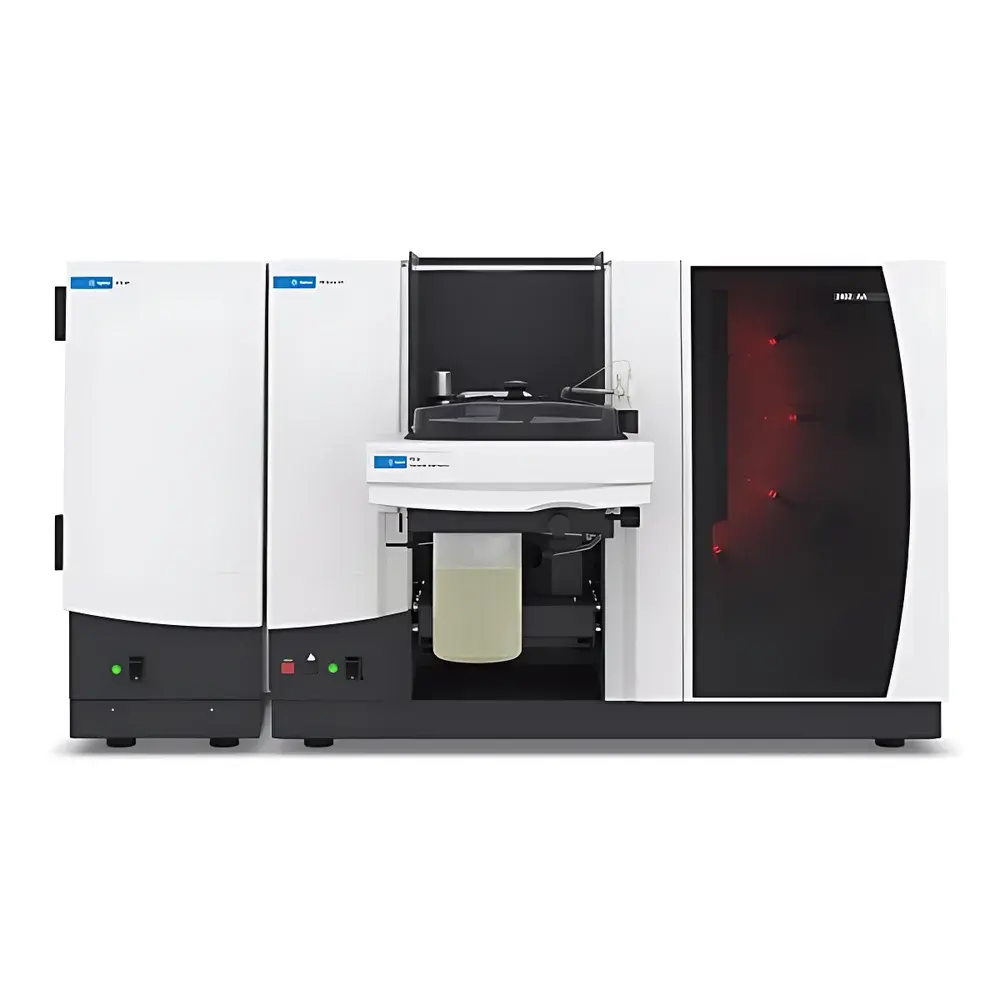
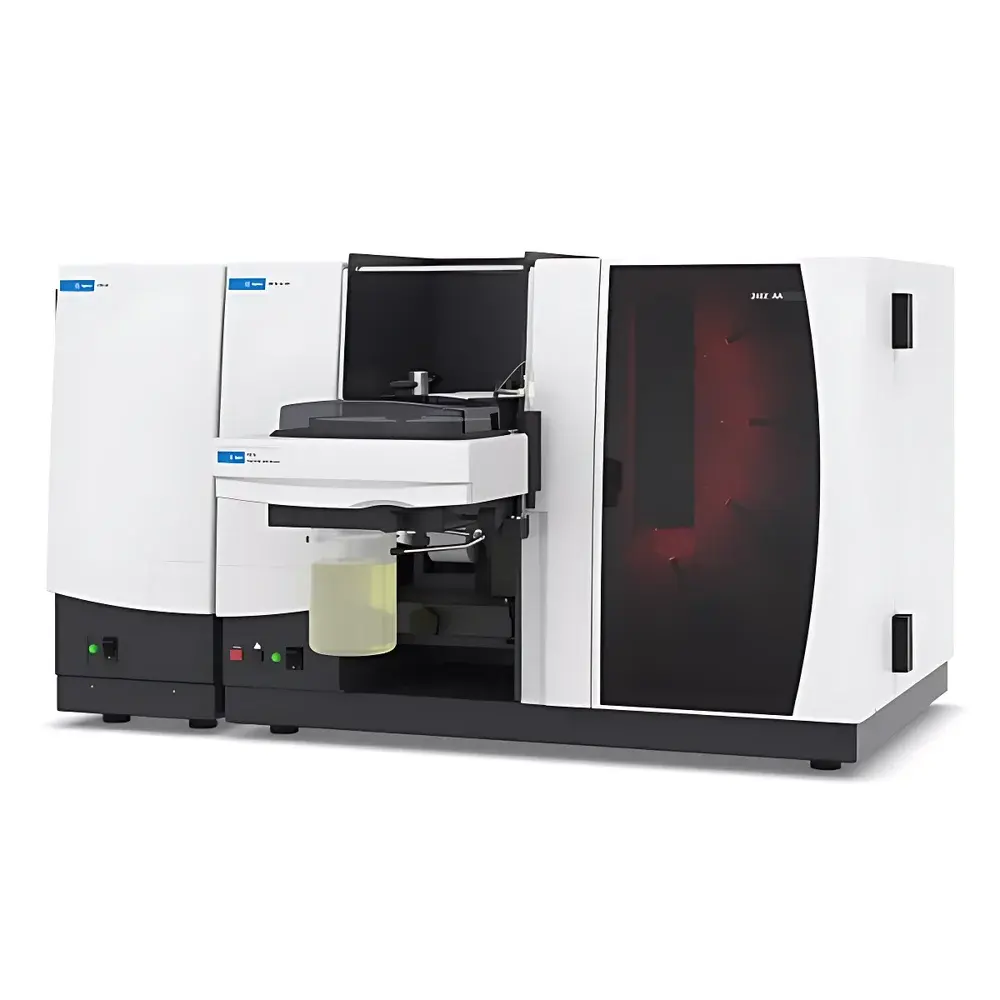
Agilent 240Z AA Zeeman Graphite Furnace Atomic Absorption Spectrometer
| Brand | Agilent Technologies |
|---|---|
| Origin | Malaysia |
| Manufacturer Type | Original Equipment Manufacturer (OEM) |
| Origin Category | Imported Instrument |
| Model | 240Z AA |
| Instrument Type | Graphite Furnace AAS |
| Monochromator | Echelle Grating |
| Optical System | Double-Beam |
| Detector | Photomultiplier Tube (PMT) |
| Background Correction | Zeeman Effect |
| Spectral Resolution | ≤0.2 nm |
| Repeatability (RSD) | <2% |
| Detection Limit (Cd) | ≤0.006 µg/L |
Overview
The Agilent 240Z AA Zeeman Graphite Furnace Atomic Absorption Spectrometer is a high-performance, laboratory-grade analytical instrument engineered for trace and ultra-trace elemental quantification in complex matrices. It operates on the fundamental principle of atomic absorption spectroscopy (AAS), where ground-state free atoms in a graphite furnace absorb characteristic radiation from a hollow cathode or UltrAA lamp. The 240Z AA employs transverse Zeeman background correction—based on magnetic field-induced splitting of atomic absorption lines—to distinguish analyte signals from structured and non-structured spectral background with exceptional fidelity. This physical correction method eliminates reliance on deuterium or continuum-source subtraction, delivering inherently higher accuracy and stability in demanding applications such as environmental monitoring, pharmaceutical impurity testing, and food safety compliance.
Key Features
- Transverse Zeeman background correction with real-time magnetic field modulation, enabling robust interference-free quantification even in high-salt or organic-rich samples.
- Stabilized Temperature Platform (STPF) graphite furnace architecture with integrated temperature ramping control, ensuring precise thermal program reproducibility and minimized matrix effects.
- Four-lamp turret with automatic lamp selection and alignment—compatible with standard hollow cathode lamps (HCLs) and high-intensity UltrAA lamps for enhanced sensitivity down to sub-ppt levels.
- PSD120 programmable autosampler with integrated sample dilution, standard addition, and multi-injection capabilities—designed for GLP-compliant workflow execution and reduced manual error.
- HD Tube-CAM system providing real-time, high-resolution visual feedback of graphite tube condition, sample deposition, drying, pyrolysis, and atomization stages—critical for method optimization and troubleshooting.
- SRM (Standard Reference Material) Method Development Wizard that guides users through systematic parameter optimization—including drying/pyrolysis/atomization temperatures, gas flow rates, and modifier selection—based on ISO/IEC 17025-aligned best practices.
Sample Compatibility & Compliance
The 240Z AA supports liquid samples (aqueous, acidic digests, organic extracts) and solid micro-samples via slurry introduction. Its STPF furnace design accommodates up to 30 µL injection volumes and tolerates up to 25% v/v organic solvents (e.g., methanol, ethanol) without compromising tube lifetime. The system complies with key regulatory frameworks including ASTM D396, EPA Methods 200.8 and 200.9, ISO 8288, and USP for heavy metals. Full audit trail functionality—including user login, method versioning, parameter change logs, and raw data timestamps—is enabled to meet FDA 21 CFR Part 11 requirements when paired with Agilent OpenLab CDS software.
Software & Data Management
Controlled via Agilent’s proprietary AA Analyst software, the 240Z AA provides intuitive method setup, real-time signal visualization, and automated peak integration using advanced polynomial baseline correction (up to 5th order). Unlike linear interpolation used in legacy systems, this algorithm improves calibration accuracy by over 11× across wide dynamic ranges (0.01–1000 µg/L). All acquisition parameters, spectra, and processing metadata are stored in vendor-neutral .csv and .xml formats. Data export supports LIMS integration via ASTM E1384-compliant interfaces, and secure electronic signatures are available under validated configurations for GMP environments.
Applications
- Environmental analysis: Cd, Pb, As, Cr, Ni, and Tl quantification in drinking water, wastewater, soil leachates, and airborne particulate filters per EPA 200.8.
- Pharmaceutical quality control: Residual catalyst metals (Pd, Pt, Rh) in APIs and excipients; elemental impurities screening per ICH Q3D guidelines.
- Food and beverage testing: Lead and cadmium in infant formula, rice, seafood, and dietary supplements aligned with EU Commission Regulation (EU) No 1881/2006.
- Clinical and biological research: Zinc, copper, and selenium determination in serum, whole blood, and tissue homogenates using matrix-matched calibration.
- Geochemical and metallurgical QA/QC: Trace element profiling in ores, alloys, and recycled materials with certified reference material (CRM) traceability.
FAQ
What background correction technology does the 240Z AA use, and why is it preferred for complex matrices?
The instrument utilizes transverse Zeeman effect correction, which physically separates analyte absorption from broadband and structured background via magnetic field modulation—eliminating spectral interferences without sacrificing sensitivity.
Can the 240Z AA be upgraded for hydride generation analysis?
Yes—via optional VGA (Vapor Generation Accessory) module, enabling As, Se, Sb, Bi, Te, and Hg determination with improved detection limits and reduced polyatomic interferences.
Is the PSD120 autosampler compatible with standard graphite tubes and platforms?
Yes—it supports all Agilent-certified graphite tubes (e.g., GTA110, GTA120) and platform types (pyrolytic-coated, end-capped), with auto-calibration of injection volume based on tube geometry.
How does the HD Tube-CAM system contribute to method validation?
It provides time-stamped, frame-locked imaging of thermal events, allowing direct correlation between visual morphology (e.g., spitting, splashing, premature volatilization) and signal anomalies—essential for OQ/PQ documentation.
Does the 240Z AA support multi-element sequential analysis?
No—it is a single-element AAS platform; however, rapid lamp switching (<1 s) and automated wavelength repositioning minimize turnaround time between elements in batched analyses.
Related Products





