
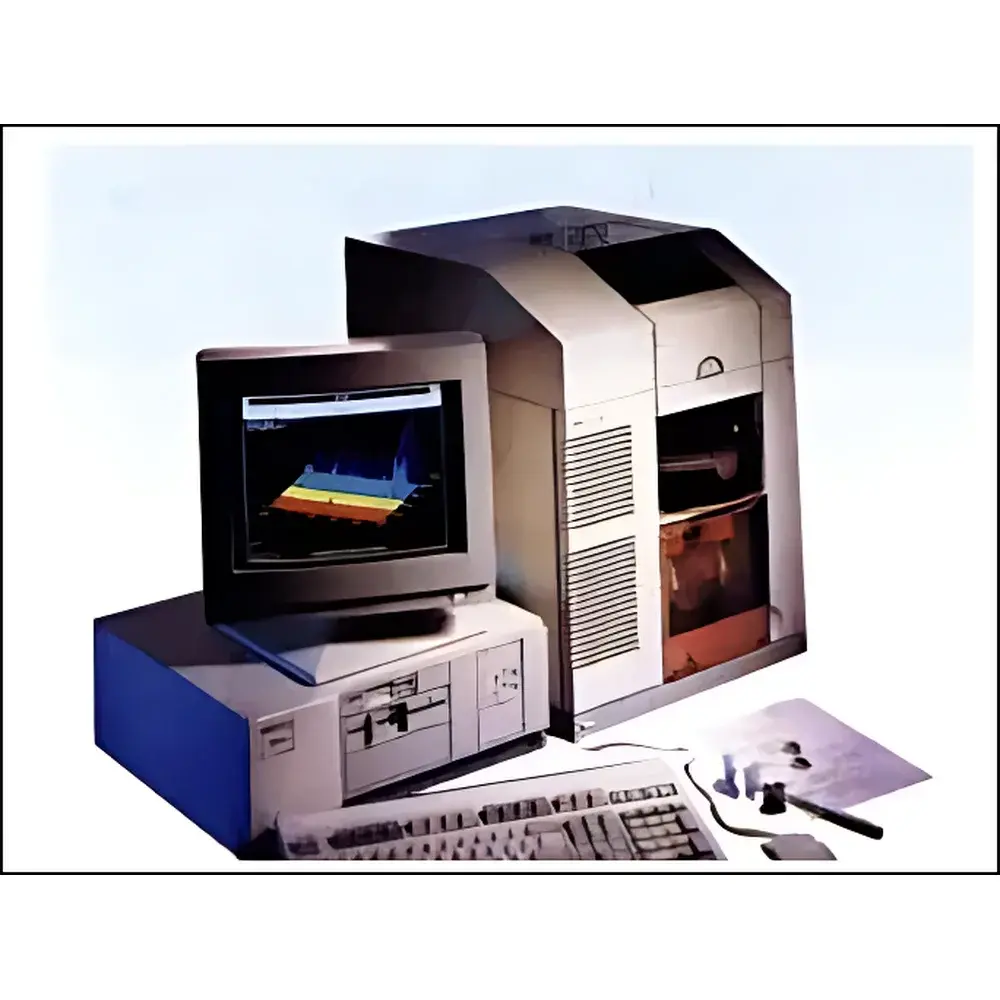
Agilent 3D CE Capillary Electrophoresis System
| Brand | Agilent Technologies |
|---|---|
| Origin | USA |
| Model | 3D CE |
| Instrument Type | Capillary Electrophoresis (CE) |
| Sample Application | Organic Analysis |
| Detection | Diode Array Detector (DAD) |
| Capillary Temperature Control | Peltier + High-Velocity Air Cooling (10 m/s) |
| Injection | Self-Calibrating Pressure-Based Injection |
| Buffer Management | Offline Buffer Replenishment System |
| Optical Path Enhancement | Extended-Path Capillary Technology |
| Detector Compatibility | DAD, LIF, MS |
| CE-MS Coupling | Single-Supplier Integrated Interface |
| Fraction Collection | Yes |
| CE-CGC Compatibility | Yes |
Overview
The Agilent 3D CE Capillary Electrophoresis System is a high-performance, modular platform engineered for precision separation and quantitative analysis of charged organic molecules—including small-molecule pharmaceuticals, metabolites, peptides, chiral compounds, and ionic additives. Based on the fundamental principle of capillary electrophoresis—where analytes migrate under an applied electric field through a fused-silica capillary filled with electrolyte buffer—the 3D CE system delivers exceptional resolution, reproducibility, and detection sensitivity. Its architecture integrates electrokinetic and pressure-driven injection modalities, thermally stabilized capillary cartridges, and multi-detector expandability to support both routine QC and advanced research workflows in regulated and non-regulated laboratories.
Key Features
- Self-calibrating pressure-based injection mechanism ensures sub-nanoliter volumetric accuracy and linear dynamic range exceeding 3 orders of magnitude—critical for quantitative bioanalysis and impurity profiling.
- Offline buffer replenishment system eliminates on-capillary buffer depletion artifacts, maintaining consistent ionic strength and pH across >100 consecutive runs—enabling long-term method robustness per ICH Q2(R2) guidance.
- Extended-path capillary technology increases optical pathlength by up to 5× without compromising separation efficiency, significantly enhancing UV-Vis absorbance detection limits for low-concentration analytes.
- Peltier-controlled thermal management combined with high-velocity air cooling (10 m/s airflow) maintains capillary temperature within ±0.2 °C over extended run times—ensuring migration time RSD < 0.5% for GLP-compliant method validation.
- Modular detector interface supports simultaneous or sequential coupling of diode array detection (DAD), laser-induced fluorescence (LIF), and mass spectrometry (MS) via Agilent’s proprietary CE-MS interface kit.
- Fraction collection capability enables offline downstream characterization—including NMR, enzymatic assays, or secondary chromatographic analysis—without compromising electrophoretic integrity.
- Pre-configured cartridge formats accommodate standard 50–100 µm ID capillaries and are compatible with capillary electrochromatography (CEC) columns for hybrid separation mechanisms.
Sample Compatibility & Compliance
The 3D CE system is validated for analysis of thermally labile, highly polar, and ionizable organic compounds that exhibit poor retention or peak tailing in reversed-phase HPLC. Typical applications include enantiomeric purity assessment (using chiral selectors), oligonucleotide purity profiling, amino acid quantitation in bioprocess streams, and counterion analysis in APIs. The platform conforms to key regulatory expectations for analytical instrumentation: audit trail functionality (21 CFR Part 11–ready software), electronic signature support, and full traceability of method parameters, injection sequences, and detector calibration logs. All hardware components meet IEC 61010-1 safety standards, and capillary handling protocols align with ISO/IEC 17025 documentation requirements for accredited testing laboratories.
Software & Data Management
Controlled via Agilent OpenLab CDS CE Edition, the system provides intuitive method development tools—including voltage ramping, dynamic pH adjustment, and real-time current monitoring—as well as automated peak integration with baseline correction algorithms optimized for electrophoretic zone profiles. Raw data files adhere to ASTM E1984-compliant format, enabling interoperability with third-party spectral libraries and statistical analysis packages (e.g., SIMCA, JMP). Audit trails record all user actions, parameter modifications, and instrument status events with immutable timestamps. Data archiving supports networked storage with role-based access control, facilitating compliance with FDA, EMA, and PMDA review expectations during regulatory submissions.
Applications
- Pharmaceutical QC: Assay and related substances testing of small-molecule APIs per USP <721> and EP 2.2.46.
- Biopharmaceutical characterization: Charge variant analysis of monoclonal antibodies and ADCs using cation-exchange CE-SDS mode.
- Clinical research: Quantitative profiling of urinary organic acids and plasma catecholamines in metabolic disorder studies.
- Food & environmental analysis: Detection of banned dyes, preservatives, and pesticide metabolites in complex matrices following solid-phase extraction cleanup.
- Academic & method development labs: Platform for optimizing chiral selectors, buffer additives, and coating chemistries for novel CE separations.
FAQ
Does the 3D CE system support hyphenated CE-MS analysis?
Yes—Agilent provides a fully integrated CE-MS interface kit including nanospray source alignment fixtures, sheath liquid delivery modules, and method templates optimized for Q-TOF and triple quadrupole mass spectrometers.
What capillary dimensions and coatings are supported?
Standard operation uses 365 µm OD × 50–100 µm ID fused silica capillaries; neutral, cationic, anionic, and zwitterionic polymeric coatings are available through Agilent’s certified capillary catalog.
Is the system compliant with 21 CFR Part 11 requirements?
The OpenLab CDS CE Edition software includes electronic signatures, audit trail generation, and secure user authentication—meeting core technical controls outlined in FDA’s Part 11 guidance for electronic records and signatures.
Can the 3D CE be used for carbohydrate analysis?
Yes—when coupled with borate buffer systems and indirect UV detection, or with LIF detection following reductive amination labeling, the system resolves mono- and disaccharide isomers with baseline resolution.
What maintenance intervals are recommended for optimal performance?
Capillary replacement every 200–300 runs; buffer vial cleaning after each sequence; annual Peltier module calibration and airflow sensor verification per Agilent Service Bulletin CE-3D-MAINT-2023.





