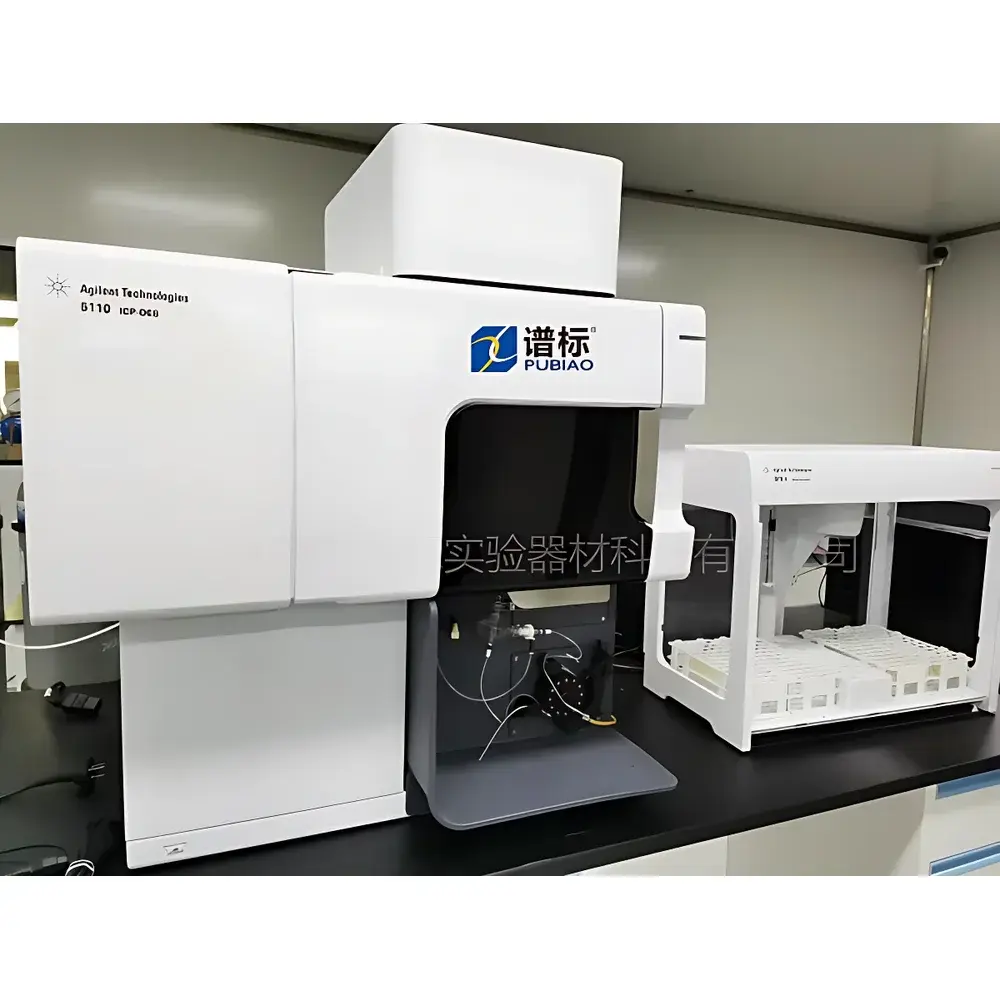
Agilent 5110 ICP-OES Spectrometer (Refurbished)
| Brand | Agilent Technologies |
|---|---|
| Origin | USA |
| Model | 5110 |
| Type | Inductively Coupled Plasma Optical Emission Spectrometer (ICP-OES) |
| Configuration Options | Synchronized Vertical Dual View (SVDV), Vertical Dual View (VDV), or Vertical View (VV) |
| Detector | VistaChip II CCD |
| RF Generator | Solid-State |
| Warranty | 12 months |
| Operational Age | 3–5 years |
| Compliance | ASTM D1976, ISO 11885, USP <232>/<233>, EPA Methods 200.7, 200.8, 6010D, 6020B |
Overview
The Agilent 5110 ICP-OES Spectrometer is a high-performance, refurbished inductively coupled plasma optical emission spectrometer engineered for trace multi-element analysis in environmental, clinical, geochemical, and industrial laboratories. Operating on the principle of plasma excitation—where sample aerosols are atomized, ionized, and excited in a 6,000–10,000 K argon plasma—the instrument detects element-specific atomic emission lines across the UV-Vis spectrum (167–785 nm) with high spectral resolution and linearity. Its core innovation lies in Synchronized Vertical Dual View (SVDV) optical architecture, enabling simultaneous axial and radial plasma viewing without mechanical repositioning. This eliminates view-switching delays and ensures consistent signal acquisition for both low-concentration analytes (via axial view) and high-matrix samples (via radial view), all within a single integration cycle.
Key Features
- Synchronized Vertical Dual View (SVDV): Real-time concurrent axial and radial plasma observation using a dual-optic path and beam-splitting optics—no moving parts, no time loss, no calibration drift between views.
- Intelligent Spectral Combination (DSC) Technology: Algorithm-driven spectral merging that dynamically selects optimal line intensities from axial/radial channels per element, maximizing signal-to-background ratio and minimizing interferences.
- VistaChip II CCD Detector: Back-thinned, thermoelectrically cooled charge-coupled device with full-frame readout; enables rapid, gas-free spectral acquisition (no purge gas required) and supports full-spectrum recording in <100 ms.
- Vertical Torch Design: Optimized for stability with high-dissolved-solids (HDS), volatile organic solvents (e.g., kerosene, MIBK), and HF-containing matrices—reducing carbon deposition and torch clogging.
- Advanced Valve System (AVS): 6- or 7-port programmable switching valve enabling precise bubble-injection control during aspiration, reducing rinse time by up to 60%, shortening stabilization intervals, and cutting argon consumption by ~50% versus conventional systems.
- Solid-State RF Generator (27.12 MHz): Delivers stable 1.0–1.5 kW plasma power with <0.1% long-term output variation—critical for reproducible nebulization efficiency and plasma robustness over extended runs.
- IntelliQuant Semi-Quantitative Mode: Rapid survey analysis of all detectable elements (Z = 11–92) without prior calibration; provides elemental fingerprints for method scouting, contamination screening, or unknown sample characterization.
Sample Compatibility & Compliance
The 5110 accommodates aqueous solutions, digested environmental solids (EPA SW-846), organic extracts (ASTM D5185), high-salt brines (up to 25% w/v NaCl), and HF-digested geological samples when paired with optional quartz torches and inert sample introduction kits. It meets regulatory requirements for routine compliance testing under EPA Methods 200.7 (metals in drinking water), 200.8 (wastewater), 6010D (soil/sediment), and 6020B (multi-matrix). Instrument software supports 21 CFR Part 11-compliant audit trails, electronic signatures, and role-based access control—fully aligned with GLP and GMP laboratory practices. All refurbished units undergo full performance verification per Agilent’s PQ/OQ protocols, including wavelength calibration accuracy (±0.003 nm), resolution (≤0.007 nm at 200 nm), and detection limit validation (e.g., ≤0.05 µg/L for Mg II 280.270 nm in 2% HNO₃).
Software & Data Management
Controlled exclusively via Agilent’s ICP Expert software v7.x or later, the system delivers intuitive workflow management—from method setup and calibration to reporting and data archiving. The software includes embedded spectral interference correction libraries (e.g., ArO⁺ on Fe 238.204 nm), internal standard normalization (e.g., Y, Sc, In), and customizable QC templates (control charts, spike recovery tracking, drift monitoring). Raw spectral data is stored in vendor-neutral .csv and .spc formats; full audit logs record user actions, parameter changes, and instrument status events with timestamps and operator IDs. Optional connectivity to LIMS via ASTM E1384-compliant interfaces enables seamless data transfer and chain-of-custody documentation.
Applications
- Environmental: Multi-element quantification in wastewater, surface water, soil leachates, and airborne particulate filters per EPA and ISO standards.
- Geochemistry: Major/minor/tracer element profiling in rock digests, ore concentrates, and exploration core samples.
- Pharmaceuticals: Catalyst metal residue testing (Pd, Pt, Ni, Rh) in APIs per ICH Q2(R2) and USP /.
- Food & Agriculture: Nutrient (Ca, Mg, K, P) and contaminant (As, Cd, Pb) analysis in fortified foods, beverages, and feedstuffs.
- Materials Science: Impurity screening in battery cathode precursors (Ni, Co, Mn, Al), semiconductor-grade chemicals, and recycled metals.
FAQ
What does “refurbished” mean for this Agilent 5110 ICP-OES unit?
All units undergo complete functional restoration at an Agilent-authorized service center: optical alignment verification, plasma torch and nebulizer replacement, RF generator recalibration, detector dark-current characterization, and full PQ/OQ testing against factory specifications.
Is the original software license included?
Yes—each unit ships with a valid, transferable ICP Expert software license (v7.5 or newer), pre-installed and activated with full feature set including IntelliQuant, DSC, and AVS control modules.
Can this system be upgraded to support hydride generation?
Yes—compatible with Agilent’s Multi-Mode Sample Introduction System (MSIS), enabling sub-ppb detection of As, Se, Hg, Sb, and Bi via cold vapor/hydride techniques without hardware modification or manual mode switching.
What maintenance support is available post-purchase?
A 12-month comprehensive warranty covers parts, labor, and remote diagnostics. Extended service plans—including priority response, preventive maintenance visits, and spare torch/nebulizer kits—are available upon request.
Are consumables and accessories included?
Standard configuration includes one quartz torch, OneNeb inert nebulizer, Scott-type double-pass spray chamber, and 10 m of PFA sample tubing. Optional accessories (SPS-4 autosampler, MSIS, HF-compatible kits) are quoted separately.