
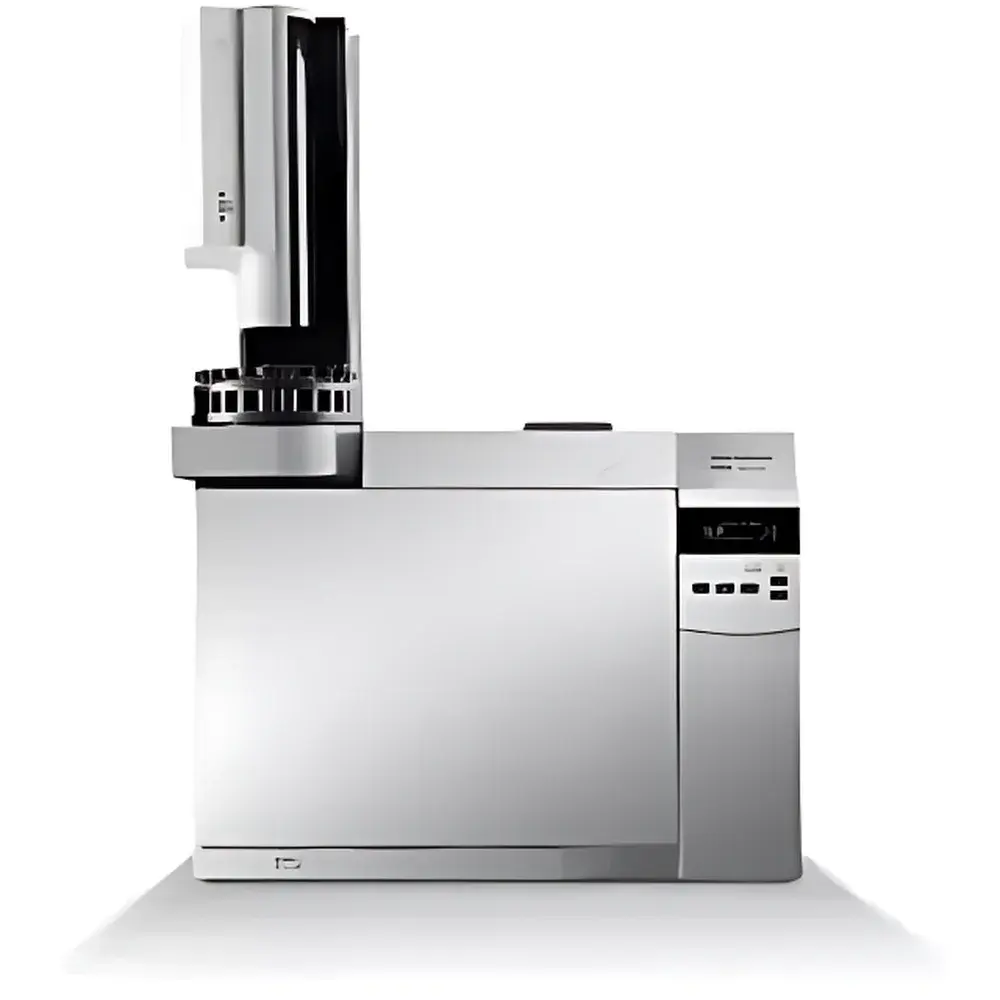
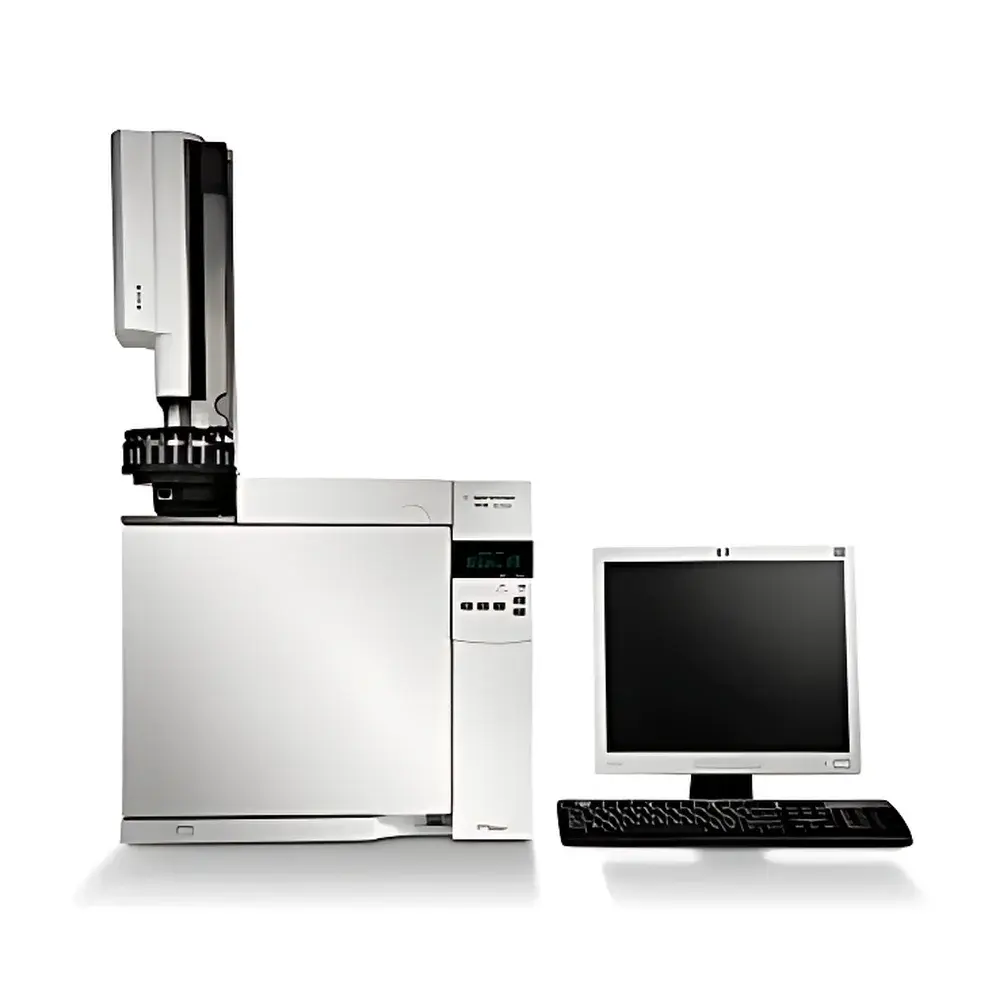
Agilent 7820A Gas Chromatograph
| Brand | Agilent |
|---|---|
| Origin | USA |
| Instrument Type | Laboratory Gas Chromatograph |
| Application Scope | General-Purpose |
| Oven Temperature Range | 8 °C to 425 °C |
| Maximum Ramp Rate | 75 °C/min |
| Cooling Time | 999.99 min (maximum runtime) |
| Carrier Gas Flow Range & Control | 0–1200 mL/min |
| Carrier Gas Pressure Range & Control | 0–970 psi |
| Injector Maximum Operating Temperature | 450 °C |
| Injector Pressure Setpoint Range | 0–970 psi |
| Injector Total Flow Setpoint Range | 0–1200 mL/min |
| Column Oven Dimensions | 28.0 × 30.5 × 16.5 cm |
| Retention Time Reproducibility | < 0.06% RSD |
| Peak Area Reproducibility | < 2% RSD |
| Power Requirement | 220 V (±10%), 47.5–63 Hz, 1500 W (100 V: 2250 W) |
| Weight | 50 kg |
| Compliance | IEC/EN 61010, UL 61010, CSA C22.2 No. 61010, CISPR 11/EN 55011 Class A, ISO 9001 |
Overview
The Agilent 7820A Gas Chromatograph is a robust, entry-level laboratory GC engineered for routine analytical workflows requiring high reproducibility, regulatory readiness, and operational simplicity. Built on Agilent’s proven gas chromatography platform, it employs precision electronic pressure control (EPC) across all pneumatic modules—including inlet systems and detectors—to deliver consistent carrier gas delivery, precise temperature programming, and stable baseline performance. Its column oven supports operation from 8 °C above ambient to 425 °C with ramp rates up to 75 °C/min and thermal stability of < 0.01 °C per 1 °C ambient fluctuation—ensuring retention time repeatability better than 0.06% RSD and peak area precision under 2% RSD. Designed for daily use in QC laboratories, environmental testing facilities, and academic research settings, the 7820A meets core requirements for method transfer, method validation, and compliance-driven environments including those governed by USP , ASTM D3606/D5501, and EPA Methods 8021B/8270.
Key Features
- Full electronic pneumatic control (EPC) for all inlets and detectors—eliminating mechanical flow controllers and enabling automated method transfer, pressure tuning, and leak diagnostics
- Intuitive front-panel interface with backlit LCD display showing real-time sequence status, oven/inlet/detector temperatures, pressure/flow values, and system alerts
- Dual independent heated zones for inlet modules (up to two simultaneously installed), plus four additional heated zones for detectors and auxiliary components—each programmable to 350 °C
- Modular inlet configuration supporting both split/splitless (S/SL) capillary inlets (0–60 psi, 0–500 mL/min with H2/He) and purged packed-column (PP) inlets (up to 400 °C, 100 mL/min)
- Multi-detector capability: simultaneous installation of up to two detectors—including FID, TCD, ECD (where permitted), and NPD—with EPC-regulated gas flows and temperature control
- Integrated LAN port and analog output (1 mV / 1 V / 10 V) for seamless integration into LIMS, SCADA, or third-party data acquisition systems
Sample Compatibility & Compliance
The 7820A accommodates a broad range of sample matrices—including volatile organic compounds (VOCs), residual solvents, hydrocarbon fractions, pesticides, and environmental contaminants—when coupled with standard fused-silica capillary columns (0.1–0.53 mm ID) or packed columns (1/8″ or 1/4″ OD). Its inlet design supports direct liquid injection, headspace analysis (via optional accessories), and purge-and-trap interfaces. The system complies with international safety and electromagnetic compatibility standards: IEC/EN 61010-1, UL 61010-1, CSA C22.2 No. 61010-1, and CISPR 11/EN 55011 Class A. Manufacturing adheres to ISO 9001 quality management principles, and full traceability documentation—including calibration certificates and factory test reports—is available upon request. While not natively 21 CFR Part 11 compliant, audit trail functionality and user access controls can be implemented via Agilent EZChrom Elite Compact software when deployed in validated environments under GLP/GMP frameworks.
Software & Data Management
The Agilent EZChrom Elite Compact software provides a streamlined, Windows-based environment for instrument control, data acquisition, peak integration, reporting, and method archiving. It supports batch processing, custom report templates (PDF/CSV/XLS export), and integration with enterprise databases via ODBC. The software enables full EPC parameter scripting—including pressure ramps, flow gradients, and detector gas switching—within sequence methods. For regulated laboratories, optional audit trail logging, electronic signatures, and user role-based permissions are configurable to support ALCOA+ data integrity principles. Raw data files (.D format) are stored in an open, non-proprietary structure compatible with third-party reprocessing tools. Remote monitoring and control are supported over standard TCP/IP networks without proprietary drivers.
Applications
- Pharmaceutical quality control: residual solvent analysis per ICH Q3C guidelines using headspace-GC/FID
- Environmental monitoring: BTEX, PAHs, chlorinated hydrocarbons, and organochlorine pesticides via EPA 8270D (GC/MS-ready interface)
- Fuel and petrochemical analysis: gasoline hydrocarbon distribution (PIONA), diesel cetane improvers, and biodiesel FAME profiling
- Food and flavor testing: ethanol quantification, off-flavor compound screening, and essential oil fingerprinting
- Academic teaching labs: foundational chromatography training with hands-on method development and troubleshooting exercises
FAQ
What is the maximum operating temperature for the split/splitless inlet?
The S/SL inlet is rated to 400 °C; however, the system supports an optional high-temperature injector module capable of sustained operation at 450 °C.
Can the 7820A be used for method validation under current GMP guidelines?
Yes—when paired with EZChrom Elite Compact and configured with appropriate access controls, audit trails, and electronic signatures, the system supports IQ/OQ/PQ execution and satisfies core elements of FDA 21 CFR Part 11 and EU Annex 11 for computerized system validation.
Is nitrogen suitable as a carrier gas for all detector types?
Nitrogen is fully compatible with FID and ECD; however, optimal sensitivity for FID requires hydrogen or helium, while TCD performance is significantly enhanced with helium or hydrogen carrier gases.
Does the 7820A support unattended operation overnight?
Yes—the system supports run times up to 999.99 minutes and includes automatic shutdown, cool-down sequencing, and alarm-triggered email/SNMP notifications when integrated with network management software.
What auxiliary hardware is required to add headspace analysis capability?
A dedicated Agilent 7697A Headspace Sampler or equivalent third-party headspace autosampler with GC trigger interface and compatible transfer line is required; no internal hardware modification is needed.
Related Products





