
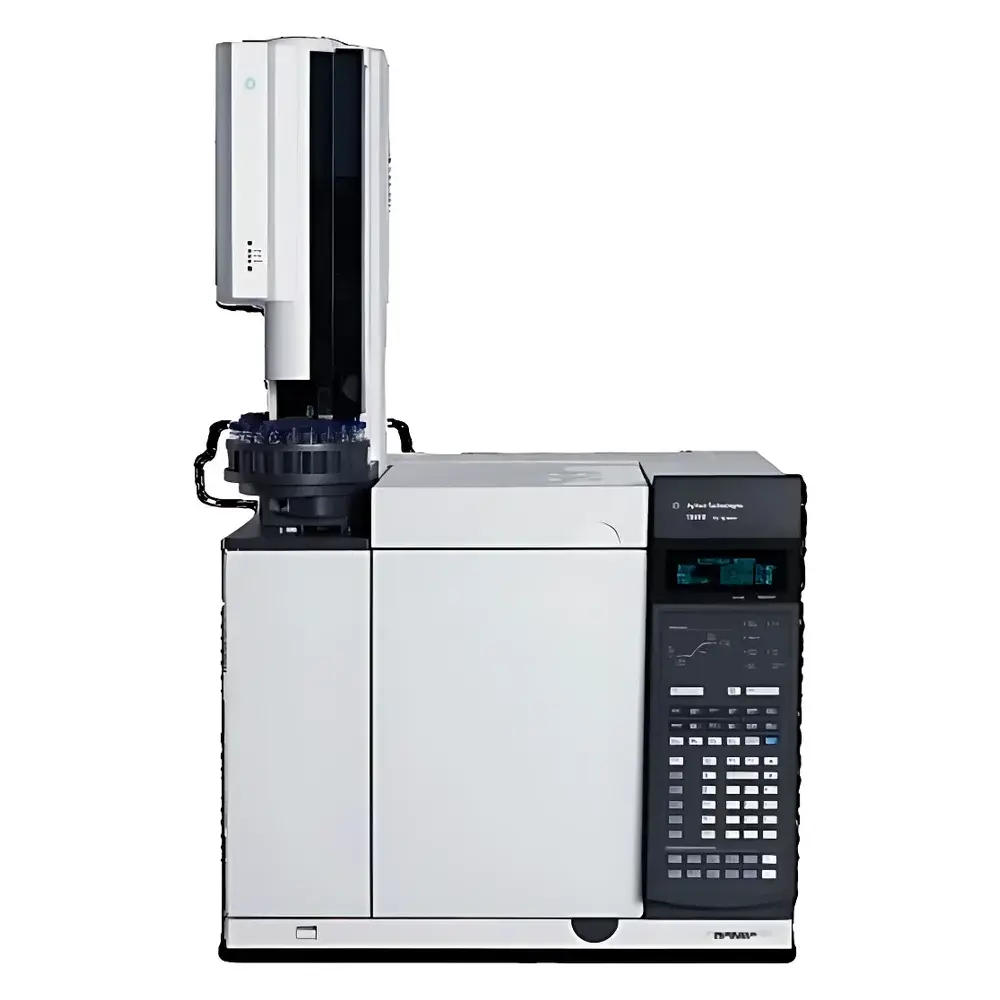
Agilent 7890B Gas Chromatograph
| Brand | Agilent Technologies |
|---|---|
| Origin | USA |
| Manufacturer Type | Original Equipment Manufacturer (OEM) |
| Origin Category | Imported Instrument |
| Model | 7890B |
| Instrument Type | Laboratory Gas Chromatograph |
| Application Field | Petrochemical Industry |
| Heating/Cooling Rate | Enabled by Low Thermal Mass (LTM) modules for direct, rapid column heating and cooling |
| Compliance | Designed to support GLP/GMP workflows with audit-trail-capable data systems (when paired with OpenLab CDS or ChemStation software) |
Overview
The Agilent 7890B Gas Chromatograph is a high-performance, modular laboratory GC system engineered for precision, reproducibility, and method robustness in regulated and research environments. Based on proven dual-channel architecture and advanced temperature control, the 7890B employs capillary flow technology (CFT) and low thermal mass (LTM) column oven design to deliver rapid cycle times—reducing analysis duration without compromising resolution or retention time stability. Its core separation principle relies on differential partitioning of volatile and semi-volatile analytes between a mobile gas phase (carrier gas: He, H₂, or N₂) and a stationary phase coated inside fused-silica capillary columns. The system supports both isothermal and programmable temperature ramping profiles, with precise oven temperature control from –10 °C to 450 °C and ramp rates up to 120 °C/min (dependent on LTM module configuration). Though discontinued for new production as of 2015, the 7890B remains widely deployed in petrochemical, environmental, and quality control laboratories due to its field-proven reliability, extensive method library compatibility, and continued technical support—including refurbished units via Agilent’s Certified Pre-Owned Instrument Program.
Key Features
- Retention Time Locking (RTL): Enables cross-instrument, cross-column, and cross-laboratory retention time reproducibility—critical for method transfer and regulatory compliance (e.g., ASTM D3606, USP <621>).
- Capillary Flow Technology (CFT): Supports complex multidimensional configurations including heart-cutting (GC-GC), comprehensive two-dimensional GC (GC×GC) with flow modulators, and active column backflushing (pre-, mid-, and post-column).
- Single-Filament Thermal Conductivity Detector (TCD): Eliminates need for reference gas or manual bridge balance; delivers low-drift baseline stability and linear response over five orders of magnitude.
- Auto-ranging Flame Ionization Detector (FID): Provides dynamic range from ppb to % levels in a single injection—ideal for wide-concentration hydrocarbon profiling in refinery streams.
- Integrated Sulfur/Nitrogen Chemiluminescence Detection (SCD/NCD): Delivers selective, isomolar response for sulfur- and nitrogen-containing compounds at sub-ppb levels in fuels and lubricants.
- Helium Conservation Module & Alternative Carrier Gas Support: Reduces helium dependency via hydrogen or nitrogen optimization algorithms—validated per ISO 10101 and ASTM D6729.
- Hydrogen Sensor Module (Series 2): Monitors H₂ leakage continuously using embedded diagnostics; triggers automatic shut-off and alerts—calibration interval: every 6 months.
- Large Volume Oven (LVO) & Multi-Mode Inlet (MMI): Accommodates up to four LTM modules simultaneously and enables programmable temperature vaporizing (PTV) injection for trace enrichment and large-volume injection.
- Agilent Inert Flow Path: Deactivated tubing, liners, and seals minimize adsorption and degradation of reactive species (e.g., aldehydes, amines, organometallics), preserving sensitivity and peak shape.
Sample Compatibility & Compliance
The 7890B is validated for use with liquid, gaseous, and solid-phase microextraction (SPME) samples across petrochemical matrices—including crude oil fractions, gasoline, diesel, jet fuel, LPG, and refinery process gases. It meets instrumental requirements outlined in EPA Methods 8015M, 8260D, and 8270D; ASTM standards D1319 (hydrocarbon types), D5186 (determining aromatic content), and D6729 (gasoline analysis); and ISO 6974 series for natural gas composition. When operated with Agilent OpenLab CDS or legacy ChemStation software under controlled IT environments, the system supports 21 CFR Part 11 compliance—including electronic signatures, audit trails, user access controls, and data integrity safeguards required for GLP and GMP audits.
Software & Data Management
Data acquisition, processing, and reporting are managed through Agilent ChemStation (for legacy deployment) or OpenLab CDS (for modernized, networked labs). Both platforms provide automated calibration curve generation, peak integration with customizable baselines, retention time alignment tools, and customizable report templates compliant with ISO/IEC 17025 documentation requirements. OpenLab CDS adds centralized instrument monitoring, remote diagnostics, and integrated instrument qualification (IQ/OQ/PQ) workflow support. All raw data files (.D format) are stored in vendor-neutral, non-proprietary structures compatible with third-party chemometric software (e.g., MATLAB, SIMCA) for multivariate analysis.
Applications
Primary applications include hydrocarbon group-type analysis (PIONA, OH, DHA), benzene/toluene/xylenes (BTX) quantification in reformulated gasoline, sulfur speciation in ultra-low-sulfur diesel (ULSD), oxygenate determination (MTBE, ETBE), residual solvent testing in pharmaceutical excipients, and volatile organic compound (VOC) profiling in ambient air and stack emissions. Its modular inlet and detector options also enable method development for emerging applications such as biofuel blend analysis (e.g., fatty acid methyl esters), pyrolysis oil characterization, and catalyst deactivation studies.
FAQ
Is the Agilent 7890B still supported by Agilent Technologies?
Yes—Agilent continues to supply consumables, spare parts, service contracts, and firmware updates for the 7890B. Refurbished units are available through the Agilent Certified Pre-Owned Instrument Program with full warranty and installation support.
Can the 7890B be upgraded to meet current data integrity requirements?
When configured with OpenLab CDS 2.4 or later and operated in a validated environment, the system satisfies ALCOA+ principles and 21 CFR Part 11 technical controls—including electronic signatures, change history, and audit trail review capabilities.
What carrier gases are supported—and how does helium conservation work?
He, H₂, and N₂ are fully supported. The Helium Conservation Module dynamically adjusts pressure and flow parameters during run-time to maintain optimal separation efficiency while reducing helium consumption by up to 80%, as verified per ASTM D7217.
Does the 7890B support GC×GC configurations?
Yes—via CFT-enabled flow modulation using the Agilent 220 GC×GC Modulator or third-party cryogenic modulators, with native support in OpenLab CDS for contour plot generation and structured peak table export.
What is the maximum number of LTM modules supported?
Up to four LTM modules can be installed and operated simultaneously within the Large Volume Oven, enabling parallel method execution or multi-zone column temperature programming.



