
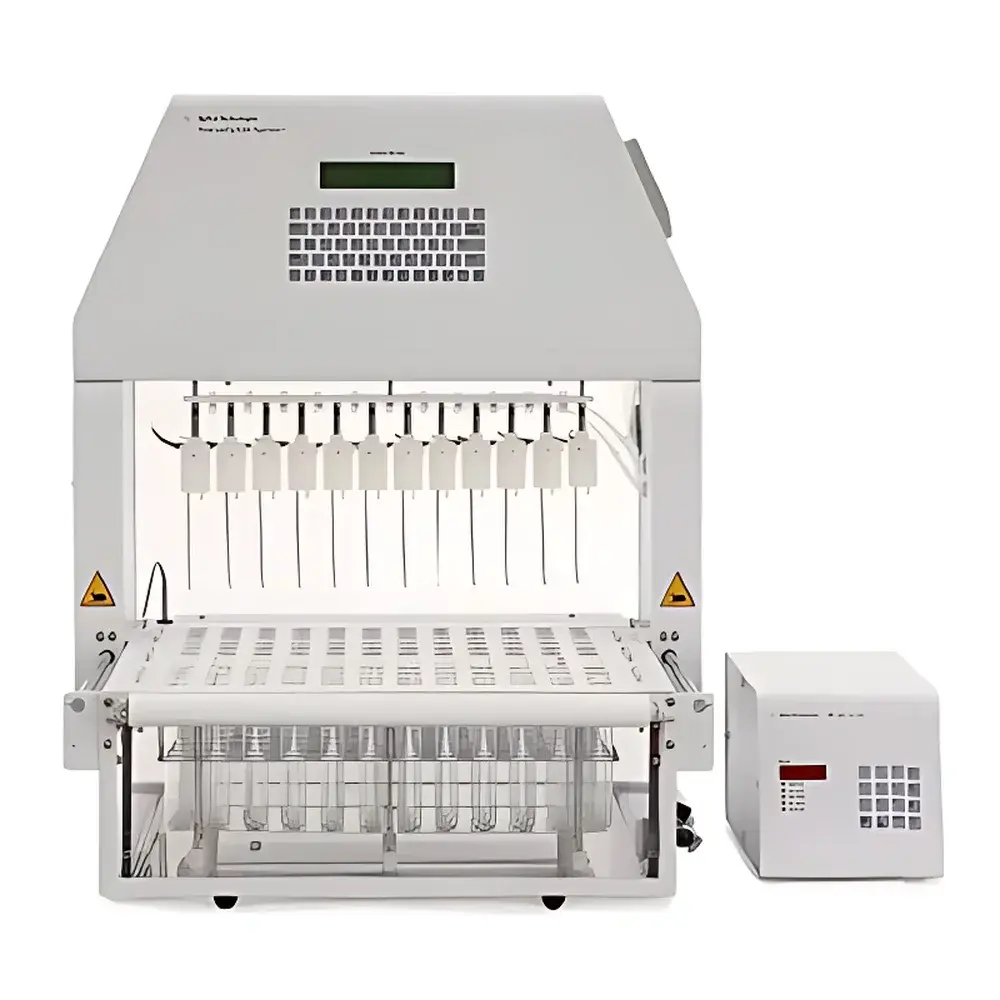
Agilent App7 Reciprocating Holder Dissolution Tester
| Brand | Agilent Technologies |
|---|---|
| Origin | Imported |
| Manufacturer Type | Manufacturer |
| Instrument Type | Online Dissolution Tester |
| Vessel Configuration | 7-position or 12-position reciprocating rack |
| Temperature Range | Ambient +5 °C to 55 °C |
| Temperature Accuracy | ±0.1 °C |
| Stroke Rate | 5–40 cycles/min |
| Stroke Distance | 20 mm |
| Water Bath Volume | 25 L |
| Vessel Capacities Supported | 50 mL, 100 mL, 300 mL |
| Maximum Media Exchange Cycles | 6 per test |
| Unattended Operation Duration | Up to 144 hours (6 days) |
Overview
The Agilent App7 Reciprocating Holder Dissolution Tester is an advanced, programmable platform engineered for biorelevant dissolution testing of complex dosage forms that cannot be adequately evaluated using conventional paddle or basket apparatuses. It operates on the principle of reciprocating motion—vertically oscillating sample holders through multiple media-filled vessels—to replicate physiological conditions such as sequential gastrointestinal transit, transdermal permeation kinetics, and localized tissue exposure. This method aligns with USP Chapter <724> Dissolution of Transdermal Delivery Systems and supports regulatory strategies requiring multi-compartment, variable-media, or low-volume dissolution protocols. Designed for high reproducibility and long-term unattended operation, the App7 enables precise simulation of residence time, mechanical agitation intensity, and thermal microenvironment—critical parameters for extended-release tablets, osmotic pumps, implantable devices, transdermal patches, and drug-eluting stents.
Key Features
- Programmable reciprocating motion with adjustable stroke rate (5–40 cycles/min) and fixed 20 mm vertical displacement—ensuring consistent mechanical stress across formulations.
- Dual vessel configuration options: standard 7-position rack (6 rows × 7 positions) for 100/300 mL vessels or high-density 12-position rack (12 rows × 12 positions) supporting 50 mL vessels with minimum operational volume of ~25 mL.
- Integrated temperature-controlled water bath (25 L capacity) maintaining setpoint accuracy within ±0.1 °C across the full operating range (ambient +5 °C to 55 °C), compliant with USP <711> and ISO 9001 calibration traceability requirements.
- Automated media exchange logic allowing up to six sequential transfers between distinct dissolution media—enabling pH-shift, enzyme-introduction, or sink-condition modulation without manual intervention.
- Onboard storage for up to 15 user-defined methods, each defining time-scheduled events including vessel transfer timing, immersion duration, emptying intervals, stroke frequency, and sampling synchronization points.
- Modular vessel adaptability via optional conversion kits—supporting seamless transition among 50 mL, 100 mL, and 300 mL configurations while preserving mechanical alignment and thermal uniformity.
Sample Compatibility & Compliance
The App7 accommodates a broad spectrum of non-conventional dosage forms, including but not limited to: matrix- and reservoir-type transdermal patches; enteric-coated and multi-layered extended-release tablets; hydrophilic/hydrophobic capsule systems; osmotic pump tablets; and polymer-based implantable matrices. Its mechanical design meets ASTM D7928-21 guidelines for dynamic dissolution apparatus validation and supports method development aligned with FDA’s Guidance for Industry: Extended Release Oral Dosage Forms. All control logic and data logging are structured to support 21 CFR Part 11 compliance when integrated with Agilent’s compliant software suite—providing audit trails, electronic signatures, and role-based access control for GLP/GMP environments.
Software & Data Management
The App7 interfaces with Agilent’s Dissolution Pro™ software (v3.2+), enabling real-time monitoring of stroke cycles, temperature stability, vessel position status, and media exchange logs. The software provides automated event-triggered sampling coordination with compatible autosamplers and UV/Vis or HPLC detection systems. All method parameters, runtime logs, and system diagnostics are stored in encrypted SQLite databases with configurable backup intervals. Raw data exports comply with CDISC SDTM standards and include metadata tags for instrument ID, operator ID, environmental timestamps, and calibration history—facilitating direct ingestion into LIMS or statistical analysis platforms such as JMP or Simca.
Applications
- Biorelevant dissolution profiling of transdermal delivery systems under simulated skin surface conditions (e.g., finite-dose application with receptor medium replacement).
- Sequential pH-dissolution studies mimicking gastric-to-intestinal transit for enteric-coated products.
- Low-volume dissolution testing of pediatric or potent APIs where material conservation is critical.
- Release kinetics assessment of implantable polymers under sustained mechanical loading and thermal cycling.
- Method development and validation per ICH Q5C and Q2(R2) requirements for dissolution assay robustness and intermediate precision.
- Supporting quality-by-design (QbD) initiatives through multivariate parameter mapping of stroke rate, dwell time, and media composition effects on release profiles.
FAQ
What types of dosage forms are best suited for reciprocating holder dissolution testing?
Transdermal patches, osmotic pumps, implantable devices, buccal films, and extended-release capsules—particularly those exhibiting non-sink behavior, adhesion-dependent release, or multi-phase dissolution mechanisms.
Can the App7 perform automated sampling during a run?
Yes—when coupled with Agilent’s 709-DS or third-party autosamplers, it synchronizes sampling events with predefined stroke cycles and vessel transfer timelines.
Is the 50 mL vessel configuration validated for regulatory submissions?
The 50 mL setup is fully supported by Agilent’s IQ/OQ documentation package and referenced in multiple peer-reviewed publications on low-volume biorelevant dissolution; method-specific validation remains the responsibility of the end user per ICH Q2(R2).
How is temperature uniformity verified across all vessel positions?
Each App7 unit undergoes thermal mapping per ASTM E2865-22 during factory qualification, with probe placement at vessel centerpoints and near-bottom zones; reports include maximum deviation limits and spatial gradient analysis.
Does the system support remote monitoring or network integration?
Yes—via Ethernet-connected Dissolution Pro™ clients and optional OPC UA server module, enabling integration into centralized laboratory informatics infrastructure.





