
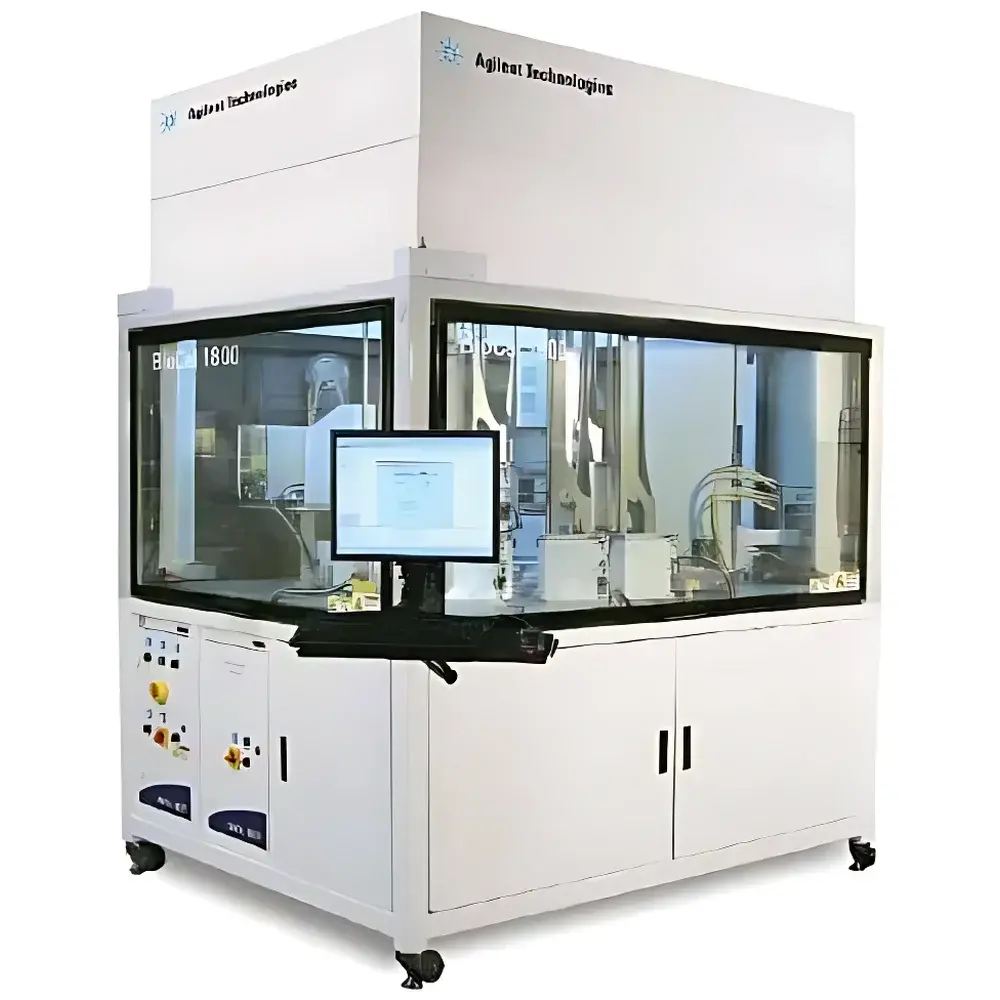
Agilent BioCel 1800 / 1200 / 900 Automated Liquid Handling Workstation
| Brand | Agilent Technologies |
|---|---|
| Origin | Singapore |
| Manufacturer | Agilent Technologies |
| Product Category | Imported Instrument |
| Models | BioCel 1800, BioCel 1200, BioCel 900 |
| Pricing | Available Upon Request |
Overview
The Agilent BioCel series—comprising the BioCel 1800, BioCel 1200, and BioCel 900—is a modular, benchtop-scale automated liquid handling workstation engineered for precision, reproducibility, and operational scalability in life science laboratories. Built upon a core architecture centered on a high-acceleration Cartesian robotic arm, the system implements deterministic pipetting motion control with sub-microliter volumetric accuracy across a wide dynamic range (typically 0.5 µL to 1,000 µL, dependent on tip configuration and assay protocol). Its design adheres to fundamental principles of fluidic automation: gravimetric calibration traceable to NIST standards, air-displacement pipetting validated per ISO 8655, and integrated environmental monitoring (temperature and humidity) to minimize evaporation-induced variability during extended run times. Unlike monolithic automation platforms, the BioCel architecture decouples hardware modularity from software-defined workflow orchestration—enabling seamless integration into existing laboratory informatics ecosystems while maintaining full GLP-compliant audit trail capabilities.
Key Features
- Compact Footprint: At 600 × 600 mm (BioCel 900) to 900 × 700 mm (BioCel 1800), the system occupies significantly less bench space than conventional liquid handlers—critical for core facilities with constrained real estate.
- High-Speed Robotic Arm: Features a dual-belt-driven X-Y-Z actuator with acceleration up to 2.5 m/s² and positional repeatability of ±0.1 mm, enabling rapid plate-to-plate transfers and minimizing cycle time in multi-step protocols.
- Extended Reach Architecture: The BioCel 1200 and 1800 models support peripheral device integration via standardized mechanical and electrical interfaces (e.g., I²C, RS-485, TTL triggers), allowing direct coupling with external readers, incubators, centrifuges, or storage modules without intermediary conveyors.
- Modular Scalability: Multiple BioCel units can be synchronized under a single software instance using Agilent’s BioCel Control Suite, enabling distributed workload balancing and fault-tolerant operation—validated for configurations up to four linked workstations.
- Cost-Optimized Lifecycle Design: Constructed with corrosion-resistant anodized aluminum frames and maintenance-free linear guides; service intervals exceed 10,000 operational hours, reducing total cost of ownership relative to legacy OEM platforms.
Sample Compatibility & Compliance
The BioCel platform supports standard ANSI/SLAS-format microplates (96-, 384-, and 1536-well), tube racks (including 1.5 mL and 2.0 mL conical tubes), and custom labware via user-defined coordinate mapping. All liquid handling operations comply with ISO/IEC 17025 requirements for testing laboratories and support FDA 21 CFR Part 11 compliance when deployed with Agilent’s optional Electronic Lab Notebook (ELN) integration module. Pipette tip ejection force, aspiration/dispense velocity profiles, and liquid class parameters are fully configurable per assay—ensuring compatibility with viscous biological matrices (e.g., glycerol stocks, cell lysates, serum-containing media) and low-surface-tension solvents used in compound management workflows.
Software & Data Management
Control is managed through Agilent BioCel Control Suite v5.x—a Windows-based application supporting drag-and-drop protocol builder, real-time execution monitoring, and embedded Python scripting for advanced logic branching. Audit trails record every command execution, user login/logout, parameter change, and hardware event with cryptographic timestamping. Raw log files are stored in SQLite format with SHA-256 hash integrity verification; export options include CSV, PDF, and XML for LIMS interoperability. The software includes built-in validation packages compliant with IQ/OQ/PQ documentation templates aligned to ASTM E2500 and USP guidelines.
Applications
- Compound library normalization and cherry-picking in early-stage drug discovery
- Automated nucleic acid extraction, PCR setup, and NGS library preparation in genomics core labs
- High-throughput screening (HTS) assay development—including dose-response curve generation and cytotoxicity profiling
- Cell-based assay workflows requiring precise reagent addition, media exchange, and endpoint lysis
- QC/QA sample dilution series preparation for method validation and reference standard generation
FAQ
What regulatory standards does the BioCel system support for GxP environments?
The system supports 21 CFR Part 11 compliance when configured with electronic signatures, audit trail logging, and role-based access control—validated per Agilent’s IQ/OQ/PQ documentation package.
Can the BioCel integrate with third-party instruments such as plate readers or centrifuges?
Yes—via standardized hardware trigger I/O ports and supported communication protocols (Modbus TCP, RS-232, and Ethernet/IP), enabling bidirectional handshake and status reporting.
Is method transfer between different BioCel models (e.g., 900 → 1800) supported?
Protocol definitions are model-agnostic within the BioCel Control Suite; only physical deck layout and maximum deck size require adjustment—no code rewriting is necessary.
What level of technical support and service coverage is available globally?
Agilent provides factory-certified field service engineers across EMEA, APAC, and the Americas, with optional extended warranty and preventive maintenance contracts including remote diagnostics and spare parts logistics.
Does the system support low-volume (<1 µL) dispensing for assay miniaturization?
With compatible positive-displacement tips and optimized liquid classes, sub-microliter precision dispensing (down to 0.25 µL CV <5%) is achievable—subject to validation per ISO 8655-6.



