
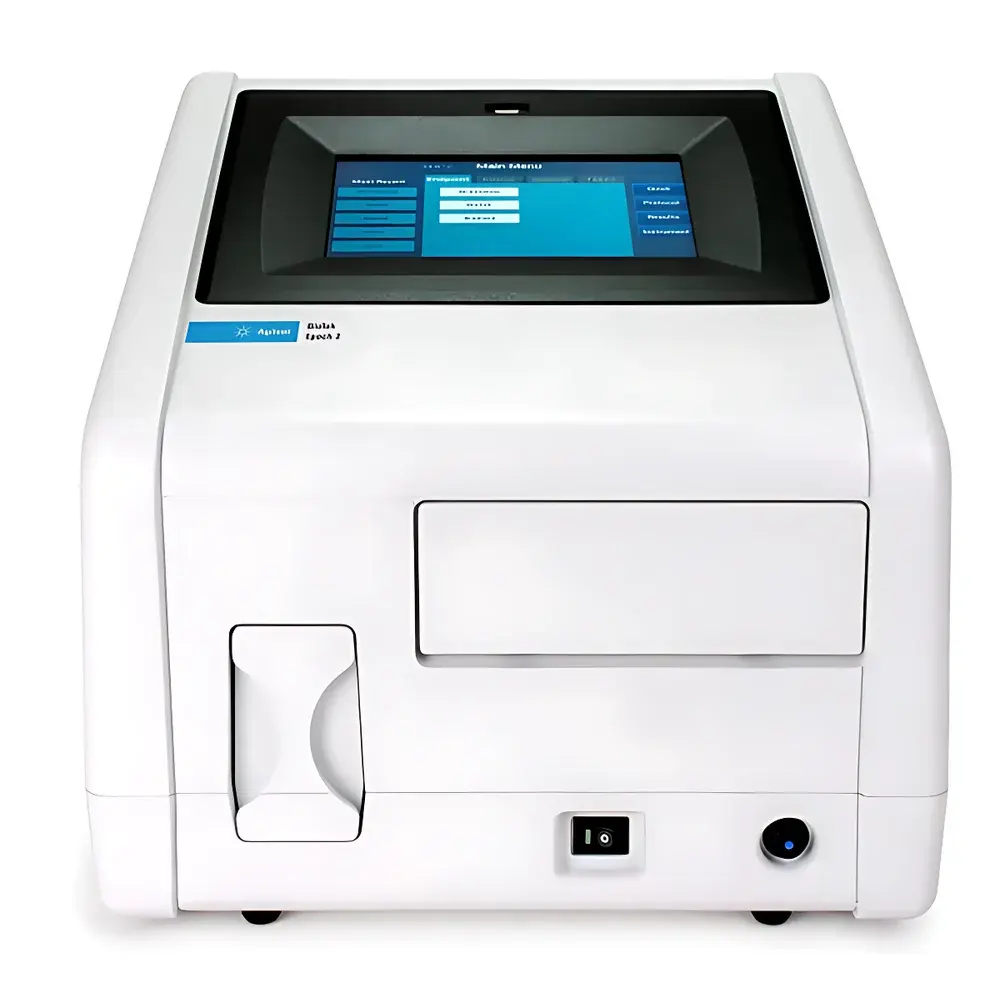
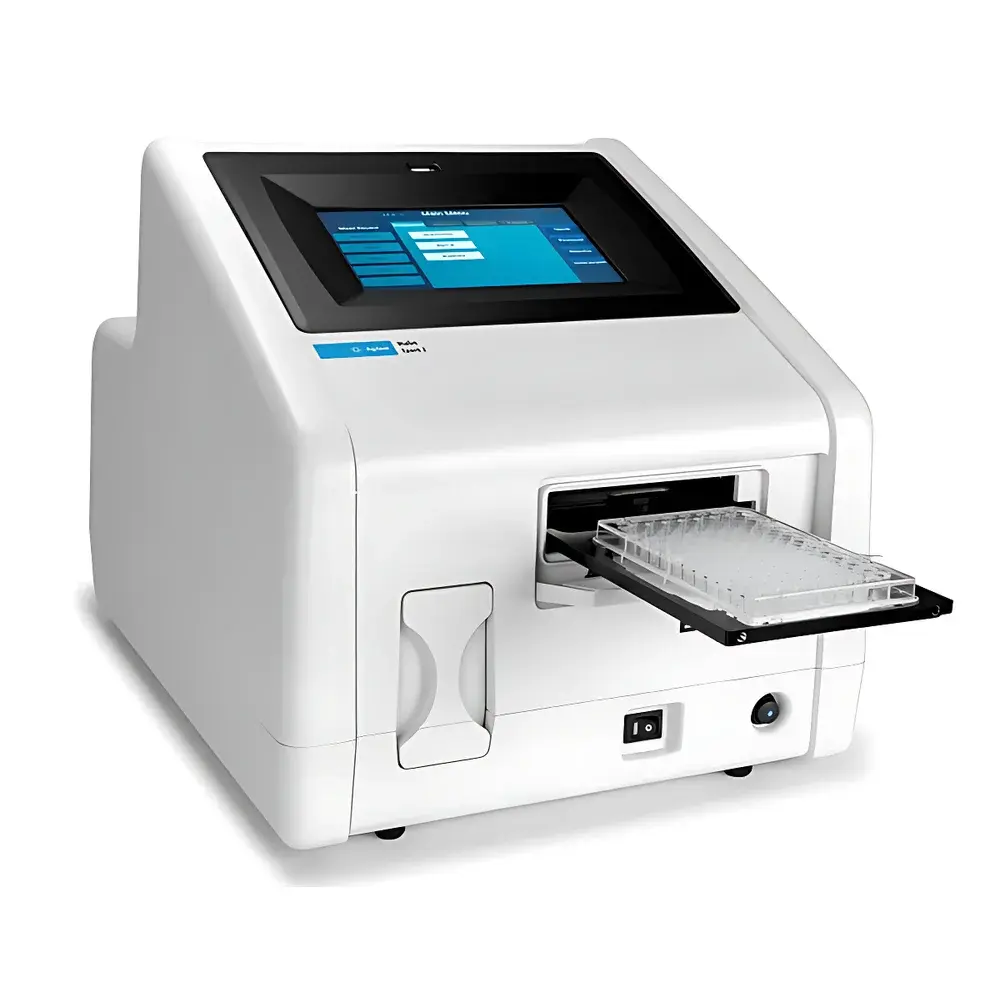
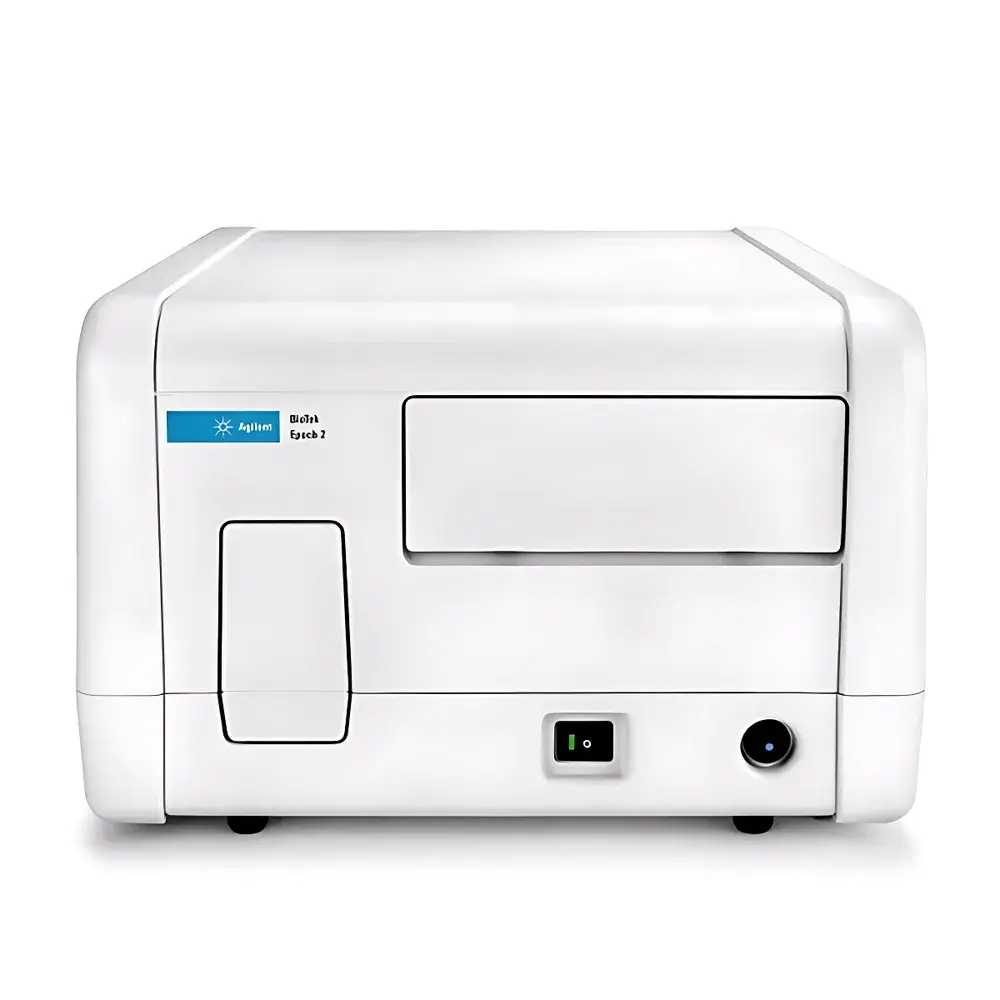
Agilent BioTek Epoch2 Microplate Spectrophotometer
| Brand | Agilent Technologies |
|---|---|
| Origin | USA |
| Manufacturer Type | Original Equipment Manufacturer (OEM) |
| Origin Category | Imported |
| Model | Epoch2 |
| Function Type | UV-Vis Absorbance-Only Microplate Reader |
| Automation Level | Fully Automated |
| Assay Modes | Endpoint, Kinetic, Spectral Scan |
| Curve Fitting Options | Linear, Quadratic, Cubic, Four-Parameter Logistic (4PL), Five-Parameter Logistic (5PL), Log-Log, Spline |
| Detector Type | UV-Visible Photodiode Array |
| Wavelength Range | 200–999 nm (1 nm increments) |
| Absorbance Range | 0–4 OD |
| Absorbance Linearity | ±1% ± 0.01 OD (0–2 OD) |
| Plate Read Time | 8 sec (96-well), 14 sec (384-well) |
| Precision | ±1% ± 0.01 OD (0–2 OD) |
Overview
The Agilent BioTek Epoch2 Microplate Spectrophotometer is a filter-free, grating-based UV-Vis absorbance microplate reader engineered for precision, reproducibility, and workflow flexibility in life science laboratories. It operates on the principle of monochromator-based spectral dispersion—using a high-efficiency holographic grating to select discrete wavelengths from 200 to 999 nm in 1 nm increments—eliminating the need for physical filter sets and enabling true full-spectrum characterization without hardware reconfiguration. Unlike fixed-wavelength or filter-based systems, the Epoch2 delivers continuous spectral coverage ideal for applications requiring wavelength optimization (e.g., nucleic acid A260/A280 ratio analysis), broad-spectrum microbial growth monitoring (e.g., OD600 kinetics across temperature gradients), or method development where empirical peak identification is critical. Its optical architecture complies with ISO 17025 traceability requirements for photometric instruments and supports GLP/GMP-aligned data integrity when paired with compliant software configurations.
Key Features
- Grating monochromator optics delivering 1 nm wavelength resolution across 200–999 nm—no filters required
- High-speed reading: 8 seconds per 96-well plate, 14 seconds per 384-well plate at single-wavelength mode
- Onboard touchscreen interface with preloaded protocols for endpoint, kinetic, and spectral scan assays
- Integrated 4-zone temperature control (ambient to 65 °C) with condensation management to ensure assay stability during extended kinetic runs
- Universal sample compatibility: supports 6–384-well microplates, standard 1 cm pathlength cuvettes (via optional cuvette port), and Take3™ micro-volume plates for 2 µL direct nucleic acid/protein quantification
- Optical performance certified to ±1% ± 0.01 OD linearity over 0–2 OD range—validated per ASTM E275 and ISO 8573-1 standards for photometric accuracy
Sample Compatibility & Compliance
The Epoch2 accommodates diverse sample formats without mechanical adaptation: standard microplates (SBS-compliant), quartz or plastic cuvettes (10 mm pathlength), and Take3 microplates featuring integrated 0.5 mm and 1 mm pathlength pedestals. This eliminates cross-platform calibration drift and ensures consistent Beer-Lambert law application across formats. The system meets IEC 61010-1 safety standards for laboratory equipment and is designed for use in environments adhering to FDA 21 CFR Part 11 requirements when operated with audit-trail-enabled Gen6 software. All thermal profiles are validated per ISO/IEC 17025 Annex A.5 for temperature uniformity and ramp fidelity—critical for enzyme kinetics, cell viability assays, and fermentation monitoring where thermal homogeneity directly impacts reaction rate reproducibility.
Software & Data Management
Controlled via Agilent BioTek Gen6 software (v3.11 or later), the Epoch2 supports role-based user access, electronic signatures, and full audit trail functionality—including timestamped parameter changes, raw data export (CSV, XML, PDF), and instrument configuration history. Gen6 includes over 40 pre-validated assay templates aligned with USP , CLSI EP17-A2, and ISO 15197 for absorbance-based quantitation. Data reduction supports multi-point curve fitting (linear, quadratic, cubic, 4PL, 5PL), outlier detection (Dixon’s Q-test), and plate mapping with well-level QC flags. Raw spectral scans export as .spc files compatible with third-party chemometric tools (e.g., MATLAB, Unscrambler) for multivariate analysis. Instrument logs and calibration records are stored in encrypted SQLite databases compliant with ALCOA+ principles (Attributable, Legible, Contemporaneous, Original, Accurate, Complete, Consistent, Enduring, Available).
Applications
- Nucleic Acid & Protein Quantification: Direct 2 µL measurement using Take3 plates; simultaneous A260, A280, A230 acquisition for purity assessment per NanoDrop-equivalent workflows
- Cell-Based Assays: Real-time OD600 monitoring of bacterial/fungal cultures under controlled 65 °C incubation for biofuel strain screening
- Enzyme Kinetics: Continuous monitoring of NADH/NADPH absorbance shifts at 340 nm with integrated shaking and thermal stabilization
- Colorimetric ELISA & BCA Assays: Dual-wavelength correction (e.g., 450 nm/620 nm) to minimize well-to-well meniscus artifacts
- Food & Beverage Safety Testing: Nitrate/nitrite detection via Griess reaction (540 nm), mycotoxin screening (450 nm), and turbidity-based spoilage indicators
FAQ
Does the Epoch2 support regulatory compliance for GxP environments?
Yes—when configured with Gen6 software v3.11+, it provides full 21 CFR Part 11 compliance including electronic signatures, audit trails, and data integrity controls.
Can the instrument perform spectral scanning across the full 200–999 nm range in a single acquisition?
Yes—scan speed is adjustable (1–5 nm/sec); typical full-range scan takes ~12 minutes with 1 nm resolution and 0.5 sec integration time.
Is the 4-zone temperature control independently programmable per zone?
No—the four zones maintain uniform setpoint temperature; gradient control is not supported, but uniformity is guaranteed to ±0.3 °C across all zones at 65 °C.
What validation documentation is provided with the system?
Factory-installed IQ/OQ documentation per ASTM E2500, plus wavelength accuracy verification (NIST-traceable holmium oxide filter), photometric linearity report, and temperature uniformity mapping.
How is carryover mitigated during cuvette-based measurements?
The optional cuvette port uses a dedicated, non-contact aspiration system with positive-pressure air purge between samples—validated to <0.001% carryover per CLSI EP10-A3 guidelines.




