
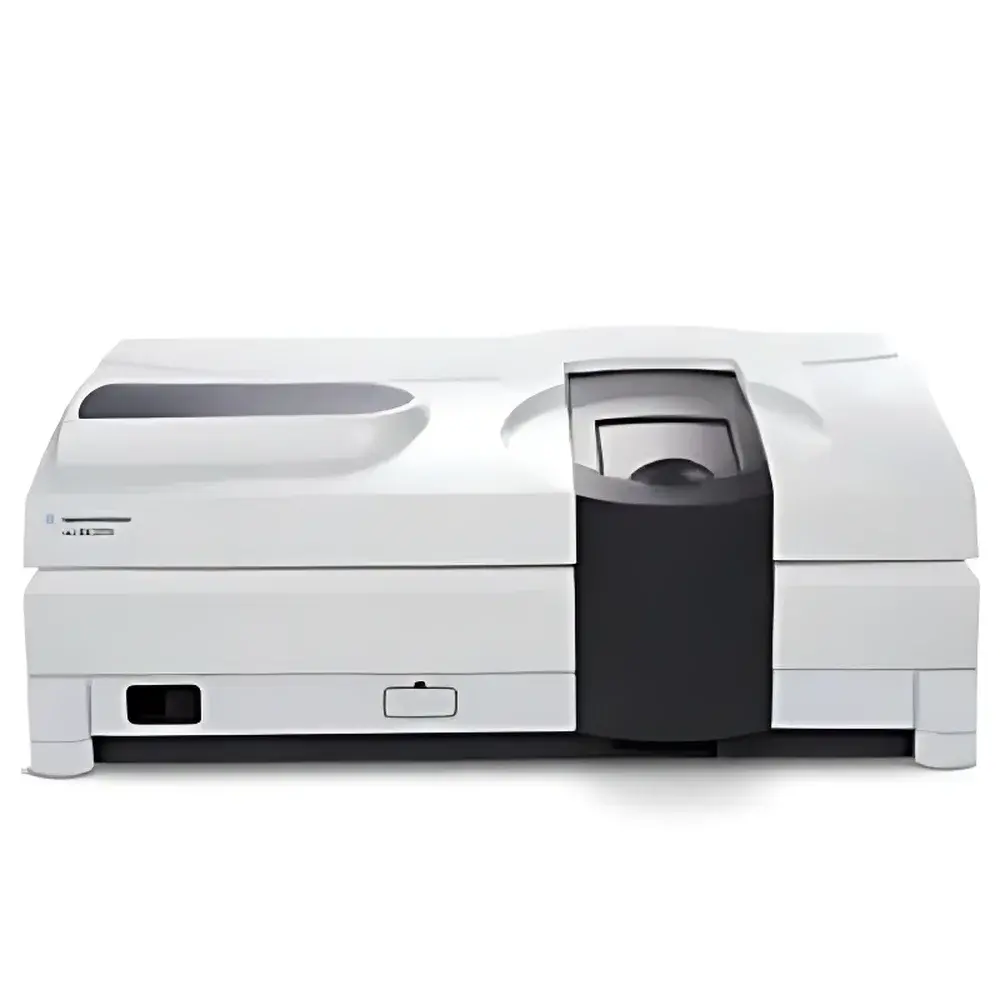
Agilent Cary 5000 UV-Vis-NIR Spectrophotometer
| Brand | Agilent Technologies |
|---|---|
| Origin | Malaysia |
| Manufacturer Type | Original Equipment Manufacturer (OEM) |
| Import Status | Imported |
| Model | Cary 5000 |
| Optical Design | Double-Beam |
| Detector Type | Photomultiplier Tube (PMT) |
| Wavelength Range | 175–3300 nm |
| Automation Level | Motorized Wavelength Scanning |
| Spectral Bandwidth | UV-Vis: 0.01–5.00 nm |
| NIR | 0.04–20 nm |
| Photometric Range | ±8.0 Abs |
| Scan Speed | UV-Vis up to 2000 nm/min |
| Dimensions (W×D×H) | 1020 × 710 × 380 mm |
| Weight | 91 kg |
| Power Supply | 100–240 VAC, 50/60 Hz |
| Purge | Dual nitrogen purge (sample chamber & monochromator) |
Overview
The Agilent Cary 5000 UV-Vis-NIR Spectrophotometer is a high-performance double-beam optical instrument engineered for quantitative and qualitative analysis across an exceptionally broad spectral range—from deep ultraviolet (175 nm) through visible light to near-infrared (3300 nm). Its measurement principle is based on Beer–Lambert law-compliant absorbance, transmittance, and reflectance spectroscopy, implemented via a dual-monochromator Littrow configuration with Schwarzchild focusing optics. This architecture delivers high photometric accuracy, low stray light (<0.00008% at 220 nm), and exceptional signal-to-noise ratio—critical for demanding applications in advanced materials characterization, pharmaceutical solid-state analysis, thin-film metrology, and nanomaterial optical property mapping. The system incorporates a dual nitrogen purge path (separate lines for sample compartment and grating monochromator housing), minimizing O₂ and H₂O vapor absorption bands in the UV and far-NIR regions. A precision-engineered cast-aluminum vibration-isolation chassis further ensures mechanical stability under laboratory conditions, supporting long-term baseline reproducibility.
Key Features
- Extended wavelength coverage from 175 nm to 3300 nm, enabled by hybrid detector architecture: PMT for UV-Vis and PbSmart InGaAs detector for NIR—optimized for sensitivity and reduced stray light in the NIR region.
- Variable spectral bandwidth (UV-Vis: 0.01–5.00 nm; NIR: 0.04–20 nm), allowing resolution optimization for narrow absorption peaks or high-throughput screening.
- Photometric linearity exceeding ±8.0 Abs, achieved via reference beam attenuation—eliminating the need for serial dilution of highly absorbing samples such as concentrated dyes, semiconductor films, or biological macromolecules.
- LockDown mechanical accessory interface: tool-free, repeatable positioning of integrating spheres, specular reflectance modules, and universal measurement accessories (UMA) within the expanded sample chamber (Z-height: 20 mm).
- Schwarzchild optical system maximizes throughput while maintaining collimation integrity—enabling accurate low-transmittance measurements (e.g., <0.01% T) without photometric drift.
- Dual-monochromator design with thermally stabilized gratings minimizes thermal wavelength drift and improves long-term calibration stability.
Sample Compatibility & Compliance
The Cary 5000 accommodates diverse sample formats—including liquid cells (up to 10 mm pathlength), solid substrates, powders (with integrating sphere), thin films, and optical coatings—via interchangeable, GLP-compliant accessories. Its modular architecture supports ASTM E275, ISO 9001, USP , and ICH Q2(R2) method validation requirements. Data acquisition and processing comply with FDA 21 CFR Part 11 when configured with audit-trail-enabled Cary WinUV software and networked user authentication. All hardware components—including the PbSmart detector assembly and nitrogen purge valves—are traceably calibrated per ISO/IEC 17025-accredited procedures at Agilent’s regional service centers.
Software & Data Management
Cary WinUV is a Windows-based, modular application platform designed for regulatory and research environments. It provides full instrument control, real-time spectral acquisition, multi-order derivative analysis, kinetic modeling, and multivariate regression (PLS, PCA). Raw data are stored in vendor-neutral .csv and .jdx formats; proprietary .spc files retain full metadata (wavelength calibration, slit width, detector gain, purge status). Built-in report templates support GLP/GMP documentation, including electronic signatures, version-controlled method storage, and automated PDF export with embedded instrument logs. Optional connectivity to Agilent OpenLab CDS enables integration into enterprise-wide QC workflows.
Applications
- Quantitative analysis of high-absorbance pharmaceutical actives (e.g., UV quantitation of doxorubicin hydrochloride at 480 nm without dilution).
- Optical bandgap determination of perovskite and quantum dot thin films via Tauc plot analysis (190–1100 nm).
- Diffuse reflectance spectroscopy (DRS) of catalysts and pigments using 60-mm integrating sphere (ASTM E308).
- Angle-resolved specular reflectance of anti-reflective coatings using UMA accessory (±10° to ±80° incidence).
- Stability-indicating assays for biologics under stressed conditions (oxidative, thermal), monitored across 200–3300 nm for aggregation and degradation signatures.
- NIR moisture and polymer crystallinity profiling in lyophilized formulations (1100–2500 nm).
FAQ
What is the maximum absorbance measurable without sample dilution?
The Cary 5000 achieves photometric linearity up to ±8.0 Abs via dynamic reference beam attenuation—enabling direct analysis of undiluted samples such as 500 ppm KMnO₄ at 555 nm.
Does the system support GMP/GLP compliance out-of-the-box?
Yes—when deployed with Cary WinUV configured for audit trail, electronic signatures, and secure user roles, it meets core requirements of 21 CFR Part 11 and Annex 11.
Can the instrument perform simultaneous UV-Vis and NIR scans without manual reconfiguration?
No—scans are segmented by detector domain (UV-Vis PMT vs. NIR PbSmart); however, automated macro sequences enable seamless multi-region acquisition with single method definition.
Is nitrogen purge required for routine UV measurements below 200 nm?
Yes—continuous N₂ purge of both the sample chamber and monochromator is mandatory for stable operation below 190 nm to suppress atmospheric O₂ absorption.
How does LockDown ensure reproducible accessory alignment?
LockDown uses hardened steel kinematic mounts and three-point mechanical registration—achieving sub-50 µm positional repeatability across >10,000 insertion cycles without recalibration.





