
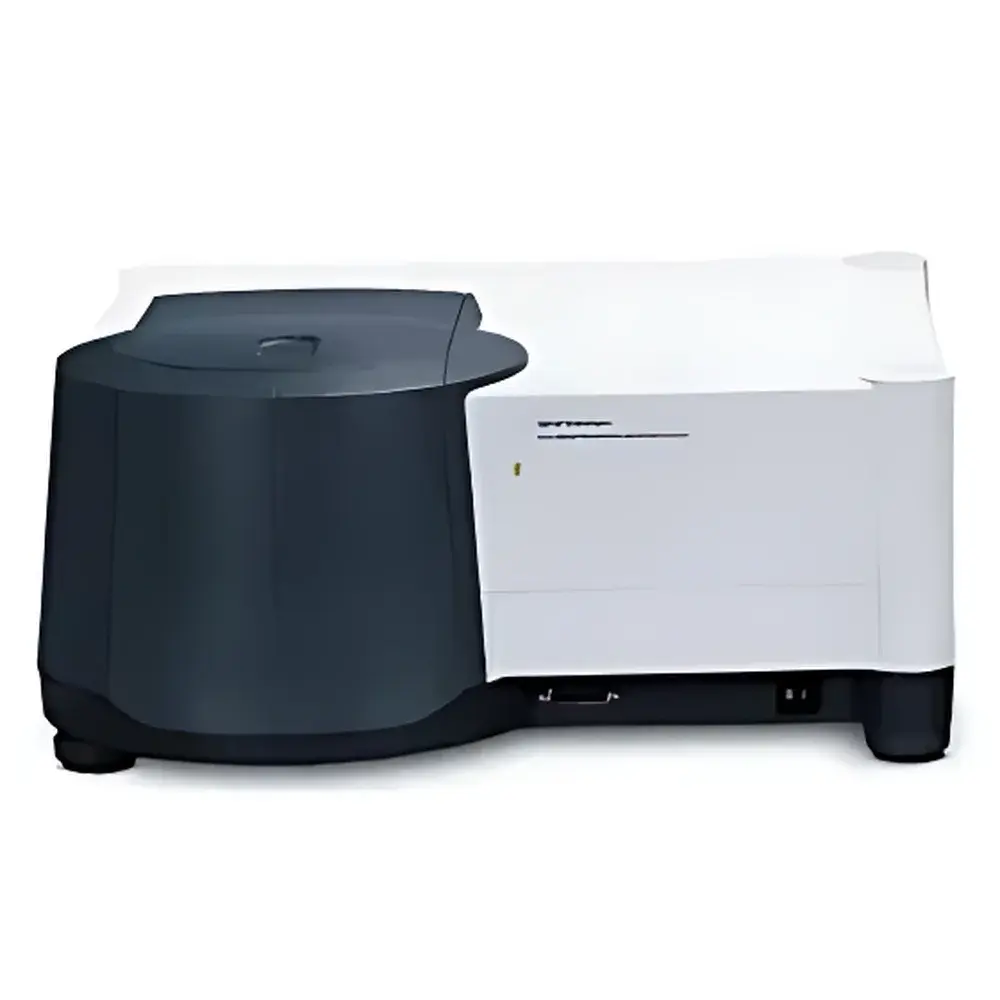
Agilent Cary Eclipse Fluorescence Spectrophotometer
| Brand | Agilent Technologies |
|---|---|
| Model | Cary Eclipse Fluorescence Spectrophotometer |
| Light Source | Pulsed Xenon Lamp |
| Wavelength Scan Speed | 24,000 nm/min |
| Data Acquisition Rate | Up to 80 points/sec (steady-state) |
| Detection Range | Extended to 900 nm |
| Detector | Red-Sensitive Photomultiplier Tube (PMT) |
| Excitation/Emission Modes | Fluorescence, Phosphorescence, Chemiluminescence/Bioluminescence, Time-Resolved Phosphorescence |
| Sample Compartment | Ambient-light-immune design (open-lid operation supported) |
| Optional Accessories | Microplate Reader (384-well), Rapid Mixing Unit, BioMelt Thermal Denaturation System |
| Minimum Sample Volume | < 0.5 mL (sub-picomolar fluorescein detection) |
Overview
The Agilent Cary Eclipse Fluorescence Spectrophotometer is a high-performance molecular fluorescence spectrometer engineered for quantitative and kinetic analysis of fluorophores across life science, pharmaceutical, and materials research laboratories. Based on double-monochromator optical architecture with interchangeable grating and filter-based dispersion units, it delivers high spectral resolution, low stray light, and exceptional signal fidelity. Its pulsed xenon lamp source enables microsecond-scale excitation pulses, supporting both steady-state and time-resolved measurements without photobleaching or thermal drift. Unlike conventional continuous-source instruments, the Cary Eclipse’s gated detection scheme and ambient-light-immune sample compartment eliminate the need for darkroom conditions—enabling open-lid operation during calibration, sample loading, or accessory integration. This architecture supports reproducible quantification from sub-picomolar concentrations (e.g., fluorescein at <0.5 mL volume) while maintaining peak position stability even at maximum scan speeds.
Key Features
- Pulsed xenon lamp with integrated UV–Vis–NIR output (190–900 nm), delivering high photon flux and extended lifetime versus deuterium/halogen alternatives
- Red-sensitive photomultiplier tube detector with thermoelectric cooling, enabling low-noise detection up to 900 nm for near-infrared fluorophores (e.g., Cy7, IRDye800)
- Four synchronized acquisition modes: fluorescence intensity, phosphorescence decay, chemiluminescence/bioluminescence kinetics, and time-resolved phosphorescence with microsecond gating
- Scan speed of 24,000 nm/min with zero spectral peak shift—validated per ASTM E275 and ISO 17025 traceable protocols
- Ambient-light-immune optical design: operational with sample compartment lid and front panel fully open, facilitating rapid method development and large-format accessory integration
- Modular software platform supporting both guided workflows for novice users and scriptable, audit-trail-enabled methods for GLP/GMP environments
Sample Compatibility & Compliance
The Cary Eclipse accommodates diverse sample formats—including cuvettes (10 mm pathlength standard), capillaries, solid films, powders, and microplates—via optional hardware modules. The 384-well microplate reader enables high-throughput screening under full spectral acquisition (excitation/emission matrix mapping). For biophysical characterization, the BioMelt thermal denaturation system integrates seamlessly, allowing real-time monitoring of protein unfolding transitions via intrinsic tryptophan fluorescence (temperature ramp rate: 0.1–5 °C/min, ±0.1 °C accuracy). All firmware and software comply with FDA 21 CFR Part 11 requirements for electronic records and signatures, including role-based access control, automated audit trails, and data integrity validation reports. Instrument performance verification follows Agilent’s IQ/OQ/PQ protocols aligned with ISO/IEC 17025 and USP guidelines.
Software & Data Management
The instrument is controlled by Agilent’s OpenLab CDS Fluorescence Edition—a validated, multi-user capable platform supporting method development, instrument qualification, and regulated data reporting. Built-in chemometric tools include synchronous scanning, 3D contour plotting, Stern–Volmer analysis, Förster resonance energy transfer (FRET) ratioing, and lifetime deconvolution using iterative reconvolution algorithms. Raw data are stored in vendor-neutral .csv and .jdx formats; metadata (instrument parameters, user ID, timestamp, calibration history) are embedded per IUPAC JCAMP-DX v6.00 standards. Data export supports direct integration with LIMS and ELN systems via secure RESTful API endpoints. Software validation packages include installation qualification (IQ), operational qualification (OQ), and performance qualification (PQ) documentation for regulated laboratories.
Applications
- Quantitative assay development for small-molecule drug candidates using intrinsic/extrinsic fluorescence
- Protein conformational stability profiling via thermal or chemical denaturation monitored by tryptophan/ANS emission shifts
- Enzyme kinetics and inhibitor screening using fluorogenic substrates (e.g., AMC, MCA derivatives)
- Nucleic acid hybridization and melting curve analysis with SYBR Green or molecular beacons
- Cellular lysate and tissue homogenate analysis without extensive purification—leveraging high signal-to-noise ratio at low volumes
- Time-resolved lanthanide chelate assays (e.g., Eu³⁺, Tb³⁺) for ultra-low-background immunoassays
FAQ
Does the Cary Eclipse support GMP-compliant data handling?
Yes—software includes full 21 CFR Part 11 compliance: electronic signatures, audit trail logging, user permission tiers, and data encryption at rest and in transit.
Can it measure phosphorescence lifetimes?
Yes—the time-resolved phosphorescence module provides adjustable gate delay (1 µs–10 s) and width settings for quantitative lifetime determination of long-lived emitters.
Is calibration traceable to NIST standards?
All wavelength and photometric calibrations are performed using Agilent-certified reference standards traceable to NIST SRM 2035 (fluorescence quantum yield) and SRM 2034 (peak wavelength).
What is the minimum detectable concentration for fluorescein?
Under standard 1-cm quartz cuvette conditions, the limit of detection is ≤50 fM fluorescein (S/N = 3), corresponding to <0.5 mL sample volume.
How does ambient-light immunity work optically?
The system employs time-gated detection synchronized to the pulsed xenon lamp, rejecting continuous background photons outside the excitation pulse window—eliminating interference from room lighting without mechanical shielding.




