
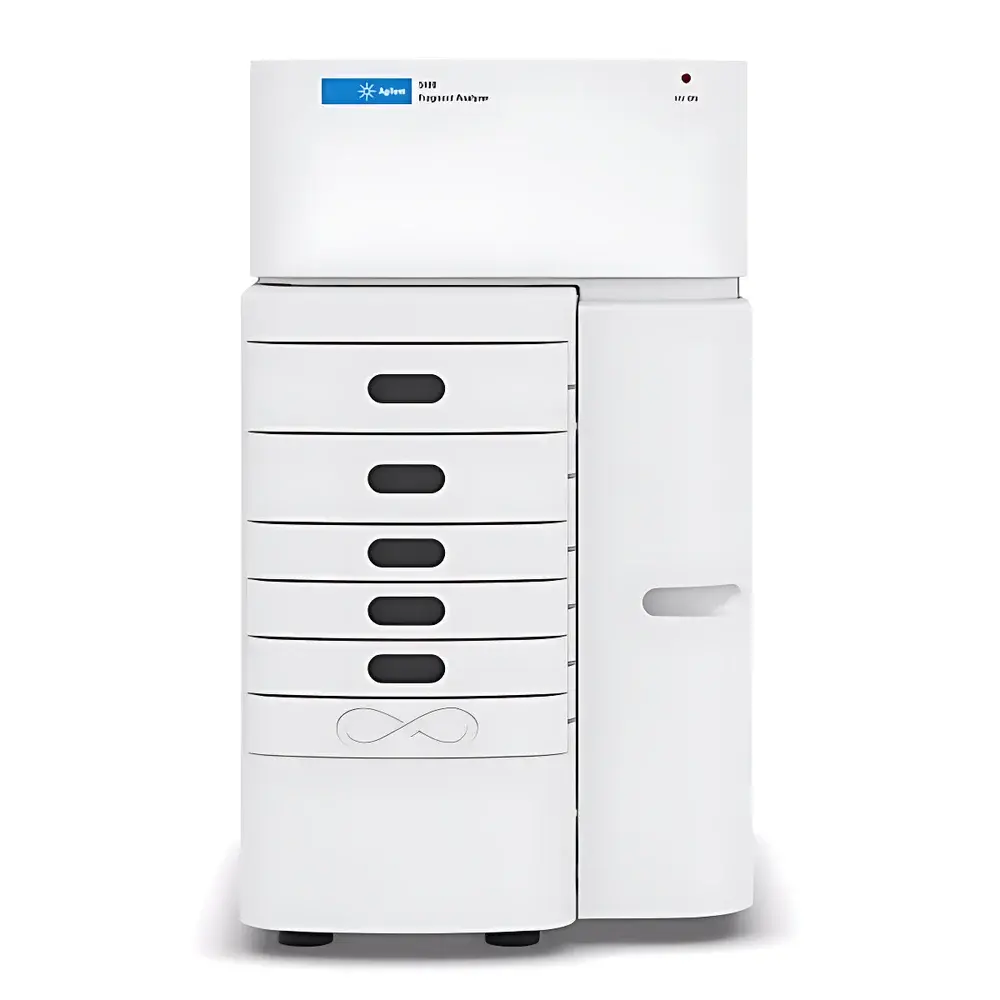
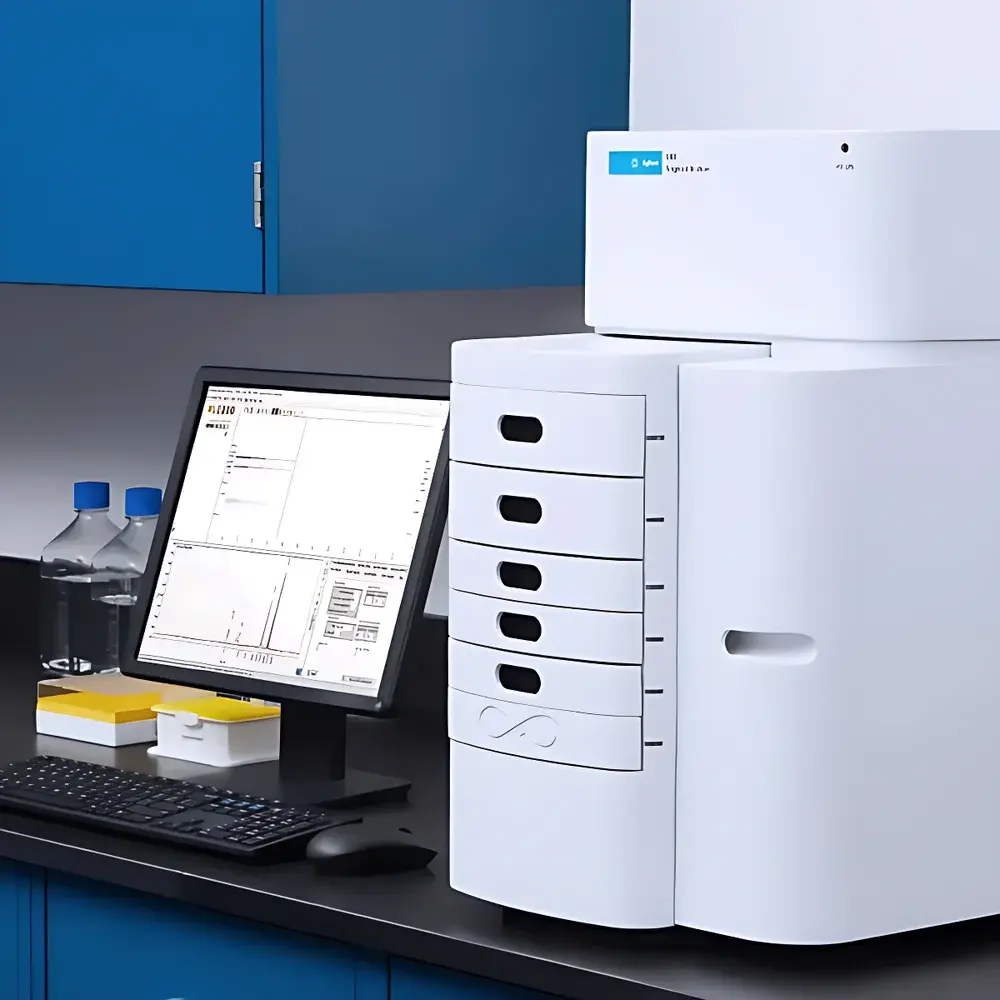
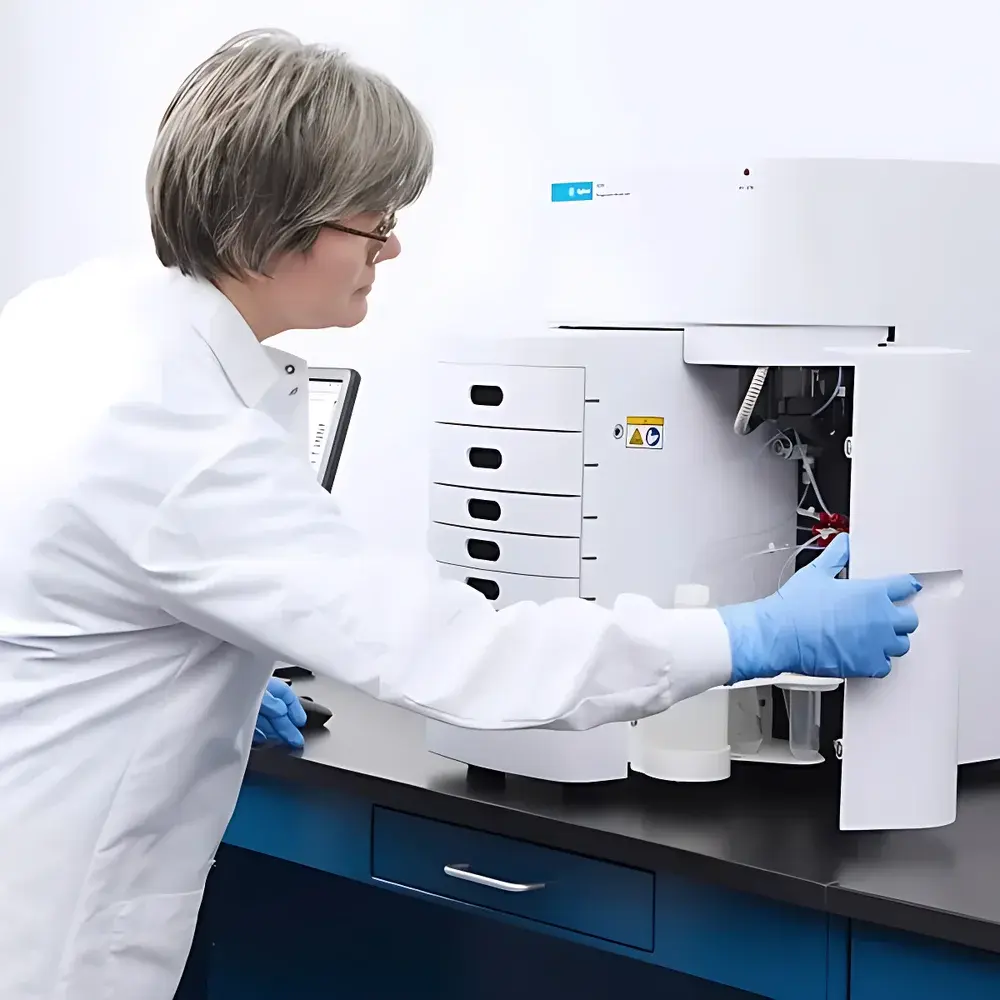
Agilent Fragment Analyzer 5400 System
| Brand | Agilent Technologies |
|---|---|
| Origin | Malaysia |
| Manufacturer Type | Original Equipment Manufacturer (OEM) |
| Import Category | Imported Instrument |
| Model | Fragment Analyzer 5400 |
| Instrument Type | Nucleic Acid Electrophoresis System |
| Sample Throughput | >2,400 samples per 24 hours |
| Voltage/Current | 100–240 VAC, 47–63 Hz |
| Dimensions (W × D × H) | 36 cm × 51 cm × 61 cm |
| Power Consumption | 150 VA |
| Operating Temperature | 19–25 °C |
| Relative Humidity | 20–80 % RH |
| Weight | 38.5 kg |
| Sample Format | 96-well plate per run |
Overview
The Agilent Fragment Analyzer 5400 System is an automated, high-throughput capillary electrophoresis platform engineered for precise nucleic acid quality control (QC) in demanding life science and biopharmaceutical laboratories. It employs parallel capillary electrophoresis—based on the principles of sieving matrix migration under controlled electric fields—to resolve DNA and RNA fragments with exceptional resolution, reproducibility, and quantitative accuracy. Unlike traditional slab-gel electrophoresis or low-resolution microfluidic systems, the 5400 leverages proprietary polymer-based separation matrices loaded into disposable capillary arrays, enabling consistent performance across thousands of runs without gel casting, staining, or destaining steps. Its architecture supports fully unattended operation for up to 24 hours, making it ideal for core facilities, NGS service labs, and GMP-compliant QC environments where throughput, traceability, and data integrity are critical.
Key Features
- Automated integration via programmable API and motorized sample drawer, compatible with major laboratory automation platforms including Hamilton STAR, Tecan Freedom EVO, and Beckman Biomek i-Series.
- High-throughput capacity: >2,400 samples per 24-hour period using standard 96-well plates—achievable with minimal operator intervention and no daily array conditioning.
- Flexible assay configuration: Supports both qualitative and quantitative applications on a single platform through interchangeable gel matrix kits—enabling seamless switching between NGS library QC, gDNA integrity assessment, total RNA profiling, small RNA analysis, and mRNA vaccine characterization.
- Resolution-optimized separation: Capable of resolving DNA fragments ≤300 bp with ≤3 bp resolution; molecular weight determination accuracy ±2–5% across validated ranges (e.g., 25–1,500 bp for DNA, 25–6,000 nt for RNA).
- Stable reagent chemistry: All separation matrices and detection dyes are formulated for room-temperature storage and extended shelf life—eliminating cold-chain logistics and reducing pre-run preparation time.
- Modular array design: Users may select capillary arrays of varying lengths (e.g., 12-cm or 33-cm) to prioritize speed (shorter arrays) or resolution (longer arrays), adapting system performance to evolving workflow requirements.
Sample Compatibility & Compliance
The Fragment Analyzer 5400 accommodates a broad spectrum of nucleic acid samples—including double-stranded DNA (dsDNA), single-stranded DNA (ssDNA), total RNA, ribosomal-depleted RNA, small RNA (miRNA, siRNA), and in vitro transcribed mRNA—without hardware modification. Each assay is validated against relevant industry standards: dsDNA fragment sizing conforms to ASTM D7929-21 for NGS library QC; RNA integrity metrics align with ISO/IEC 17025:2017 requirements for accredited testing laboratories. The system supports 21 CFR Part 11–compliant software configurations (with audit trail, electronic signatures, and role-based access control) and is qualified for GMP environments via documented IQ/OQ protocols provided by Agilent Services. All consumables—including capillary arrays, buffer cartridges, and assay-specific gel kits—are manufactured under ISO 13485-certified processes and supplied with full lot traceability.
Software & Data Management
Instrument control, data acquisition, and analysis are managed through ProSize Software v5.x—a validated, Windows-based application designed for regulated environments. ProSize automates baseline correction, peak detection, molecular weight calibration, and concentration quantitation using internal size and intensity standards included in each kit. Users define custom scoring criteria (e.g., % of fragments within target size range, presence/absence of adapter dimers, RIN-equivalent metrics for RNA) and save them as reusable templates. Reports are exportable in PDF, CSV, and XML formats; raw electropherogram files (.fda) retain full spectral and temporal metadata for retrospective reanalysis. Data security features include encrypted local storage, optional network backup integration, and configurable retention policies aligned with ALCOA+ principles (Attributable, Legible, Contemporaneous, Original, Accurate, Complete, Consistent, Enduring, Available).
Applications
- NGS library QC: Rapid sizing and quantification of Illumina, PacBio, and Oxford Nanopore libraries—including detection of adapter dimers, over-amplification artifacts, and insert size distribution.
- Genomic DNA integrity assessment: Evaluation of shearing efficiency, degradation profiles, and suitability for long-read sequencing or hybrid capture workflows.
- RNA quality control: Quantitative profiling of ribosomal RNA ratios (28S/18S), detection of degradation intermediates, and small RNA enrichment validation—critical for single-cell RNA-seq and therapeutic mRNA development.
- CRISPR editing verification: Detection of indels, HDR/NHEJ ratios, and off-target cleavage products via multiplexed amplicon analysis.
- Microsatellite (SSR) and STR genotyping: High-resolution allele calling in forensic, agricultural, and clinical diagnostics applications.
- mRNA vaccine characterization: Confirmation of full-length transcript integrity, cap structure incorporation, and poly(A) tail length distribution using specialized RNA kits.
FAQ
What regulatory standards does the Fragment Analyzer 5400 support for GMP compliance?
The system supports IQ/OQ documentation packages, 21 CFR Part 11–enabled software configurations, and audit-trail functionality required for FDA- and EMA-regulated environments.
Can the same capillary array be reused across different assay types?
No—capillary arrays are single-use, assay-specific consumables. Each kit includes matched arrays, buffers, and dyes optimized for defined size ranges and detection chemistries.
Is method transfer possible from the Fragment Analyzer 5300 to the 5400?
Yes—both platforms share identical electrophoretic principles, reagent compatibility, and ProSize software architecture, enabling straightforward protocol migration and cross-platform data comparability.
What environmental conditions are required for stable operation?
Ambient temperature must be maintained between 19–25 °C, with relative humidity of 20–80 % non-condensing; no external cooling or exhaust ventilation is required.
How is data integrity ensured during long unattended runs?
Each run generates a unique digital fingerprint (SHA-256 hash) embedded in the .fda file; all user actions, instrument events, and calibration logs are timestamped and stored in a tamper-evident audit trail.




