
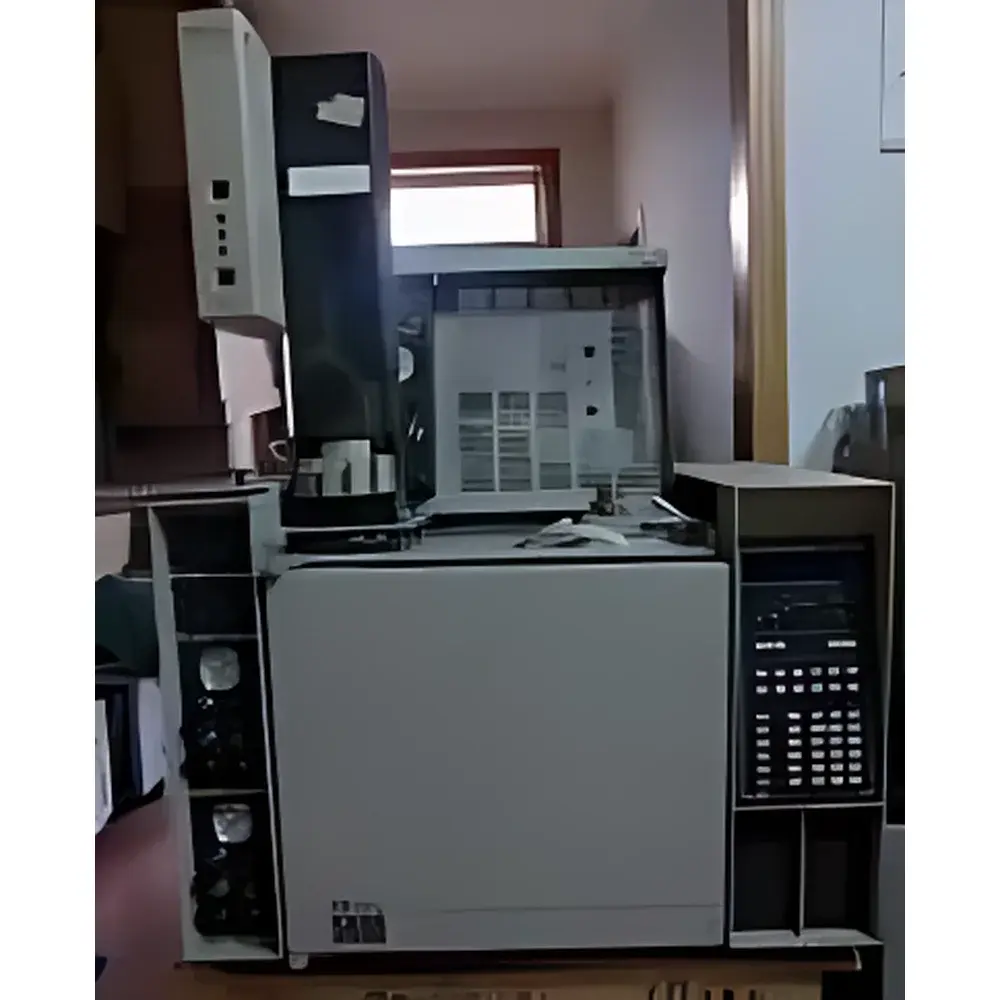
Agilent HP-5890 Series II Gas Chromatograph
| Brand | Agilent |
|---|---|
| Origin | USA |
| Model | HP-5890 Series II |
| Instrument Type | Laboratory Gas Chromatograph |
| Application Focus | Environmental Analysis |
| Detector Configuration | Dual FID (Flame Ionization Detector) |
| Injection System | Dual Capillary Inlet with Split/Splitless Mode |
| Software | Chinese-language GC Workstation |
| Column Included | One 30 m fused-silica capillary column |
| Regulatory Compliance | Designed for ASTM D1359, EPA Method 8020/8021, ISO 10378, and USP <621> applications |
| Temperature Control | Oven programmable from 35 °C to 400 °C |
| Ramp Rate | Up to 75 °C/min (typical) |
| Cool-down | Forced air cooling to ambient in <3.5 min (from 400 °C) |
| Carrier Gas Control | Electronic Pneumatic Control (EPC) for helium, hydrogen, or nitrogen |
Overview
The Agilent HP-5890 Series II Gas Chromatograph is a robust, benchtop analytical platform engineered for high-reproducibility separation and quantification of volatile and semi-volatile organic compounds in environmental matrices. Based on classical packed- and capillary-column gas chromatography principles, the system employs temperature-programmed elution coupled with flame ionization detection (FID) to deliver precise, linear response across concentration ranges typical of soil extracts, wastewater, ambient air canisters, and solid-phase microextraction (SPME) samples. Its dual-FID configuration enables simultaneous analysis of parallel sample streams or internal standard calibration workflows—critical for laboratories conducting EPA-compliant environmental monitoring under Methods 8015B, 8020B, 8260C, and 8270D. The instrument’s architecture reflects late-1990s Agilent (formerly Hewlett-Packard) engineering standards: modular oven design, analog signal processing with digital integration via RS-232 interface, and mechanical reliability validated across decades of field deployment in regulatory and contract testing labs.
Key Features
- Dual Flame Ionization Detectors (FIDs) with independent electrometer circuits and adjustable polarization voltage—optimized for trace-level hydrocarbon detection down to sub-ppb levels in aqueous and extractive matrices.
- Dual capillary inlet system supporting both split and splitless injection modes on separate channels; each inlet features independently programmable temperature control up to 400 °C and electronic pressure/flow regulation.
- Temperature-controlled oven with ±0.01 °C stability and ramp rates programmable from 0.1 to 75 °C/min; accommodates columns up to 60 m in length and 0.53 mm ID.
- Integrated electronic pneumatic control (EPC) for carrier gas (helium, hydrogen, or nitrogen), enabling reproducible retention time alignment and method transfer between instruments.
- Front-panel keypad and LCD display for standalone method setup; full operational logging via serial connection to external workstation.
Sample Compatibility & Compliance
The HP-5890 Series II is routinely deployed for analysis of priority pollutants including BTEX (benzene, toluene, ethylbenzene, xylenes), chlorinated solvents (e.g., TCE, PCE), polycyclic aromatic hydrocarbons (PAHs), organochlorine pesticides, and phthalate esters. Sample introduction supports liquid injection (via syringe or autosampler), headspace analysis (with optional heated vial tray), and thermal desorption interfaces. The system meets functional requirements for GLP-compliant environmental testing per 40 CFR Part 136, ASTM D5845–22 (determination of gasoline oxygenates), and ISO 10378:2021 (petroleum hydrocarbons in soil). While not natively 21 CFR Part 11–compliant due to its pre-digital-audit-trail architecture, it supports compliant data handling when paired with validated third-party chromatography data systems (CDS) that enforce electronic signature, audit trail, and user access controls.
Software & Data Management
The instrument operates with a dedicated Chinese-language chromatography workstation—designed for intuitive method development, peak integration, calibration curve generation (linear, quadratic, or multi-point), and report export in PDF, CSV, and XML formats. Raw data are stored as proprietary binary files (.DAT), convertible to open formats (e.g., JCAMP-DX) via Agilent ChemStation legacy utilities. The software implements baseline correction algorithms (e.g., valley-to-valley, tangent skim), retention time locking (RTL) for column aging compensation, and automatic solvent delay masking. For laboratories requiring long-term data integrity, archival procedures must follow ALCOA+ principles: attributable, legible, contemporaneous, original, accurate, complete, consistent, enduring, and available—enforced through external CDS validation and controlled backup protocols.
Applications
- Regulatory compliance testing of drinking water, groundwater, and leachate per EPA Methods 502.2, 524.2, and 8260C.
- Soil and sediment screening for petroleum hydrocarbons (TPH) and diesel-range organics (DRO) using ASTM D5369 and D7669.
- Stack emission monitoring of VOCs in industrial effluent streams under Method 18 and EN 13649–2.
- Forensic identification of ignitable liquids in fire debris per NFPA 921 and ASTM E1618.
- Quality control of environmental reference materials (e.g., NIST SRM 1648a, 2781) and certified calibration standards.
FAQ
Is the HP-5890 Series II compatible with modern LIMS or CDS platforms?
Yes—when connected via RS-232 or GPIB, it interfaces with validated chromatography data systems such as OpenLab CDS, Chromeleon, or Empower, provided appropriate driver modules and method translation protocols are implemented.
What maintenance intervals are recommended for sustained performance?
FID jet cleaning every 200 injections; column trimming every 500–1000 runs; inlet liner replacement every 100–200 injections; annual oven seal inspection and detector alignment verification.
Can this instrument support mass spectrometric detection?
No—the HP-5890 Series II lacks the vacuum interface, RF electronics, and data acquisition architecture required for GC-MS coupling; it is strictly a GC-FID platform.
Is method validation support available for EPA-compliant reporting?
Agilent provides legacy application notes (e.g., AN 124–15, AN 124–22) detailing system suitability tests, LOD/LOQ determination, and precision/recovery studies aligned with 40 CFR Part 136 Appendix B.
Related Products




