
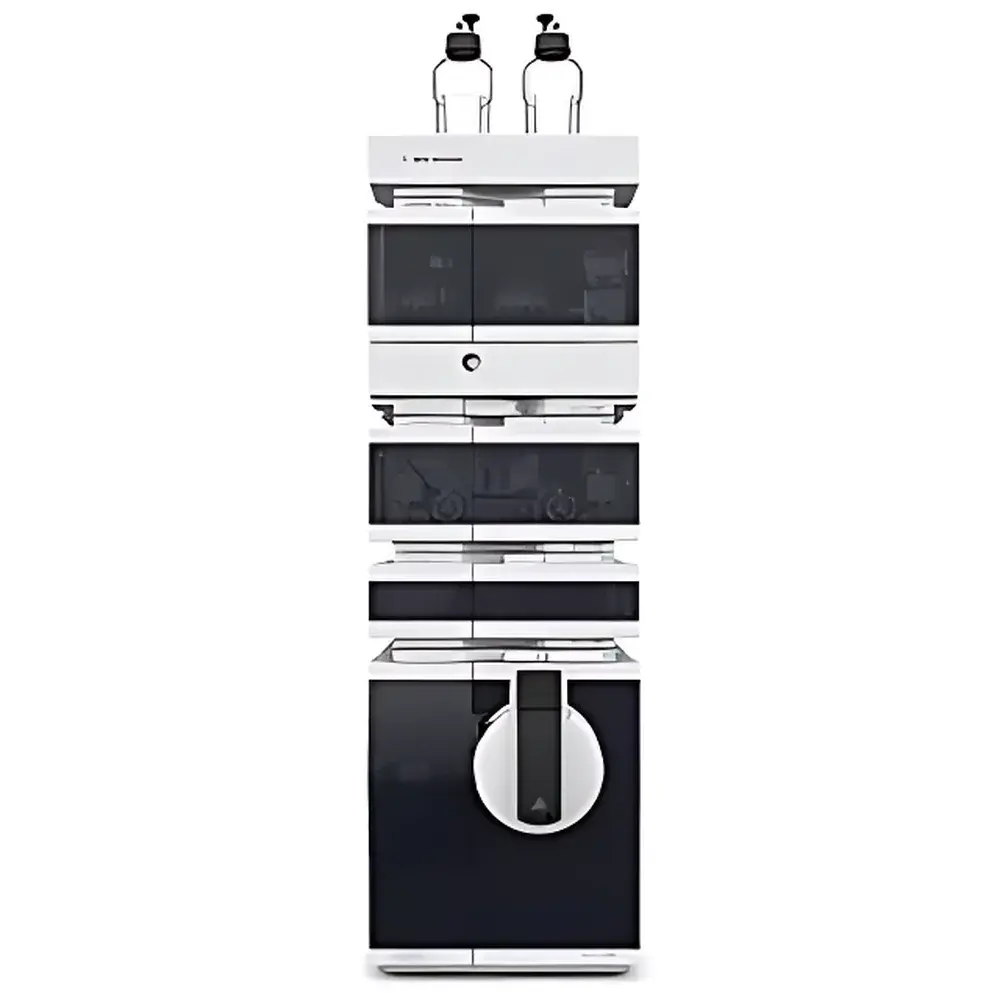
Agilent InfinityLab LC/MSD XT Single Quadrupole Liquid Chromatography Mass Spectrometry System
| Brand | Agilent Technologies |
|---|---|
| Origin | Singapore |
| Manufacturer Type | Original Equipment Manufacturer (OEM) |
| Import Status | Imported |
| Model | LC/MSD XT |
| Instrument Type | Single Quadrupole |
| Sensitivity | Sub-pg on-column detection limit (e.g., 500 fg injected for caffeine in ESI positive mode) |
| Ionization Sources | Electrospray Ionization (ESI), Atmospheric Pressure Chemical Ionization (APCI), Atmospheric Pressure Photoionization (APPI), Agilent Jet Stream (AJS) ESI/APCI, Dual-Mode Source |
| Mass Range | m/z 10–3000 |
| Scan Speed | Up to 10,000 Da/sec |
| Polarity Switching | < 200 ms |
| Software Platform | OpenLAB CDS (Chemical Workstation), compliant with FDA 21 CFR Part 11 and EU Annex 11 |
| Calibration Technology | MassWorks™ high-accuracy mass calibration (Cerno Bioscience integration) |
| Form Factor | Stackable module compatible with Agilent 1260/1290 Infinity II LC systems |
Overview
The Agilent InfinityLab LC/MSD XT is a purpose-engineered single quadrupole liquid chromatography mass spectrometry system designed for robust, high-sensitivity quantitative analysis in regulated and research environments. Operating on the principle of mass-selective detection following liquid-phase separation, the system integrates a thermally stable, radiofrequency-only quadrupole mass filter with optimized ion optics and a high-gain electron multiplier detector. Its architecture supports both electrospray ionization (ESI) and atmospheric pressure chemical ionization (APCI), with optional Agilent Jet Stream technology enabling enhanced desolvation efficiency and ion transmission—critical for achieving sub-picogram-level detection limits in complex biological matrices. The LC/MSD XT is not a standalone mass spectrometer; rather, it functions as a modular, mass-selective detector that seamlessly couples with Agilent’s InfinityLab 1260 and 1290 II UHPLC platforms, delivering chromatographic resolution at up to 1200 bar while maintaining real-time mass spectral acquisition at speeds exceeding 10,000 Da/sec.
Key Features
- Sub-pg sensitivity enabled by Agilent Jet Stream ion source technology, validated across diverse compound classes including peptides, small-molecule pharmaceuticals, and polar metabolites.
- Wide mass range (m/z 10–3000) supporting analysis of intact proteins, oligonucleotides, and synthetic polymers without fragmentation.
- Fast polarity switching (< 200 ms) for simultaneous positive/negative ion mode acquisition within a single chromatographic run—essential for multi-analyte workflows.
- Stackable mechanical design minimizing bench space footprint while preserving thermal and vibration isolation between LC and MS modules.
- Multi-ionization capability: interchangeable ESI, APCI, APPI, and dual-mode AJS sources installed without tooling or realignment.
- Mass accuracy enhancement via integrated MassWorks™ calibration algorithm (licensed from Cerno Bioscience), correcting for mass drift across wide dynamic ranges and extended acquisition periods.
Sample Compatibility & Compliance
The LC/MSD XT accommodates samples ranging from volatile organics to thermally labile biologics—including monoclonal antibodies, ADC payloads, and glycopeptides—when paired with appropriate LC conditions (e.g., shallow gradients, low-temperature column ovens, and volatile mobile phases). It complies with ISO/IEC 17025:2017 requirements for testing laboratories and supports full audit trail functionality per FDA 21 CFR Part 11 and EU GMP Annex 11 when operated under OpenLAB CDS v3.x or later. Electronic signatures, user access control, and immutable data archiving are enforced at the software layer. All firmware and driver updates undergo formal change control per ICH Q9 principles, and system suitability tests (SST) align with USP and ASTM D7594-22 guidelines for LC-MS performance verification.
Software & Data Management
OpenLAB CDS serves as the unified acquisition, processing, and reporting platform. It provides method-controlled acquisition with real-time peak tracking, automatic integration of extracted ion chromatograms (XIC), and library-based compound identification using NIST/EPA/NIH mass spectral databases. All raw data files (.d format) are stored in vendor-neutral, time-stamped directories with SHA-256 checksum validation. Audit trails record every parameter modification, integration event, and report generation—including operator ID, timestamp, and reason-for-change. Data export supports CSV, XML, and mzML formats for third-party statistical tools (e.g., SIMCA, R packages). Secure remote monitoring is available via TLS 1.2-encrypted web interface, compatible with enterprise Active Directory authentication.
Applications
The LC/MSD XT is routinely deployed in pharmaceutical quality control (QC) for assay validation, impurity profiling, and stability-indicating methods per ICH Q2(R2); in environmental labs for pesticide residue screening (EPA Method 1694); in food safety for mycotoxin quantification (AOAC 2012.01); and in academic proteomics for targeted peptide quantitation (SRM/MRM-ready with manual method optimization). Its speed and sensitivity make it particularly suitable for high-throughput bioanalysis—such as PK/PD studies requiring >500 samples/day—and for method development where rapid LC gradient scouting and immediate mass confirmation reduce cycle time by >40% versus UV-only detection.
FAQ
Is the LC/MSD XT compliant with 21 CFR Part 11 for electronic records and signatures?
Yes. When configured with OpenLAB CDS v3.4 or later and deployed under validated IT infrastructure, the system meets all technical and procedural requirements—including role-based access, audit trail retention, electronic signature enforcement, and data integrity controls.
Can the LC/MSD XT perform tandem MS experiments?
No. As a single quadrupole instrument, it does not support collision-induced dissociation (CID) or multiple reaction monitoring (MRM). For MS/MS capability, Agilent recommends the 6470 or 6495 triple quadrupole systems.
What maintenance intervals are recommended for the ion source and vacuum system?
Ion source cleaning is advised every 2–4 weeks depending on sample matrix complexity; turbomolecular pump oil replacement is scheduled annually, with vacuum gauge calibration verified quarterly per Agilent Service Bulletin SB-LCMSD-2023-01.
Does the system support untargeted data-dependent acquisition (DDA)?
No. The LC/MSD XT operates exclusively in full-scan, selected ion monitoring (SIM), or profile/SIM hybrid modes. Untargeted workflows require time-of-flight (TOF) or high-resolution accurate-mass (HRAM) platforms such as the Agilent 6545 or 6550 Q-TOF.
Is method transfer possible from legacy Agilent MSD systems?
Yes. OpenLAB CDS includes backward-compatible method import tools for 1100/1200 MSD and G1969A configurations, with automated parameter mapping for scan range, dwell time, and source settings.
Related Products






