
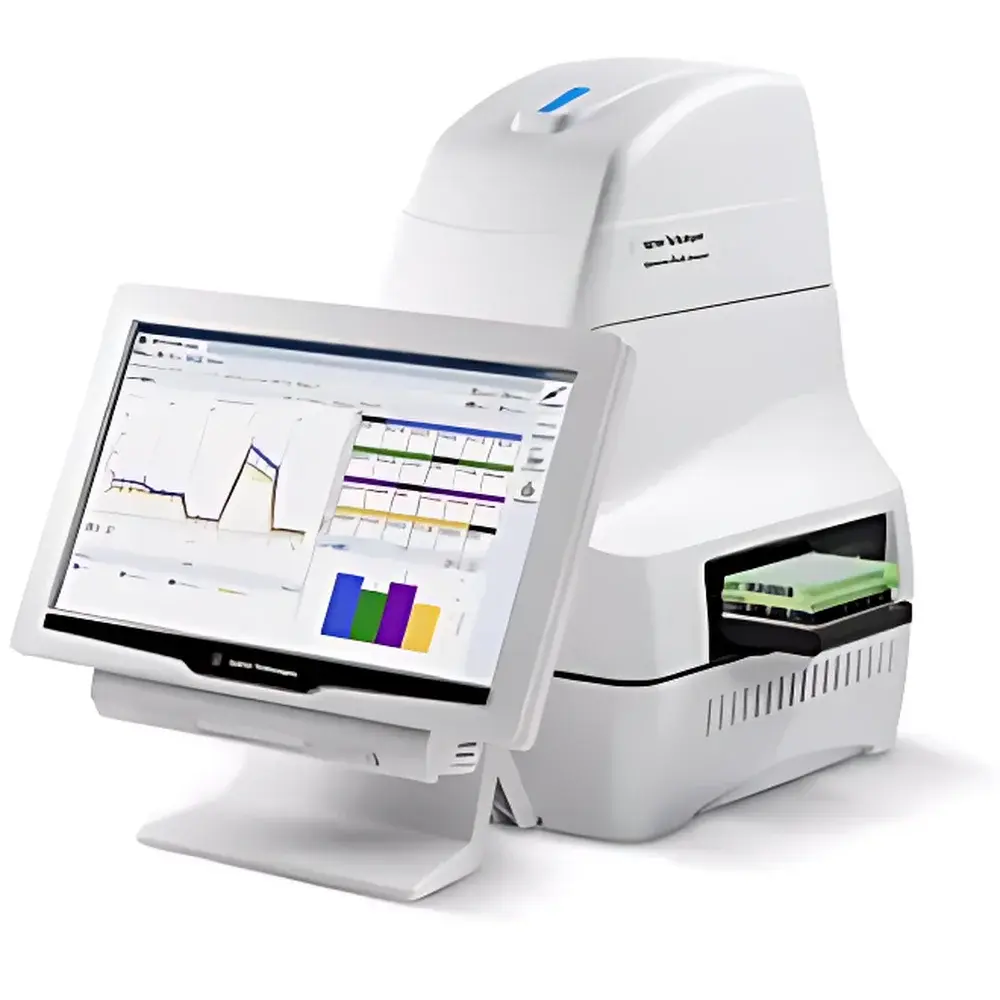
Agilent Seahorse XFe24 Extracellular Flux Analyzer
| Brand | Agilent Technologies |
|---|---|
| Origin | USA |
| Manufacturer Type | Original Equipment Manufacturer (OEM) |
| Product Origin | Imported |
| Model | Seahorse XFe24 |
| Pricing | Available Upon Request |
Overview
The Agilent Seahorse XFe24 Extracellular Flux Analyzer is a label-free, real-time live-cell metabolic phenotyping platform engineered for quantitative measurement of mitochondrial respiration and glycolytic function in adherent and suspension cells. It operates on the principle of extracellular flux (XF) analysis—detecting dynamic changes in dissolved oxygen concentration (O2) and extracellular acidification rate (ECAR), which serves as a proxy for proton efflux linked to lactic acid production. These parameters—oxygen consumption rate (OCR) and ECAR—are measured simultaneously in each well of a specialized 24-well XF microplate using solid-state fluorescent biosensors embedded in a disposable sensor cartridge. During assay execution, the instrument forms transient microchambers (~7 µL for standard plates; ~28 µL for islet plates) above the cell monolayer or 3D sample by lowering the probe plate, enabling high-sensitivity kinetic sampling without perturbing cellular physiology. Each measurement cycle includes a 3-minute equilibration followed by a 3-minute sensing period, with automatic probe lift-and-mix sequences between injections to restore baseline conditions and ensure reproducible compound delivery.
Key Features
- 24-well parallel assay format optimized for medium-throughput metabolic profiling of primary cells, immortalized lines, organoids, and small model organisms (e.g., zebrafish larvae, pancreatic islets)
- Integrated four-injection port system with programmable mixing—enables sequential, timed delivery of substrates, inhibitors, or modulators (e.g., oligomycin, FCCP, rotenone/antimycin A) to interrogate bioenergetic flexibility and reserve capacity
- High-precision thermal control: maintains sample temperature between 16–42 °C while operating in ambient environments from 4–30 °C, ensuring physiological relevance across diverse experimental models
- Low-cell-number compatibility: robust OCR and ECAR detection from as few as 10,000 cells per well—ideal for rare primary isolates and miniaturized culture systems
- Dedicated XF microplates with optimized surface chemistry and geometry to maximize sensor proximity, minimize diffusion delay, and support both 2D monolayers and 3D spheroid/islet cultures
- Self-contained controller workstation featuring Windows 10 Enterprise OS, 16 GB RAM, integrated touchscreen interface, and native support for full experimental design, real-time monitoring, and onboard data visualization
Sample Compatibility & Compliance
The XFe24 supports a broad range of biologically relevant samples including human and murine immune cells (T cells, macrophages, dendritic cells), cancer cell lines, stem cell-derived cardiomyocytes, neuronal cultures, and intact microtissues. Its non-invasive, label-free methodology eliminates artifacts associated with genetic reporters or fluorescent dyes, aligning with GLP-compliant workflows where endogenous functional readouts are required. The system’s data acquisition architecture complies with FDA 21 CFR Part 11 requirements when used with Wave Desktop software configured for audit trail logging, electronic signatures, and secure user access controls. All assay protocols adhere to widely accepted metabolic phenotyping standards referenced in peer-reviewed literature (e.g., Nature Protocols, Cell Metabolism) and are compatible with ISO/IEC 17025-accredited laboratory quality management systems.
Software & Data Management
Data acquisition and analysis are managed via Agilent’s Wave software suite—comprising Wave Controller (instrument control) and Wave Desktop (post-acquisition analysis). Wave Desktop provides unlimited license use, automated rate calculation (OCR, ECAR, ATP-linked respiration, proton leak, maximal respiration, glycolytic capacity), and customizable normalization options (per protein, DNA, or cell count). Export formats include CSV, Excel, and HDF5 for integration into third-party statistical platforms (R, Python/Pandas, GraphPad Prism). Raw time-course traces, injection timing markers, and metadata (temperature, humidity, calibration logs) are stored in structured, timestamped files supporting traceability and reanalysis. Cloud-based Seahorse Analytics offers optional web-accessible tools for collaborative data review, batch comparison, and machine learning–enabled clustering of metabolic profiles.
Applications
The XFe24 enables functional interrogation of bioenergetic pathways in disease modeling, drug discovery, and basic cell biology. In immunometabolism research, it quantifies metabolic shifts during T-cell activation, macrophage polarization (M1/M2), and memory differentiation—providing mechanistic insight into checkpoint inhibitor responses and adoptive cell therapy efficacy. In oncology, it characterizes the Warburg effect, identifies metabolic vulnerabilities in treatment-resistant tumors, and evaluates synergy between metabolic inhibitors and targeted therapies. In metabolic disease studies, it assesses mitochondrial dysfunction in diabetic islets, fatty acid oxidation defects in hepatocytes, and substrate utilization flexibility in skeletal myotubes. Its compatibility with CRISPR-edited isogenic lines further supports causal inference between genetic perturbations and energetic phenotypes.
FAQ
What types of biological samples are compatible with the XFe24 platform?
Primary cells, immortalized cell lines, 3D spheroids, pancreatic islets, zebrafish embryos/larvae, and dissociated tissue explants—all cultured in standard XF microplates.
Does the system require fluorescent labeling or genetic modification?
No. The XFe24 uses label-free, solid-state optical sensors to detect extracellular O2 and pH changes—preserving native cell state and eliminating dye toxicity or transfection artifacts.
How is data integrity ensured during long-duration assays?
Real-time environmental monitoring (temperature, humidity), automatic sensor calibration prior to each run, and built-in drift correction algorithms maintain measurement fidelity over multi-hour kinetic experiments.
Can assay data be exported for regulatory submission?
Yes. When configured with audit-trail-enabled Wave Desktop and validated instrument settings, raw and processed data meet documentation requirements for IND-enabling studies and preclinical regulatory packages.
Is technical support available for protocol optimization?
Agilent provides application scientists with expertise in immunometabolism, cancer metabolism, and mitochondrial physiology—offering remote assay consultation, troubleshooting, and customized protocol development.




