
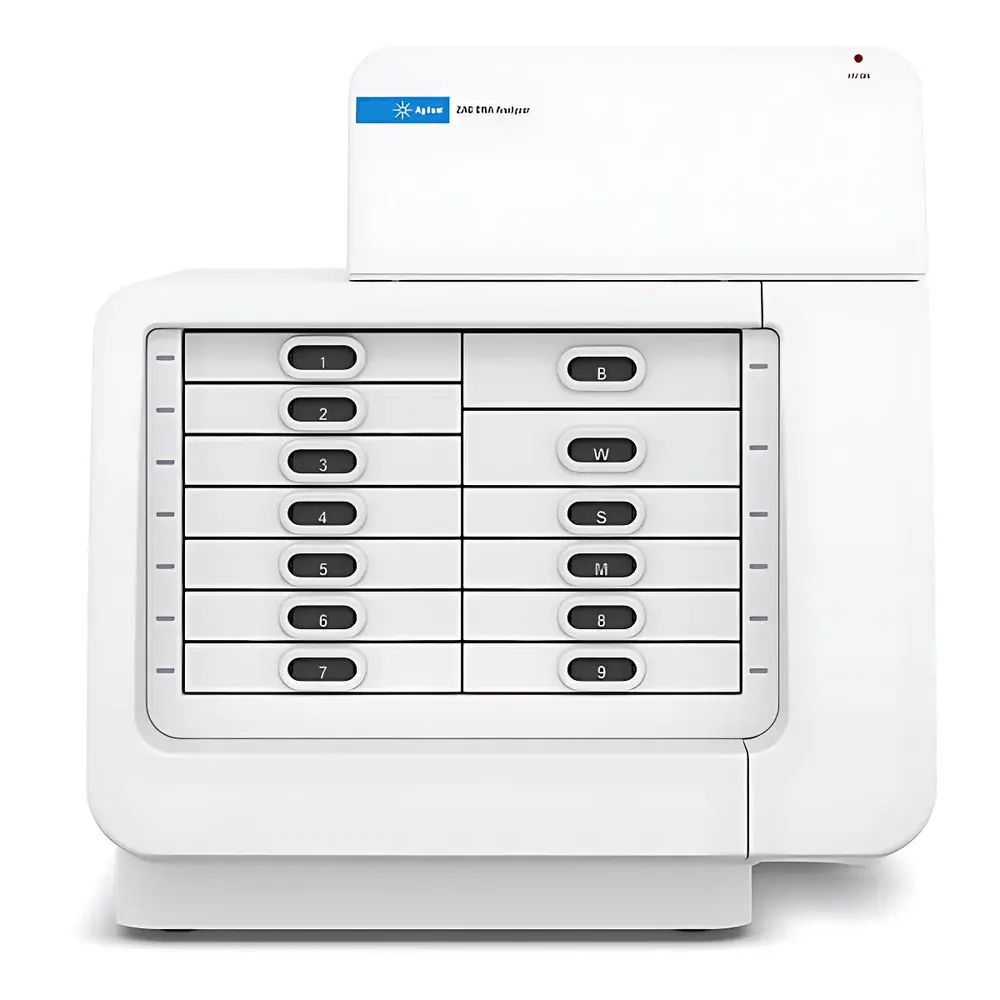
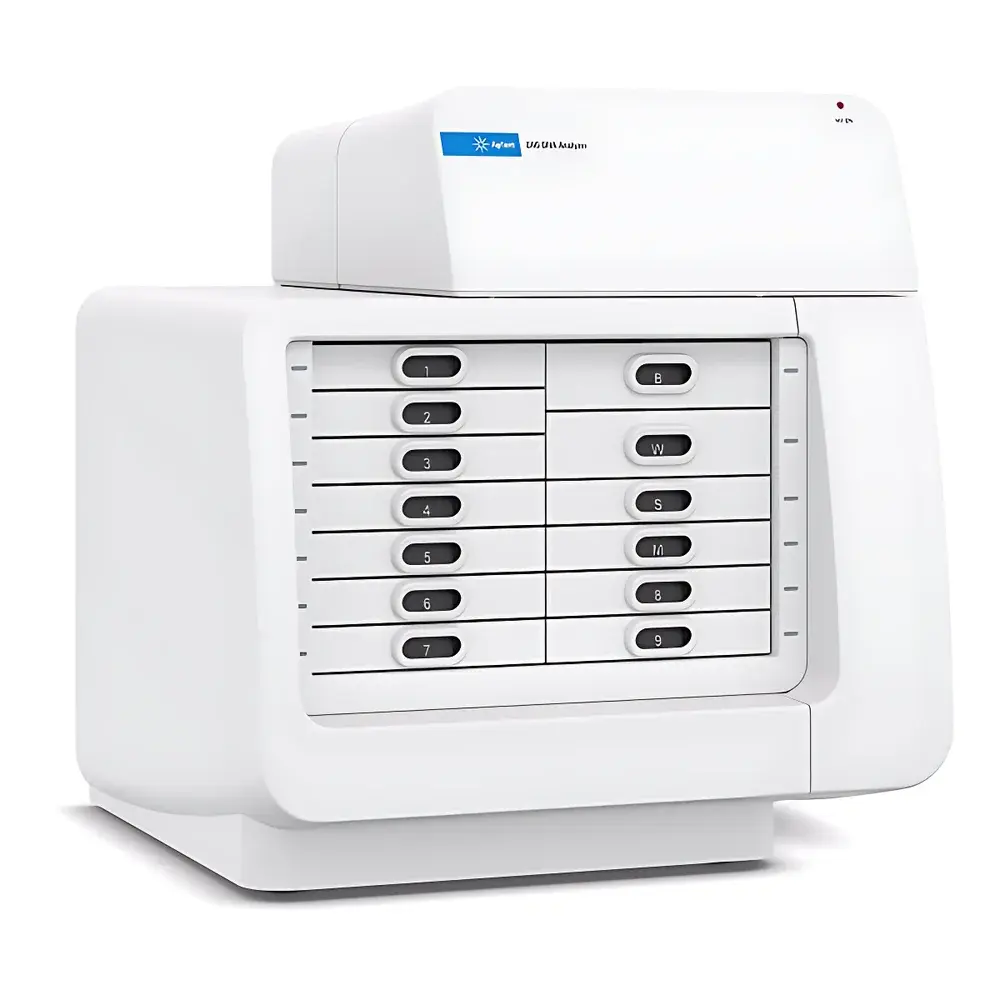
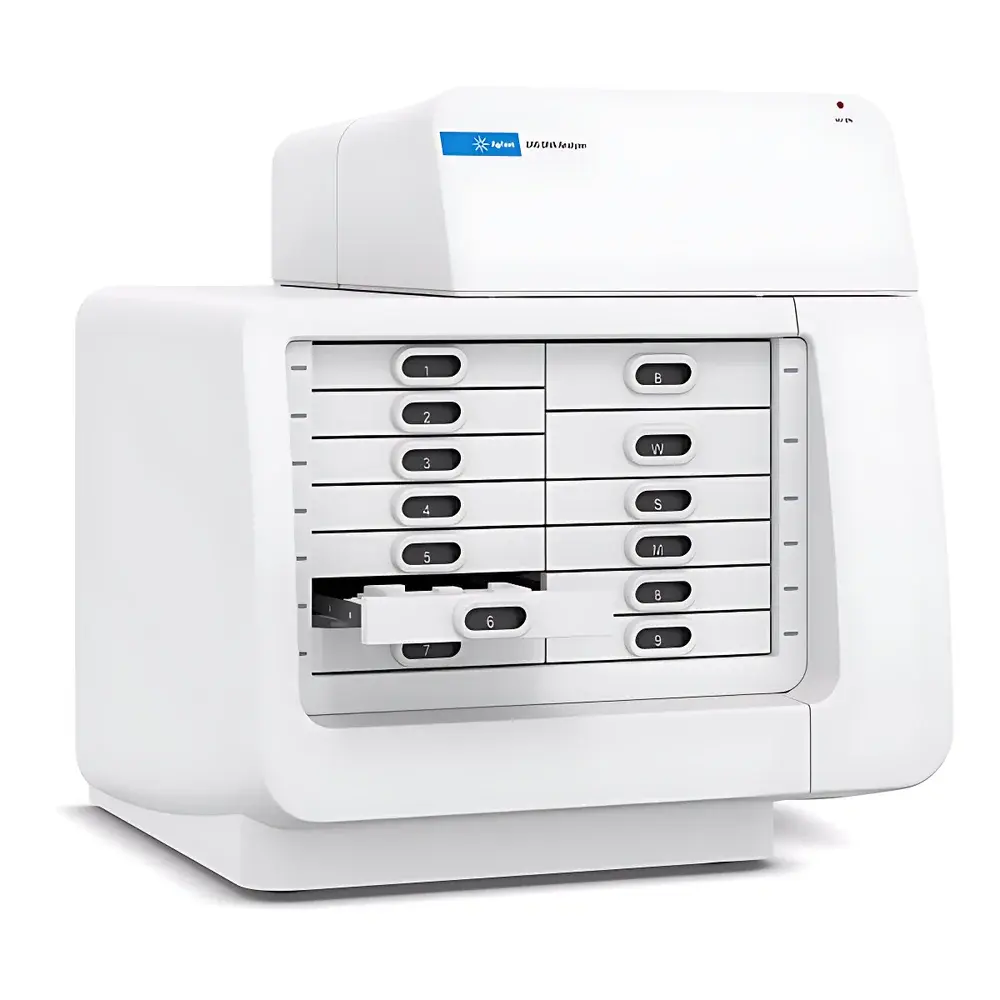
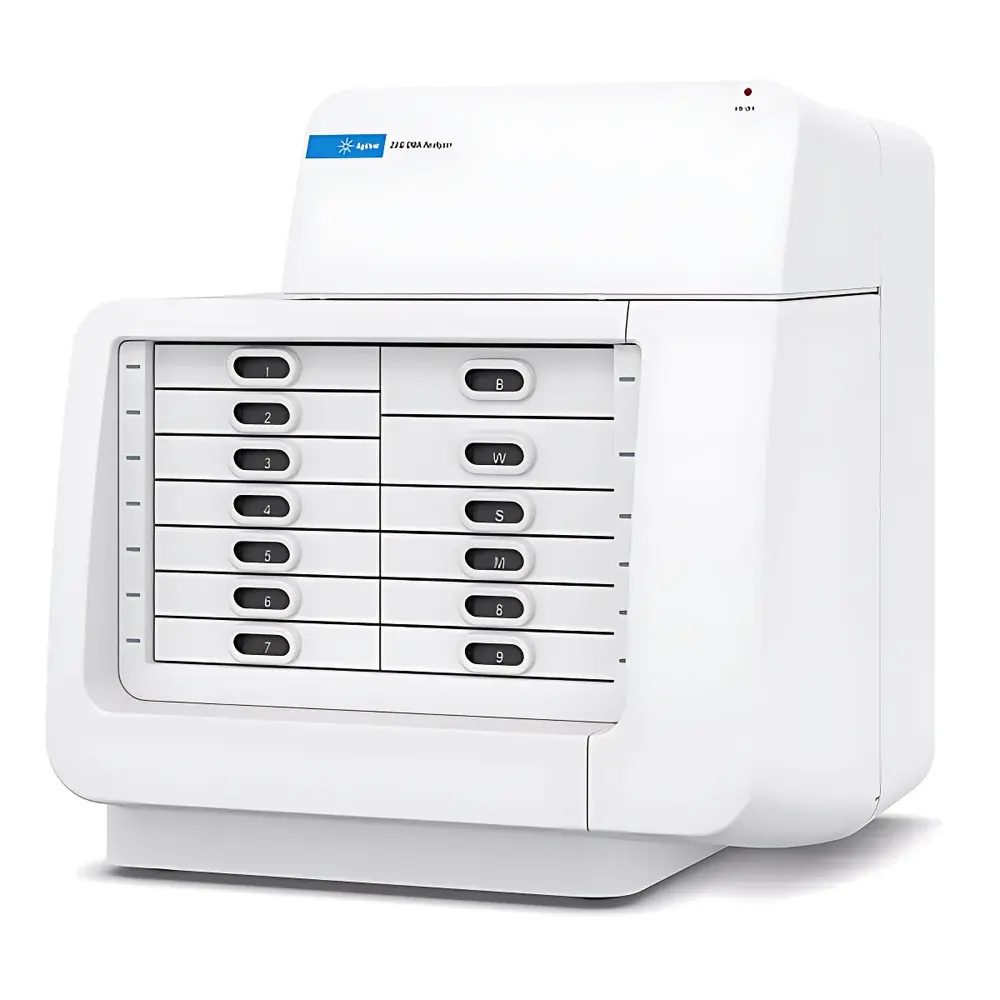
Agilent ZAG DNA Analyzer
| Brand | Agilent Technologies |
|---|---|
| Origin | Malaysia |
| Manufacturer Type | Original Equipment Manufacturer (OEM) |
| Import Status | Imported |
| Model | ZAG |
| Instrument Type | Capillary Electrophoresis System |
| Sample Application | Organic Analysis (DNA Fragment Analysis) |
| Voltage | 100–240 VAC, 47–63 Hz |
| Power Consumption | 150 VA |
| Operating Temperature | 19–25 °C |
| Relative Humidity | 20–80 % |
| Dimensions (W × D × H) | 61 cm × 59 cm × 67 cm |
| Weight | 68 kg |
| Throughput | Up to 96 samples per run, 48 × 96-well plates per 24 h |
| Separation Time | ≤20 min per 96-well plate |
| Resolution | Reliable separation of DNA fragments differing by ≥3 bp |
| Molecular Weight Range | 35 bp – 20,000 bp (dependent on selected DNA analysis kit) |
| Software | Integrated electropherogram analysis with automated sizing, binning, and reporting |
| Kit Compatibility | Qualitative DNA analysis kits (e.g., fragment analysis, microsatellite, PCR product sizing) |
Overview
The Agilent ZAG DNA Analyzer is a fully automated capillary electrophoresis (CE) system engineered for high-throughput, high-resolution DNA fragment analysis in molecular biology, clinical diagnostics, and genetic research laboratories. It employs parallel capillary array electrophoresis—utilizing multiple fused-silica capillaries under controlled electric field conditions—to separate DNA fragments based on size-to-charge ratio in polymer-based sieving matrices. Unlike traditional slab-gel electrophoresis, the ZAG system eliminates manual gel pouring, staining, imaging, and band quantification steps, replacing them with integrated sample loading, electrokinetic or pressure-assisted injection, real-time UV detection, and digital data capture. Its design targets throughput bottlenecks in routine genotyping, PCR product verification, STR (short tandem repeat) profiling, and microsatellite instability (MSI) assays—enabling reproducible, traceable, and audit-ready results compliant with GLP and ISO/IEC 17025 frameworks.
Key Features
- Parallel CE architecture with 96-capillary array for true high-throughput operation—supports up to 48 full 96-well plates (4,608 samples) in a single 24-hour cycle.
- High-resolution DNA sizing: capable of resolving fragments differing by as little as 3 base pairs across the full dynamic range (35–20,000 bp), validated using industry-standard DNA ladders and internal size standards.
- Automated workflow integration: includes robotic liquid handling for unattended sample and reagent dispensing, capillary conditioning, and post-run cleaning—minimizing hands-on time and inter-operator variability.
- Thermally regulated capillary cartridge housing ensures consistent electroosmotic flow and migration time stability (RSD < 1.5% for fragment sizing across runs).
- UV-LED detection at 260 nm with adjustable gain and sampling rate, optimized for low-volume, low-concentration DNA samples without intercalating dyes.
- Modular hardware design allows field-upgradable components—including detector modules, high-voltage power supplies, and cartridge adapters—for future assay expansion.
Sample Compatibility & Compliance
The ZAG DNA Analyzer accommodates standard 96-well and 384-well microplates loaded with PCR-amplified, restriction-digested, or ligated DNA samples. It supports both dye-labeled and unlabeled DNA analysis when used with compatible Agilent DNA analysis kits (e.g., Fragment Analyzer Reagents, Microsatellite Analysis Kits). All consumables—including capillary arrays, polymer sieving matrices, and buffer solutions—are manufactured under ISO 13485-certified processes and supplied with lot-specific QC documentation. The system meets electromagnetic compatibility (EMC) requirements per IEC 61326-1 and electrical safety standards per IEC 61010-1. For regulated environments, it supports 21 CFR Part 11-compliant user authentication, electronic signatures, and audit trail generation via optional software licensing.
Software & Data Management
The ZAG system operates with Agilent’s proprietary ProSize™ Analysis Software v5.x, a Windows-based application designed for CE data acquisition, visualization, and interpretation. Key capabilities include automated peak detection, mobility calibration using internal standards, fragment sizing with ±0.5 bp accuracy (within validated range), allele binning for STR analysis, and customizable report templates (PDF, CSV, Excel). Raw electropherogram files (.fsa, .chg) are stored with full metadata—including instrument parameters, run history, reagent lot numbers, and operator ID—ensuring full traceability. Data backups, version-controlled method files, and role-based access control align with laboratory information management system (LIMS) integration requirements and support FDA audit readiness.
Applications
- PCR product verification and quality control in NGS library preparation workflows.
- Microsatellite (STR) analysis for forensic identification, plant/animal genotyping, and cancer biomarker screening (e.g., MSI testing in colorectal tumors).
- Plasmid and vector integrity assessment during bioprocess development.
- CRISPR editing efficiency validation via fragment deletion/insertion detection.
- Quality control of synthetic oligonucleotides and gene fragments in contract research organizations (CROs) and core sequencing facilities.
- Regulatory submissions requiring documented, repeatable DNA sizing data (e.g., USP , CLSI MM19-A3).
FAQ
What types of DNA samples are compatible with the ZAG system?
Genomic DNA, PCR amplicons, restriction digests, and enzymatically labeled fragments—provided they are purified, free of salts and proteins, and resuspended in low-ionic-strength buffers (e.g., TE or water).
Does the ZAG support multiplexed fluorescent detection?
No—the ZAG is optimized for UV absorbance detection at 260 nm and does not incorporate laser-induced fluorescence (LIF) optics. Fluorescent labeling requires downstream imaging or alternative platforms.
Can the system be integrated into an existing LIMS environment?
Yes—via standardized ODBC and HL7 interfaces; raw data export formats (FSA, CSV) and structured metadata enable seamless ingestion into enterprise-grade LIMS and ELN systems.
Is routine maintenance required between runs?
Capillary flushing and conditioning are fully automated per run protocol; annual preventive maintenance (PM) by Agilent Field Service Engineers is recommended to ensure long-term voltage stability and detector linearity.
How is data integrity ensured during extended unattended operation?
Each run generates a unique digital fingerprint including timestamp, environmental logs (temperature/humidity), HV calibration status, and checksum-verified raw data files—all retained with immutable audit trails.
Related Products





