
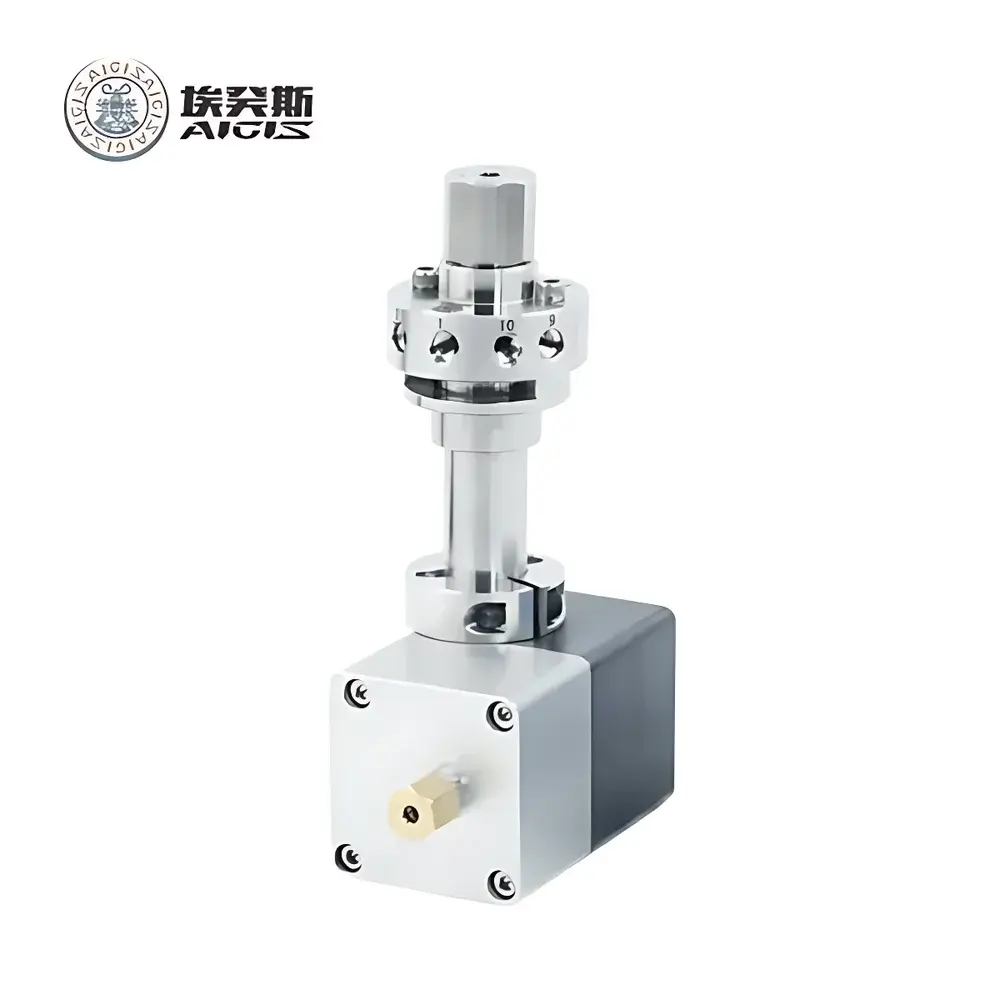
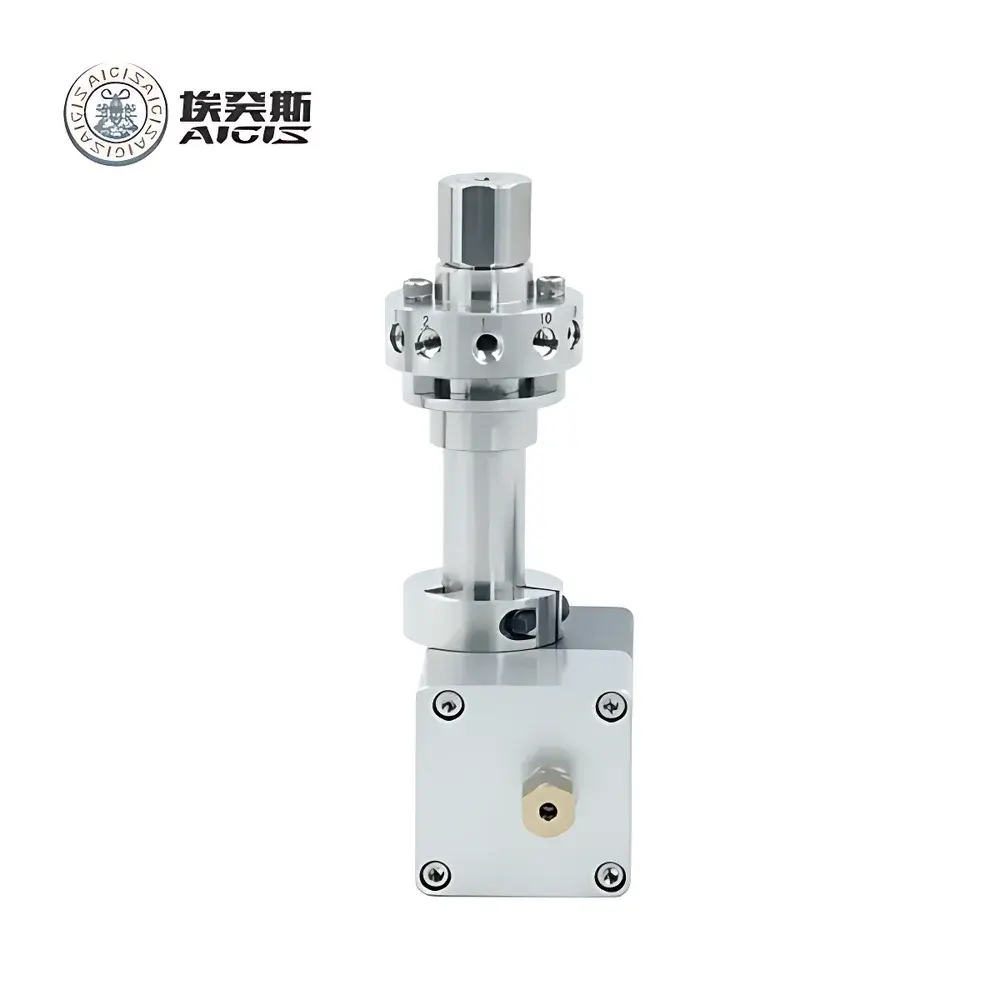
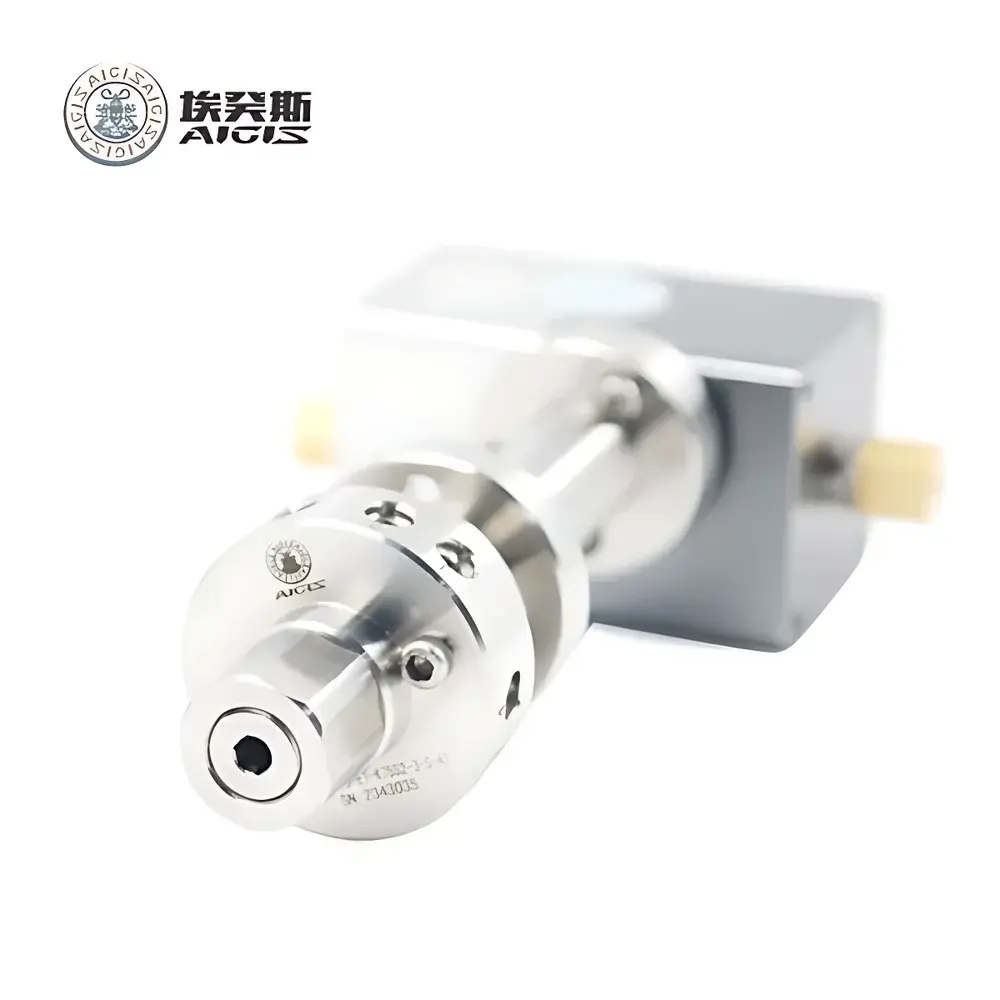
AGS-GAG06-ET-K10S1-2-S-Q1A 6-Channel Gas Chromatography Sample Injection Selector Valve Assembly
| Brand | AIGIS |
|---|---|
| Origin | Fujian, China |
| Manufacturer Type | OEM/ODM Producer |
| Valve Body Material | SUS316L / Alloy N60 / Hastelloy C / Hastelloy B |
| Rotor Material | PEEK |
| Max. Pressure (Gas) | 0.7 MPa |
| Max. Pressure (Liquid) | 3 MPa |
| Max. Operating Temperature | 250 °C |
| Flow Path Bore | 0.4 mm / 0.75 mm |
| Port Thread | 10-32 UNF Internal |
| Actuation | Electric (24 VDC / 2.5 A) or Pneumatic |
| Communication Interfaces | RS232, RS485, Digital I/O |
| Extended Stem Options | 2", 3", 4" |
Overview
The AGS-GAG06-ET-K10S1-2-S-Q1A is a precision-engineered 6-channel sample injection selector valve assembly designed for integration into gas chromatography (GC) systems requiring automated, high-integrity sample routing. Based on rotary valve architecture with a fixed stator and rotating PEEK rotor, it enables deterministic, low-dead-volume switching between up to six independent sample or standard gas/liquid streams. Its operation adheres to fundamental principles of flow path isolation and pressure-tight sealing under dynamic actuation—critical for maintaining chromatographic fidelity, minimizing carryover, and ensuring retention time reproducibility across sequential injections. The valve is optimized for use in regulated analytical environments where consistent dwell time, minimal peak dispersion, and thermal stability are prerequisites for method robustness—particularly in environmental monitoring, petrochemical QA/QC, and industrial process gas analysis.
Key Features
- Modular 6-port configuration with selectable bore diameters (0.4 mm or 0.75 mm) to balance flow resistance and sample volume requirements across GC inlet types (split/splitless, PTV, cold-on-column)
- Corrosion-resistant valve body options including electropolished SUS316L, nickel-based Alloy N60, and duplex Hastelloy C-276 and Hastelloy B-2—validated for aggressive media such as H2S, Cl2, HF, and high-sulfur hydrocarbon streams
- PEEK rotor engineered for dimensional stability at elevated temperatures (up to 250 °C), low extractables, and compatibility with both organic solvents and compressed gases
- Dual-actuation capability: electrically driven via 24 VDC/2.5 A stepper motor with position feedback, or pneumatically actuated using clean, oil-free instrument air (optional solenoid manifold interface)
- Extended stem variants (2″, 3″, 4″) accommodate thermal insulation sleeves and facilitate integration into heated oven compartments without compromising mechanical alignment or seal integrity
- Hermetic sealing performance verified per ISO 5208 Class C leakage rate (<1 × 10⁻⁶ mbar·L/s He) at maximum rated pressure and temperature
Sample Compatibility & Compliance
The valve supports both gaseous and liquid-phase samples within its specified pressure and temperature envelope. It is compatible with common GC carrier gases (He, H2, N2), calibration standards (ppb–% v/v), and solvent-diluted liquid standards (e.g., EPA Method 8260B analytes). Materials of construction conform to ASTM F899 (stainless steel) and ASTM D4571 (polymer compatibility), and the design incorporates features supporting GLP/GMP traceability—including hardware-level position verification and non-volatile memory for cycle count logging. While not certified to IEC 61508 or SIL standards out-of-the-box, the valve’s fail-safe positioning logic (default “home” port on power loss) and configurable I/O interlocks enable integration into safety-rated control architectures when deployed with appropriate system-level validation.
Software & Data Management
Electric actuation supports bidirectional communication via RS232 (ASCII command set) and RS485 (Modbus RTU protocol), enabling synchronization with third-party GC data systems (e.g., Agilent OpenLab, Thermo Chromeleon, Shimadzu LabSolutions). Digital I/O lines provide TTL-compatible status signals (valve position, motion complete, fault flag) and trigger inputs for external event coordination (e.g., oven ramp start, detector acquisition). Firmware includes configurable dwell time (10–5000 ms), acceleration profiles, and error recovery routines. All communication events and actuation logs can be timestamped and exported for audit trail generation—supporting compliance with FDA 21 CFR Part 11 when paired with validated host software and electronic signature controls.
Applications
- Automated multi-stream environmental air monitoring (e.g., continuous VOC measurement from ambient, stack, and reference cylinders)
- High-throughput refinery gas analysis (ASTM D1945, D1946) with parallel sampling from fractionation columns, reactors, and storage vessels
- In-line QC for pharmaceutical excipient purity testing (USP ) requiring repeated injection of residual solvent standards
- Method development workflows involving rapid column or detector switching without manual re-plumbing
- Calibration gas delivery systems compliant with ISO 6142 and ISO 6145 for primary standard certification labs
FAQ
What is the typical dead volume between ports?
Typical internal dead volume is ≤1.2 µL per flow path segment, measured at the rotor-stator interface with 0.4 mm bore configuration.
Can this valve be used with hydrogen carrier gas at elevated pressures?
Yes—when constructed with Hastelloy C-276 body and PEEK rotor, it maintains leak integrity up to 0.7 MPa at 250 °C with H2, including permeation resistance validated per ASTM E1672.
Is firmware update capability supported over serial interface?
Yes—field-upgradable firmware is provided via RS232 using secure bootloader protocol; version history and checksums are logged internally.
Does the valve support position-hold during power interruption?
No—rotor position is not actively maintained during power loss; however, the default spring-return or detent mechanism ensures repeatable return to Port 1 (“Home”) upon re-energization.
What documentation is supplied for regulatory submissions?
Standard package includes material certifications (EN 10204 3.1), pressure test reports (ASME B16.34), RoHS/REACH declarations, and electrical safety test summaries (IEC 61010-1). Custom IQ/OQ protocols available upon request.
Related Products





