
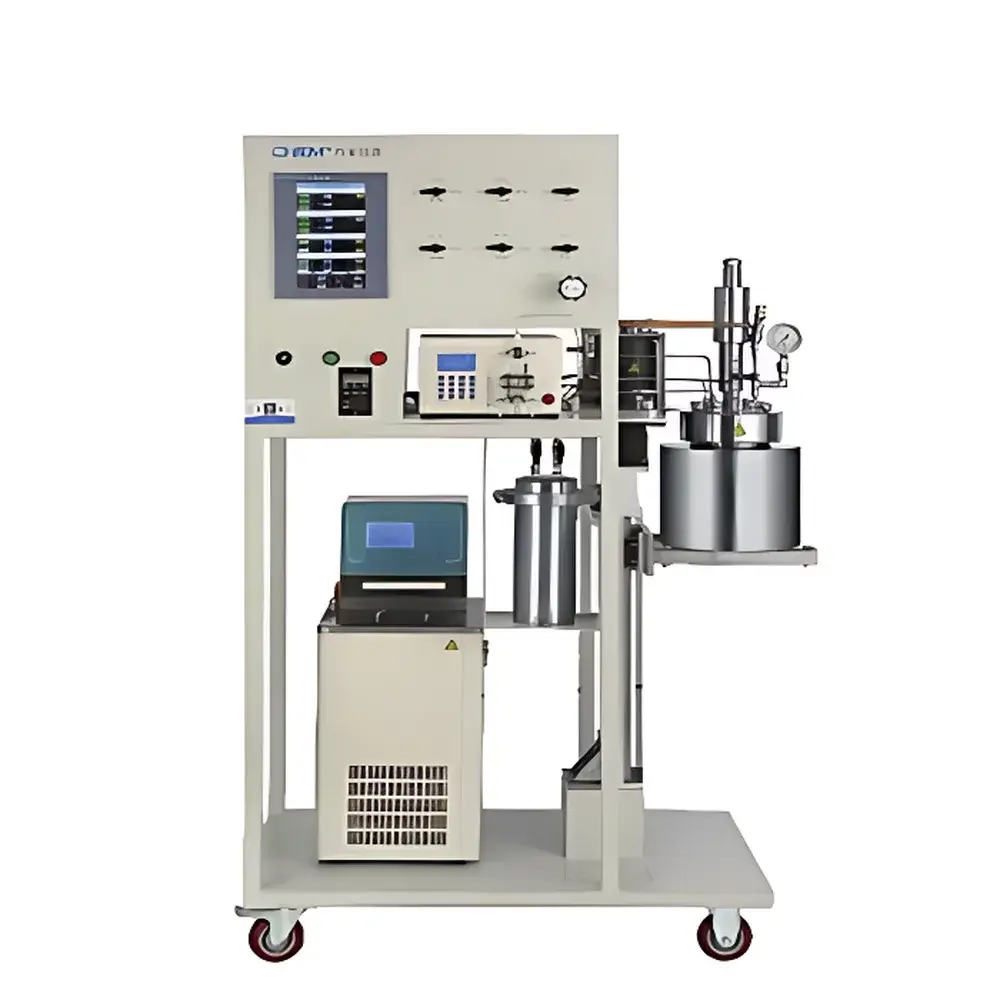
Ahkemi MSD2L-SS1-L1G2 Solution-Phase Polyolefin Synthesis Reactor System
| Brand | Ahkemi |
|---|---|
| Origin | Anhui, China |
| Manufacturer Type | Authorized Distributor |
| Country of Origin | China |
| Model | MSD2L-SS1-L1G2 |
| Reactor Type | High-Pressure Batch Reactor |
| Vessel Volume Options | 300 mL, 2 L, 5 L, 10 L |
| Design Pressure | 10 MPa |
| Design Temperature | 300 °C |
| Construction Material | Stainless Steel (SS316L standard) |
| Stirring Mechanism | Magnetic Coupling Drive with Propeller or Anchor Impeller (Single- or Dual-Stage) |
| Gas Inlet Control | Constant-Flow or Constant-Pressure Mode |
| Liquid Dosing | Anhydrous/Oxygen-Free Injection via Septum or Valve-Isolated Port |
| Vacuum Capability | ≤10⁻³ mbar (with optional vacuum pump interface) |
| Pressure Monitoring | WIKA Bourdon Tube Gauge + MEAS 4–20 mA Pressure Transmitter |
| Temperature Monitoring | Dual Pt100 RTD Sensors (Jacket & Internal) |
| Heating Method | Electric Cartridge Heaters or External Oil Circulator Interface |
| Safety Systems | Rupture Disk + Spring-Loaded Safety Valve + Redundant Interlock Logic (Temperature/Pressure/Combustible Gas Detection) |
| Data Acquisition | 10.2″ HMI Touchscreen with Local Historian |
| Sampling | Integrated Quenchable Liquid Sampling Loop with Cryo-Trap and Inert Gas Purge |
Overview
The Ahkemi MSD2L-SS1-L1G2 Solution-Phase Polyolefin Synthesis Reactor System is an engineered high-pressure batch reactor platform designed specifically for catalytic solution polymerization of ethylene, propylene, and higher α-olefins. It operates on the fundamental principle of homogeneous catalysis under strictly controlled inert atmospheres—where precise regulation of temperature, pressure, gas partial pressures, and reagent addition kinetics directly determines polymer microstructure (e.g., comonomer incorporation, molecular weight distribution, and branching density). The system integrates leak-tight mechanical design (ASME Section VIII Div. 1 compliant construction), dual-stage magnetic coupling drive for zero-seal leakage, and modular process interfaces to support Schlenk-line-level oxygen/moisture exclusion (<1 ppm O₂/H₂O). Its architecture reflects iterative co-development with academic and industrial polymer research groups—including the University of Science and Technology of China, Tianjin University, PetroChina Research Institute, Donghua University, and Soochow University—to meet reproducible scale-up requirements from catalyst screening to kilogram-scale process validation.
Key Features
- Stainless steel (SS316L) pressure vessel rated to 10 MPa at 300 °C, with full traceability of material certifications and hydrostatic test reports.
- Magnetic coupling agitation system delivering torque stability up to 5 N·m, compatible with single- or dual-stage impellers (propeller for dispersion, anchor for viscous media).
- Dual independent temperature monitoring: jacket-side and internal immersion RTD sensors, enabling closed-loop PID control with ±0.5 °C accuracy across the full operating range.
- Gas handling subsystem featuring Fitok stainless steel needle valves, mass flow controllers (MFCs) for ethylene/propylene/hydrogen, and automated purge sequences using ultra-high-purity nitrogen or argon.
- Anhydrous/anaerobic liquid injection module with septum-sealed ports, syringe-driven metering pumps, and integrated solvent/catalyst transfer lines equipped with double-block-and-bleed isolation.
- Comprehensive safety architecture: primary mechanical protection (rupture disk + spring-loaded relief valve), secondary electronic interlocks (trip thresholds configurable for T, P, and combustible gas concentration), and fail-safe shutdown logic per IEC 61511 SIL1 requirements.
Sample Compatibility & Compliance
The MSD2L-SS1-L1G2 accommodates a wide range of organometallic catalyst systems—including metallocenes, post-metallocenes, and late-transition-metal complexes—commonly used in solution-phase polyolefin synthesis. All wetted surfaces are electropolished (Ra < 0.4 µm) and passivated per ASTM A967 to minimize catalytic deactivation. The system supports ASTM D5292 (polyethylene melt index), ISO 1133 (melt flow rate), and USP extractables testing protocols when coupled with downstream analytical instrumentation. It is fully compatible with GLP-compliant laboratory workflows, including audit-ready electronic records (21 CFR Part 11–enabled data logging), instrument qualification documentation (IQ/OQ/PQ templates provided), and traceable calibration certificates for all critical sensors.
Software & Data Management
A real-time embedded control system runs on a Linux-based HMI with a 10.2″ capacitive touchscreen, displaying synchronized trends for temperature, pressure, agitation torque, gas flow rates, and dosing volumes. Historical data is stored locally in CSV/SQLite format with timestamped metadata (including operator ID, batch tag, and environmental conditions). Remote access is supported via secure SSH or HTTPS API endpoints, enabling integration into LIMS or MES platforms. Data export complies with ASTM E2500-13 (verification of computerized systems) and includes digital signatures, change logs, and version-controlled configuration backups. Optional MATLAB® or Python SDKs facilitate custom kinetic modeling and multivariate analysis of polymerization progress curves.
Applications
- High-throughput catalyst evaluation under industrially relevant conditions (e.g., 5–8 MPa C₂H₄ partial pressure, 60–120 °C reaction temperature).
- Structure–property relationship studies linking polymerization kinetics to final resin attributes (e.g., Mw/Mn, short-chain branching distribution, crystallinity).
- Process intensification trials involving continuous catalyst feeding, segmented quenching, or multi-stage comonomer addition.
- Development of next-generation polyolefin elastomers (POEs) and plastomers requiring precise control over ethylene/α-olefin feed ratios and hydrogen chain-transfer modulation.
- Training platform for graduate-level chemical engineering courses covering reaction engineering, thermodynamics of polymer solutions, and safety-critical process operation.
FAQ
What is the maximum allowable working pressure and temperature for this reactor system?
The vessel is ASME-certified for 10 MPa at 300 °C; operational limits are enforced via hardware interlocks and software-configurable setpoints.
Can the system be configured for continuous gas-phase co-feed during liquid-phase polymerization?
Yes—optional gas distribution manifolds with independent MFCs allow simultaneous, ratio-controlled introduction of up to three gases (e.g., C₂H₄, C₃H₆, H₂) through bottom spargers or side-entry diffusers.
How is moisture/oxygen contamination prevented during catalyst charging?
All liquid and solid feed ports integrate double-valve isolation, inert gas purging cycles, and residual moisture detection (TDLAS sensor option); glovebox-integrated loading modules are available as accessories.
Is third-party calibration support available for pressure and temperature sensors?
Yes—Ahkemi provides NIST-traceable calibration services with certified uncertainty budgets, aligned with ISO/IEC 17025 accredited laboratories.
Does the control software support automated recipe execution and deviation reporting?
Yes—the HMI supports step-based procedural automation with configurable hold points, alarm escalation matrices, and auto-generated deviation reports compliant with Annex 11 and ALCOA+ data integrity principles.



