
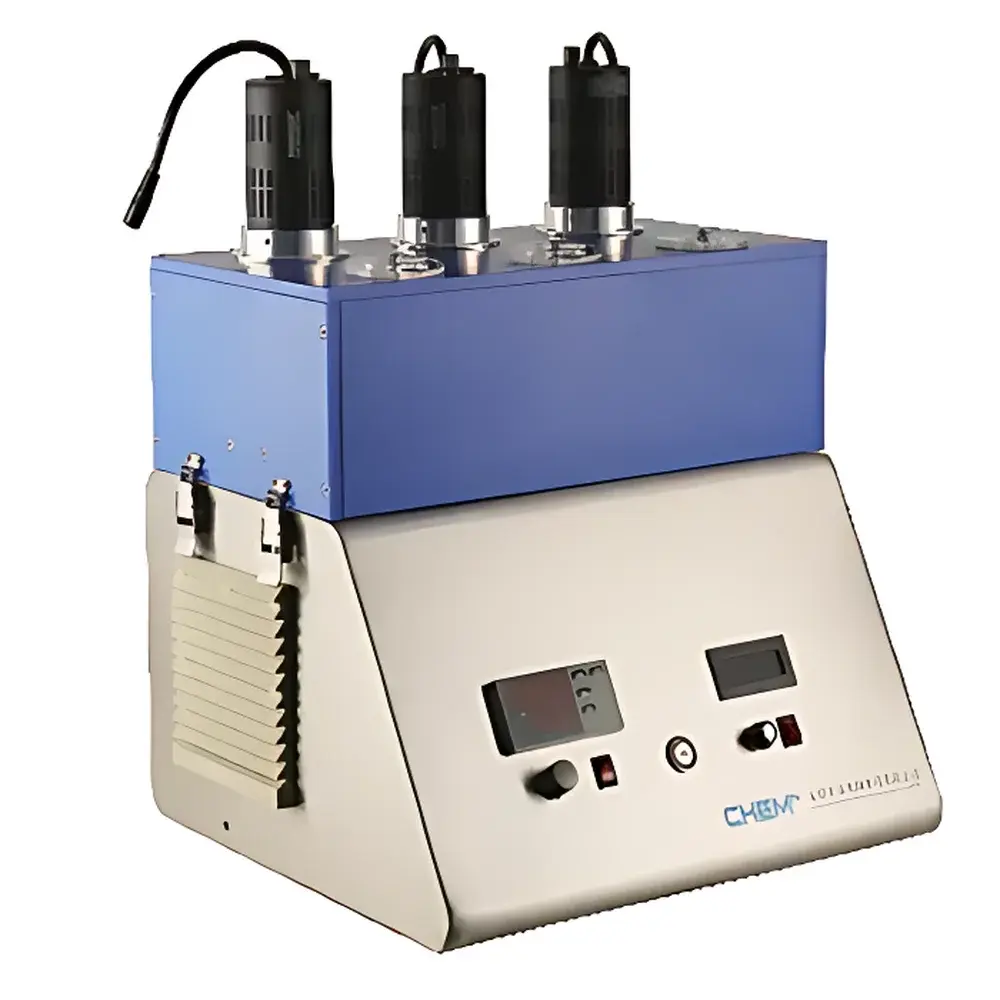
Ahkemi SCI-PCRS-3-455-K Reflective Temperature-Controlled High-Throughput Photocatalytic Reactor
| Brand | Ahkemi |
|---|---|
| Origin | Anhui, China |
| Model | SCI-PCRS-3-455-K |
| Cooling Capacity | 130–445 W |
| Refrigeration Power Consumption | 70–220 W |
| Temperature Control Range | 10–50 °C |
| Temperature Control Accuracy | ±0.2 °C |
| Stirring Speed | 150–1000 rpm (stepless) |
| LED Power Supply Interface | 24 V / 8 A |
| Standard Sample Capacity | 12 parallel reactors |
| Dimensions (W×D×H) | 500 × 470 × 570 mm |
| Refrigerant | R134a |
| Heating Method | Ceramic fan-heater |
| Cooling Method | DC inverter-driven compressor with finned heat exchanger |
Overview
The Ahkemi SCI-PCRS-3-455-K Reflective Temperature-Controlled High-Throughput Photocatalytic Reactor is an engineered platform designed for reproducible, scalable photocatalytic screening under rigorously controlled thermal and irradiation conditions. It operates on the principle of simultaneous multi-channel photochemical activation, where incident photons drive redox reactions on semiconductor catalysts (e.g., TiO₂, g-C₃N₄, or MOFs) in liquid-phase or gas-solid heterogeneous systems. Unlike conventional immersion-type photoreactors, this system employs a reflective illumination architecture—comprising precisely angled aluminum-coated reflectors—to deliver uniform photon flux across three orthogonal surfaces (front, rear, and bottom) of each reaction vessel. This geometry mitigates shadowing effects and angular dependency, significantly improving inter-replicate irradiance homogeneity (CV < 5% across 12 positions, per internal validation per ISO/IEC 17025-compliant calibration protocols). Integrated DC inverter-driven refrigeration compensates for radiative heating from high-power LED arrays, enabling stable isothermal operation within ±0.2 °C—even during extended irradiation at 365 nm or 455 nm wavelengths—thereby decoupling photonic input from thermal drift, a critical requirement for kinetic modeling and Arrhenius analysis.
Key Features
- Reflective Multi-Angle Illumination: Patented three-surface (front/rear/bottom) reflective optical path ensures spatially uniform photon distribution without moving parts or complex optics—eliminating hotspots and enhancing experimental repeatability across parallel channels.
- Precision Active Thermal Management: Closed-loop refrigeration system using R134a and a variable-speed DC compressor delivers rapid thermal equilibration (≤10 °C/min cooling rate) and maintains chamber temperature within ±0.2 °C over 24-hour continuous operation, fully counteracting LED-induced thermal load.
- Modular Reaction Chamber Architecture: Tool-free quick-release design allows interchangeable cavity inserts—supporting configurations for vial-based slurry reactions, flow-through microreactors, or gas-phase photocatalysis—enabling one platform to serve diverse mechanistic and process-development workflows.
- Independent High-Torque Magnetic Stirring: Rare-earth permanent magnet drive motors operate each stir bar independently at 150–1000 rpm (stepless), ensuring consistent mass transfer and suspension stability across all 12 standard positions—even with viscous or particulate-laden media.
- Standardized Electrical & Mechanical Interfaces: 24 V/8 A regulated DC output per channel supports third-party LED modules (e.g., Thorlabs, Phoseon), while standardized 12-position tube holders accept 10–25 mm OD borosilicate vials, screw-cap reactors, or custom-fitted quartz jackets.
Sample Compatibility & Compliance
The SCI-PCRS-3-455-K accommodates aqueous, organic, and biphasic photocatalytic systems—including suspended nanoparticle slurries, immobilized catalyst films on glass substrates, and gas-phase CO₂ reduction setups using sealed quartz tubes. All wetted components comply with USP Class VI and ISO 10993-5 biocompatibility standards; stainless-steel and anodized aluminum construction meets IP54 ingress protection for laboratory environments. The system supports GLP-aligned operation through optional audit-trail-enabled firmware (available upon request), logging timestamped temperature setpoints, stirring speed, runtime, and error flags—fully traceable for FDA 21 CFR Part 11 compliance when paired with validated LIMS integration.
Software & Data Management
While the base unit operates via intuitive front-panel controls with real-time LCD feedback, optional USB- and Ethernet-enabled firmware enables remote parameter scheduling, data streaming (CSV/TXT), and synchronization with external light meters or quantum yield analyzers. All thermal and agitation logs are time-stamped and exportable for post-hoc correlation with GC-MS, HPLC, or UV-Vis kinetic datasets. Firmware updates follow IEC 62443-3-3 security guidelines, and configuration backups support ISO/IEC 17025 method validation documentation requirements.
Applications
- High-throughput screening of photocatalyst libraries for H₂ evolution, CO₂ reduction, or organic pollutant degradation
- Kinetic isotherm studies under controlled photon flux (measured via NIST-traceable radiometers)
- Thermal contribution isolation in photo-thermal catalysis experiments
- Scale-up parameter translation from lab-scale vials to pilot photoreactor designs
- Stability testing of photocatalysts under accelerated illumination and thermal stress
FAQ
Can the reactor accommodate non-standard reaction vessels?
Yes—modular tube holder inserts can be CNC-machined to fit custom diameters (8–30 mm OD), quartz jackets, or flat-bottom microplates upon engineering review.
Is the refrigeration system compatible with external cold baths?
No—the integrated compressor-based system is self-contained; however, optional chilled-water jacket interfaces are available for hybrid thermal control in ultra-low-temperature applications.
What safety certifications does the unit hold?
It complies with CE marking (EMC Directive 2014/30/EU and LVD Directive 2014/35/EU), RoHS 2011/65/EU, and conforms to IEC 61010-1:2010 for laboratory electrical equipment.
How is light intensity calibrated across positions?
Users may deploy a handheld spectroradiometer (e.g., Ocean Insight HDX) at each port; Ahkemi provides a standardized calibration map documenting relative irradiance deviation (±3.2% typical) at 455 nm under default reflector alignment.
Is remote monitoring supported out-of-the-box?
Basic USB serial communication is standard; full TCP/IP remote control and data logging require optional firmware upgrade and dedicated driver installation.



