
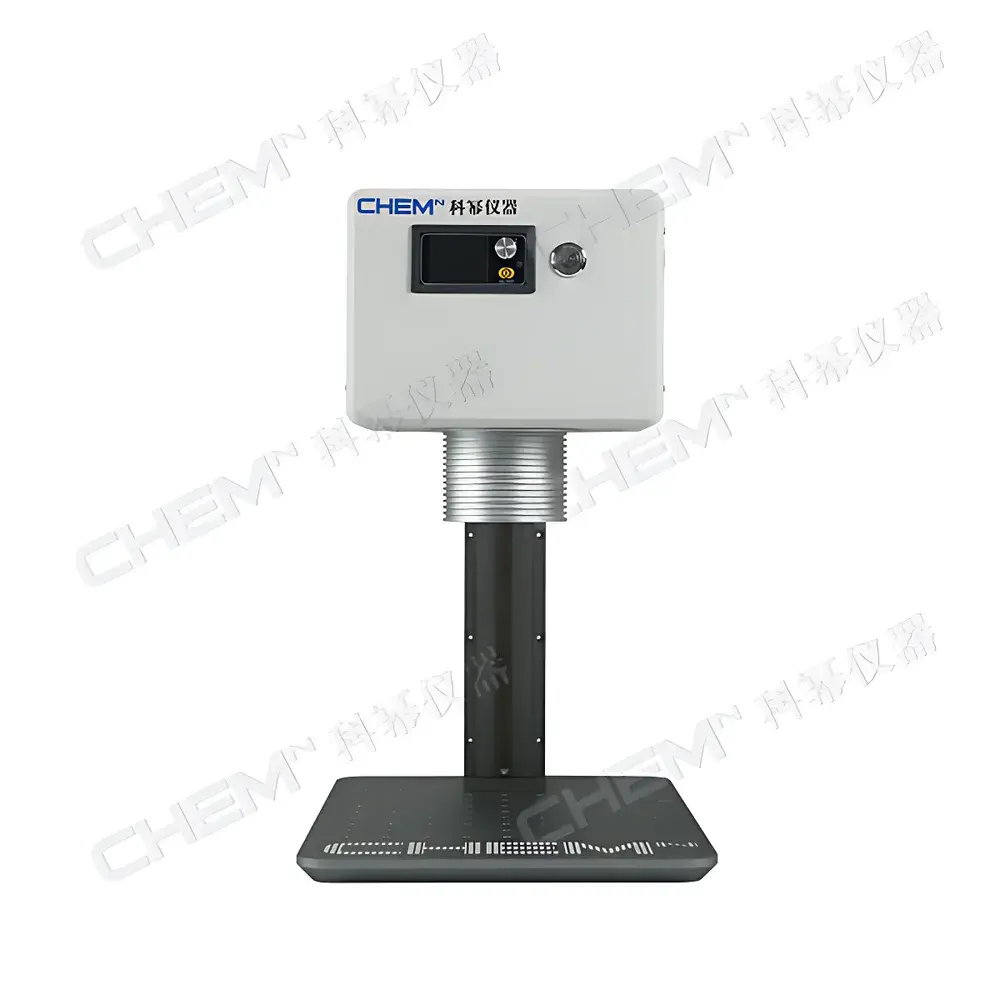
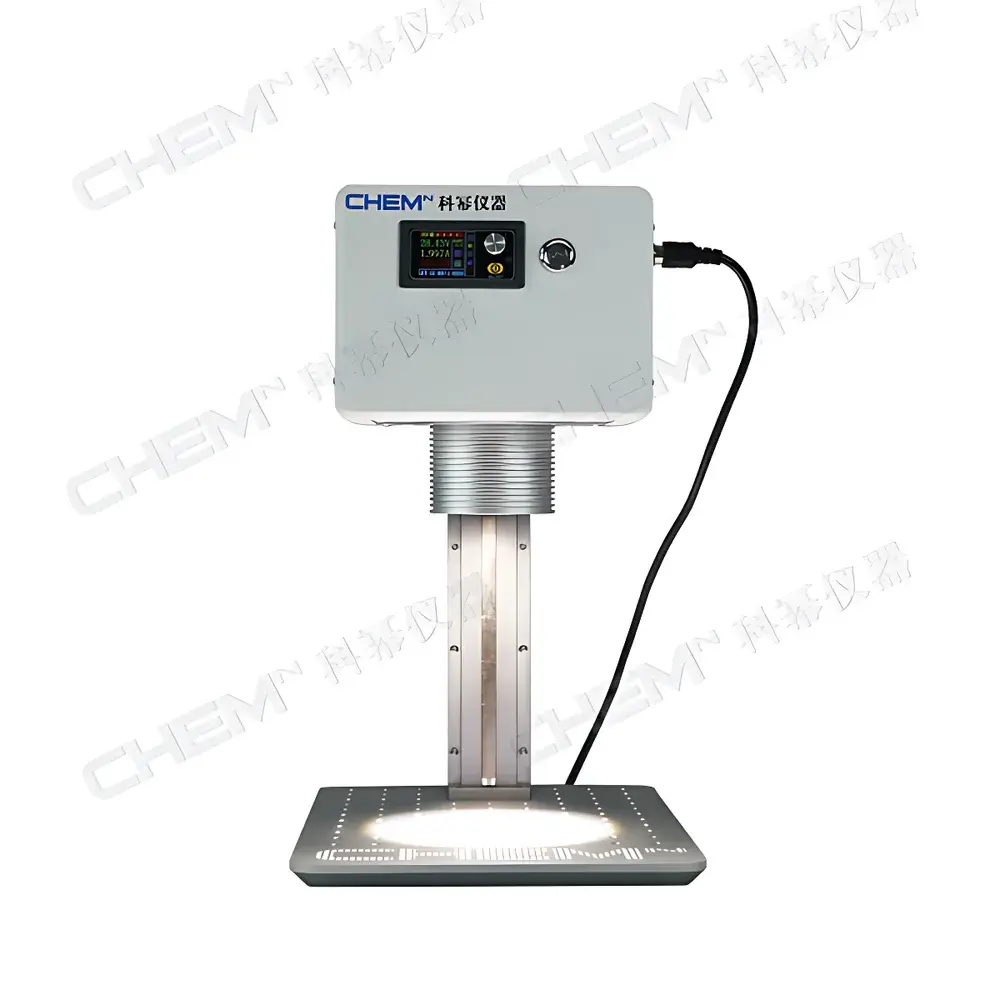
Ahkemi SLS-LED-80A LED Solar Simulator
| Brand | Ahkemi |
|---|---|
| Origin | Anhui, China |
| Model | SLS-LED-80A |
| Light Source Type | High-Power Broadband LED Array |
| Illumination Mode | External Irradiation |
| Spectral Range | 400–800 nm |
| Spectral Match Class | ASTM E927-22 Class A |
| Spatial Uniformity Class | ASTM E927-22 Class A |
| Temporal Stability Class | ASTM E927-22 Class A |
| Effective Illuminated Area | Ø80 mm |
| Irradiance Range | 0–2.1 suns (AM1.5G, 100 mW/cm² equivalent) |
| Rated Lifetime | >10,000 h (L70) |
| Beam Orientation | Fully Adjustable (Pitch/Yaw/Roll via Integrated Goniometric Mount) |
Overview
The Ahkemi SLS-LED-80A LED Solar Simulator is an engineered Class A solar simulation system designed for laboratory-scale photovoltaic characterization, photochemical reaction control, and radiometrically traceable optical testing. Unlike broadband arc-lamp-based simulators, this unit employs a tightly integrated array of spectrally optimized high-flux LEDs—individually binned and thermally stabilized—to reproduce the AM1.5G reference spectrum (IEC 60904-9, ASTM E927-22) across the photosynthetically active and photovoltaically relevant 400–800 nm range. Its compact monolithic architecture eliminates external optics racks, fiber couplers, or water-cooled housings, enabling direct integration into confined environments including gloveboxes, environmental chambers, and custom optical tables. The simulator operates under continuous-wave (CW) mode with zero warm-up delay, no spectral drift during operation, and intrinsic immunity to electrode degradation or UV-induced quartz darkening common in xenon-based systems.
Key Features
- Monolithic design: All critical subsystems—including LED emitter array, collimating optics, active thermal management, and constant-current driver—are fully integrated within a single, sealed lamp head (dimensions: 125 × 125 × 95 mm), minimizing alignment sensitivity and footprint.
- Class A performance certified: Meets ASTM E927-22 requirements for spectral match (±12.5% deviation tolerance), spatial uniformity (≤2% RMS over Ø80 mm area), and temporal stability (≤0.5% variation over 10 min at rated output).
- Remote digital control: IR remote interface enables non-contact power-on/off sequencing and fine-resolution irradiance adjustment (0.01 sun increments) without physical access—critical for inert-atmosphere or radiation-shielded workflows.
- Goniometric beam articulation: Precision-machined three-axis rotation stage allows ±90° pitch, ±90° yaw, and continuous 360° roll adjustment, supporting oblique-angle illumination, multi-directional photocatalytic reactor coupling, and incident-angle-dependent PV quantum efficiency mapping.
- Extended operational lifetime: Rated L70 >10,000 hours (i.e., output maintained ≥70% of initial value), exceeding typical xenon lamp lifetimes (800–1,200 h) by over one order of magnitude—reducing recalibration frequency and consumables cost per test cycle.
Sample Compatibility & Compliance
The SLS-LED-80A is compatible with standard 1-inch, 2-inch, and 3-inch diameter substrates used in thin-film PV cell fabrication, perovskite device screening, and photocatalytic powder slurry reactors. Its low radiant heat flux (<15 W/m² IR component beyond 800 nm) prevents thermal artifact interference in temperature-sensitive assays such as enzyme-driven photo-biohydrogen production or circadian rhythm studies in mammalian cell cultures. The system complies with IEC 62471 (Photobiological Safety) for Risk Group 1 (Exempt) classification and supports GLP-compliant documentation through optional RS-485/Modbus RTU interface for audit-trail-capable irradiance logging. It is not intended for use in FDA-regulated clinical phototherapy devices without additional system-level validation per 21 CFR Part 11.
Software & Data Management
While the base configuration operates via standalone IR remote, optional USB-C + CDC-ACM firmware enables integration with third-party data acquisition platforms (e.g., LabVIEW, Python PySerial, MATLAB Instrument Control Toolbox). Real-time irradiance telemetry (in suns and mW/cm²), thermal junction temperature, and driver current are streamed at 10 Hz. Firmware supports user-defined irradiance ramps (linear/logarithmic), timed exposure sequences (up to 999 min), and EEPROM-stored calibration offsets for multi-unit intercomparison studies. All calibration coefficients are traceable to NIM (National Institute of Metrology, China) spectral irradiance standards; full calibration reports—including spectral power distribution (SPD) curves and uniformity maps—are supplied with each unit.
Applications
- Perovskite and organic photovoltaic (OPV) device J-V curve measurement under stable, repeatable illumination conditions.
- Accelerated photoaging studies of encapsulant materials (EVA, POE) per IEC 61215-2 MQT10 requirements.
- Quantitative evaluation of photocatalytic hydrogen evolution rates using Pt/TiO₂ or g-C₃N₄ suspensions under controlled photon flux.
- In vitro photobiomodulation experiments assessing ROS generation kinetics in primary neuronal cultures.
- Calibration reference source for spectroradiometers and silicon photodiode-based reference cells (e.g., KG5-filtered Si detectors).
- Health lighting R&D: circadian stimulus (CS) and melanopic EDI quantification per CIE S 026/E:2018.
FAQ
Does the SLS-LED-80A meet IEC 60904-9:2020 Class AAA requirements?
Yes—its spectral match, uniformity, and stability all conform to Class A per ASTM E927-22, which aligns with IEC 60904-9:2020’s Class A definition. Full test reports are provided upon request.
Can it be operated inside a nitrogen-filled glovebox?
Yes—the lamp head requires only 24 V DC input and generates negligible outgassing; its IP52-rated enclosure is compatible with standard glovebox feedthroughs.
Is spectral recalibration required after 5,000 hours of operation?
No scheduled recalibration is mandated; however, users performing metrologically critical work are advised to verify spectral output annually using a calibrated spectroradiometer per ISO/IEC 17025 guidelines.
What mounting interfaces are included?
Standard M4 threaded holes on all four lateral faces and a centered 1/4″-20 UNC tripod socket on the rear enable rigid kinematic mounting on optical rails, breadboards, or custom fixtures.
Is there an option for automated irradiance feedback control?
Yes—an optional closed-loop sensor module (SLS-SENS-80) with integrated Si photodiode and analog voltage output (0–5 V) enables real-time irradiance stabilization within ±0.2% against ambient temperature fluctuations.





