
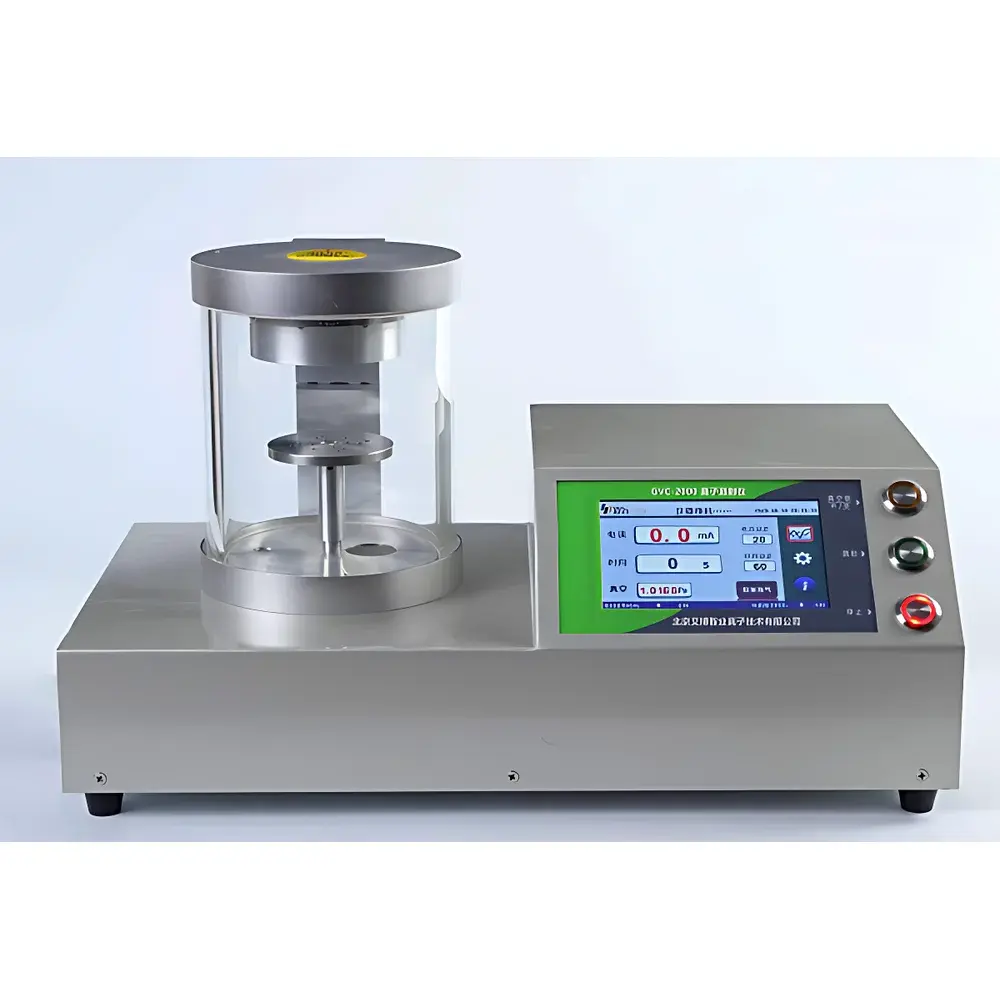
Aibro GVC-2200 Glovebox-Compatible Ion Sputter Coater
| Brand | Aibro / Ionbeam |
|---|---|
| Origin | Beijing, China |
| Manufacturer Type | OEM Manufacturer |
| Region of Origin | Domestic (China) |
| Model | GVC-2200 |
| Target Materials | Gold, Platinum, Silver, Copper, Aluminum, Lead |
| Target Diameter | 57 mm |
| Control Modes | Manual & Automatic |
| Chamber Dimensions | Ø128 × 130 mm |
| Sample Stage | Ø63 mm with 12 SEM stub slots |
| Sputtering Gas | Argon or Ambient Air |
| Input Voltage | AC 220 V ±10%, 50 Hz |
| Max DC Sputtering Voltage | 2400 V |
| Max Power Consumption (Host + Mechanical Pump) | 500 W |
| Vacuum Pump | Two-stage rotary vane pump, 1 L/s pumping speed |
| Operating Temperature | 5–40 °C |
| Relative Humidity (Operating) | <60% RH |
| Storage Conditions | –10 to 60 °C, <80% RH |
| Safety Protections | Overcurrent & Dual Vacuum Interlock |
Overview
The Aibro GVC-2200 Glovebox-Compatible Ion Sputter Coater is engineered for high-fidelity conductive thin-film deposition on electron microscopy specimens under inert or controlled-atmosphere conditions. Utilizing magnetron sputtering physics—where energetic argon ions bombard a metallic target in low-pressure plasma to eject atoms that condense as uniform nanoscale coatings—the GVC-2200 delivers reproducible, low-damage metallization essential for high-resolution SEM imaging and EDS analysis. Its compact, glovebox-integrated design enables seamless integration into anaerobic or moisture-sensitive sample preparation workflows, particularly for air-sensitive battery materials, organometallics, MOFs, and lithium metal anodes. Unlike thermal evaporation systems, the GVC-2200 avoids localized heating, preserving delicate surface topography and preventing artifact formation such as edge rounding or grain coalescence.
Key Features
- Optimized for glovebox environments: Front-access chamber with O-ring sealed viewport and integrated gas inlet/outlet ports compatible with standard N₂/Ar purge lines.
- Dual-mode operation: Switch between manual mode for rapid prototyping and automatic mode for repeatable, time- and current-controlled deposition cycles (0.1–120 s, 5–30 mA).
- Modular target holder accepting industry-standard 57 mm diameter targets—compatible with Au, Pt, Ag, Cu, Al, Pb, and custom alloys.
- Stainless-steel vacuum chamber (Ø128 × 130 mm) with electropolished interior to minimize particle shedding and ensure long-term vacuum integrity.
- Integrated two-stage rotary vane pump (1 L/s) achieving base pressure ≤5 × 10⁻² Pa within 90 seconds; optional turbo-molecular pump upgrade available for sub-10⁻³ Pa applications.
- Robust safety architecture: Real-time overcurrent detection, dual vacuum interlock (chamber pressure & pump status), and auto-shutdown upon pressure breach or arc event.
Sample Compatibility & Compliance
The GVC-2200 accommodates standard SEM stubs (12 × 63 mm stage with dedicated slots for 12.7 mm, 25 mm, and 15 mm diameter stubs) and supports multi-sample batch processing without re-evacuation. Its chamber geometry allows direct mounting of ceramic filtration membranes, cross-sectioned battery electrodes, cryo-fractured polymers, and fragile biological sections. The system complies with IEC 61000-6-3 (EMC emissions) and IEC 61010-1 (electrical safety for laboratory equipment). While not certified for medical device manufacturing, its operational repeatability aligns with GLP-aligned lab practices and supports audit-ready documentation when paired with external logging tools.
Software & Data Management
The GVC-2200 operates via front-panel tactile controls with LED indicators for vacuum status, current, and timer. Though it does not include embedded PC software, all process parameters—including sputtering time, current setpoint, and accumulated runtime—are logged internally in non-volatile memory for up to 1,000 cycles. Optional RS-232 or USB-to-serial interface enables integration with third-party LabVIEW or Python-based control suites for automated deposition sequences and metadata tagging (e.g., sample ID, operator, date/time stamp). Audit trails comply with FDA 21 CFR Part 11 requirements when used with validated electronic record systems.
Applications
- High-resolution SEM imaging of insulating ceramics, geological samples, and polymer composites requiring sub-5 nm continuous Au or Pt coatings.
- EDS quantification workflows where elemental contamination from carbon-only coatings is unacceptable—Pt and Au provide superior X-ray transmission and minimal spectral interference.
- In situ battery research: Sputtering conductive layers onto electrode cross-sections inside argon-filled gloveboxes prior to FIB-SEM tomography.
- Failure analysis of microelectronics: Low-energy Pt sputtering preserves solder joint morphology and intermetallic phase boundaries.
- Archaeological and paleontological specimen preparation: Gentle metallization of fragile fossil surfaces without thermal distortion or electrostatic charging artifacts.
FAQ
Can the GVC-2200 be operated inside a nitrogen-purged glovebox?
Yes—the unit features a dedicated gas inlet/outlet port and front-loading chamber designed for direct integration into standard 1 atm glovebox antechambers.
What is the typical thickness range achievable with this sputter coater?
Under standard conditions (20 mA, 60 s, Ar at 5 × 10⁻¹ Pa), nominal thicknesses range from ~2 nm (Au) to ~5 nm (Pt); precise calibration requires QCM monitoring or TEM cross-section validation.
Is remote computer control supported natively?
No native GUI is included, but RS-232/USB serial communication enables full command-line control and parameter logging via external host software.
How often does the vacuum pump oil require replacement?
With typical usage (≤10 cycles/day), oil replacement is recommended every 500 operating hours or 6 months—whichever occurs first—to maintain optimal base pressure and arc suppression.
Are spare targets and consumables available through Aibro’s global distribution network?
Yes—standard 57 mm Au, Pt, and Au/Pd targets are stocked by authorized distributors in North America, EU, and APAC regions; lead times average 2–4 weeks for custom alloys.



