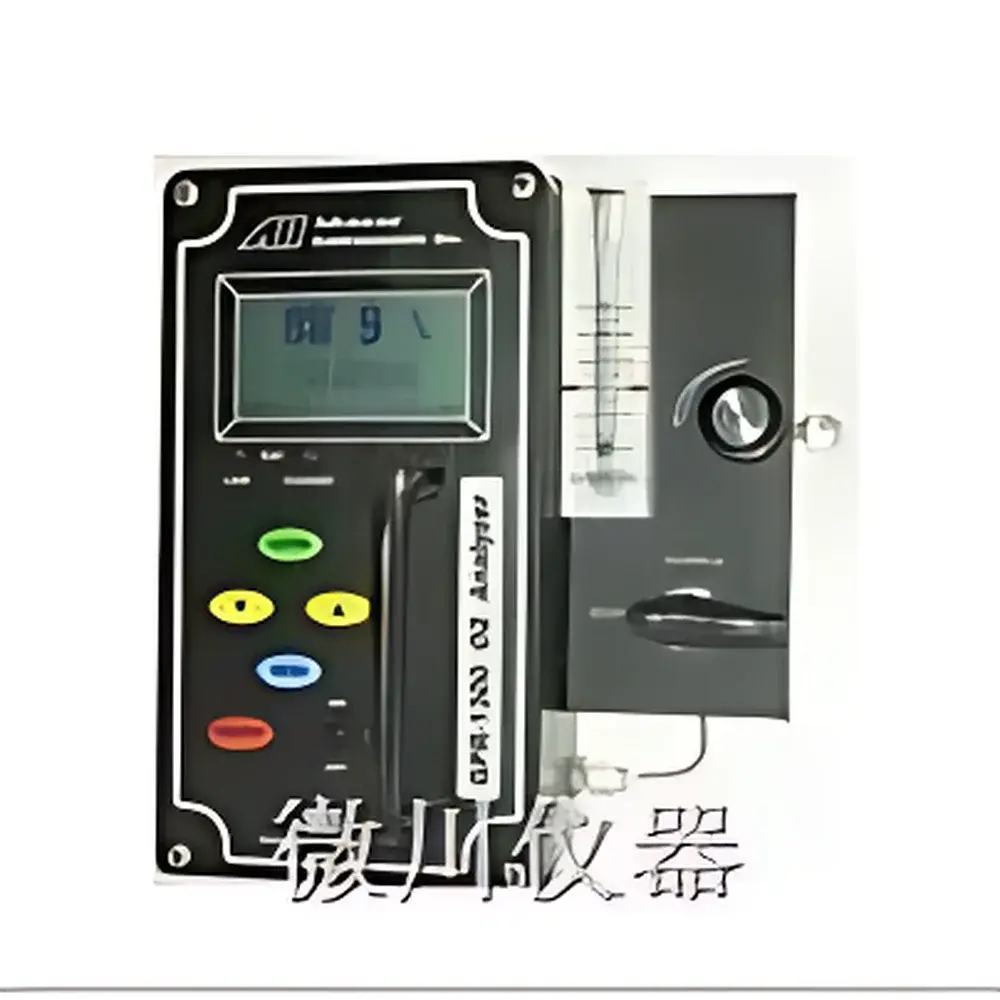
AII ADV GPR-1300 Trace Oxygen Analyzer
| Brand | AII |
|---|---|
| Origin | USA |
| Model | GPR-1300 |
| Measurement Principle | Galvanic Electrochemical Sensor |
| Range | 0–10 / 0–100 / 0–1000 ppm (user-selectable) |
| Accuracy | ±1% of full scale (at 25°C, 1 atm) |
| Resolution | 0.1% of full scale |
| Linearity | R² > 0.995 |
| T90 Response Time | ≤10 s |
| Recovery Time | ≤30 min (from air to 10 ppm) |
| Sensor Lifetime | >24 months at 1000 ppm O₂ |
| Power | Rechargeable battery (30-day operation per charge) |
| Display | Backlit LCD with real-time sample pressure & temperature readout |
| Enclosure | Anodized aluminum, NEMA 4X rated |
| Explosion Protection | Class I, Division 1, Groups A, B, C, D (intrinsic safety certified) |
| Operating Temperature | –5°C to +45°C with built-in temperature compensation |
| Operating Pressure | 5–100 psig |
| Sample Flow Rate | 0.1–5 L/min (recommended: 1 L/min) |
| Certifications | ISO 9001, CE |
| Dimensions | 5" × 9" × 3" (W × H × D) |
| Weight | 8 lbs (≈3.5 kg) |
Overview
The AII ADV GPR-1300 Trace Oxygen Analyzer is a portable, intrinsically safe electrochemical instrument engineered for continuous, high-stability measurement of oxygen concentrations in the sub-ppm to low-ppm range within industrial process streams. Utilizing a galvanic fuel cell sensor, the GPR-1300 operates without external power at the sensing element—enabling passive, zero-drift detection of trace O₂ in inert, reducing, and mildly corrosive gas matrices. Its design targets applications where oxygen ingress must be tightly controlled to prevent oxidation, catalyst poisoning, or combustion hazards—including hydrogen purification, semiconductor purge gas monitoring, cryogenic liquid storage off-gas analysis, and blanketing gas verification in pharmaceutical and food packaging systems. The analyzer integrates real-time temperature and pressure compensation algorithms, ensuring metrological consistency across variable process conditions while maintaining compliance with fundamental traceability requirements under ISO/IEC 17025-aligned laboratory practices.
Key Features
- Galvanic electrochemical sensor with no required polarization voltage or electrolyte refilling—ensuring stable baseline and minimal maintenance over extended deployment cycles.
- User-selectable measurement ranges (0–10 ppm, 0–100 ppm, 0–1000 ppm) optimized via firmware-controlled gain switching for maximum signal-to-noise ratio at each span.
- Intrinsically safe construction certified to Class I, Division 1, Groups A, B, C, D—validated for use in hazardous locations per UL 913 and CSA C22.2 No. 157 standards.
- NEMA 4X-rated anodized aluminum enclosure providing dust-tight, corrosion-resistant protection suitable for outdoor or washdown environments.
- Rechargeable lithium-ion battery supporting up to 30 days of continuous operation; integrated low-battery and over-range alarms with visual and audible indicators.
- Five-button waterproof keypad enabling intuitive navigation through system setup, span calibration, alarm threshold adjustment, and diagnostic mode—all accessible without tools or software.
- On-board temperature and pressure transducers feeding dynamic compensation to the microprocessor, eliminating manual correction factors during field operation.
Sample Compatibility & Compliance
The GPR-1300 is validated for use with hydrogen, helium, nitrogen, argon, methane, ethylene, CO₂-free natural gas, and other non-aggressive process gases. For acid gas service (e.g., streams containing H₂S or elevated CO₂), optional acid-resistant sensor variants are available upon order specification. All configurations comply with ISO 9001 quality management system requirements and bear CE marking for conformity with EU Machinery Directive 2006/42/EC and ATEX 2014/34/EU essential health and safety requirements. While not explicitly 21 CFR Part 11 compliant out-of-the-box, audit-ready calibration logs—including date/time stamps, operator ID fields, and FS calibration gas concentration—can be exported manually for GLP/GMP documentation workflows.
Software & Data Management
The GPR-1300 operates as a standalone embedded instrument with no host PC dependency. Calibration data, alarm events, and sensor health metrics are stored internally with timestamped records retained for ≥12 months. Optional RS-232 or 4–20 mA analog output modules (sold separately) enable integration into DCS/SCADA platforms for centralized trending and alarm forwarding. Firmware updates are performed via USB interface using AII-provided configuration utility software, which supports version-controlled parameter backups and secure password-protected configuration locking—facilitating reproducible instrument setup across multi-site deployments.
Applications
- Hydrogen purity verification in PEM electrolyzer and fuel cell feed lines (ASTM D7184-compliant trace O₂ screening).
- Monitoring inert gas blankets in API 650 tank vapor spaces to maintain <50 ppm O₂ for fire prevention.
- Quality assurance of ultra-high-purity (UHP) argon/nitrogen used in metal additive manufacturing and wafer annealing furnaces.
- Leak detection in vacuum gloveboxes and dry rooms by tracking ambient O₂ breakthrough during pressure hold tests.
- Verification of deoxygenated water vapor phase in steam sterilization validation protocols (ISO 17665 Annex C reference method support).
FAQ
What calibration gas is recommended for routine span verification?
A certified 80% of full-scale (FS) standard gas in balance nitrogen is recommended for daily or shift-based calibration checks. Certified gases must be traceable to NIST SRMs with stated expanded uncertainty ≤1.5% k=2.
Can the GPR-1300 measure oxygen in carbon dioxide-rich streams?
Standard sensors are not suitable for CO₂ concentrations >10%. Acid-resistant sensor variants—featuring platinum-black cathodes and stabilized electrolyte formulations—are required for reliable operation in biogas, fermentation off-gas, or CCS pipeline monitoring applications.
Is temperature compensation applied automatically during measurement?
Yes. Internal Pt100 RTD and piezoresistive pressure transducers feed real-time environmental data to the onboard microcontroller, which applies polynomial-based compensation per ASTM D6299 Annex A3 methodology.
How often does the sensor require replacement?
Under typical operating conditions (≤100 ppm average exposure), the galvanic sensor exhibits >24 months functional lifetime. A diagnostic mode displays remaining sensor capacity as a percentage, triggering preemptive replacement alerts when capacity falls below 20%.
Does the instrument support remote diagnostics or firmware updates?
Firmware updates and configuration backup/restore are supported via USB connection using AII’s Windows-compatible GPR Configuration Suite. Remote access requires optional RS-232-to-Ethernet gateway hardware and third-party SCADA integration.