
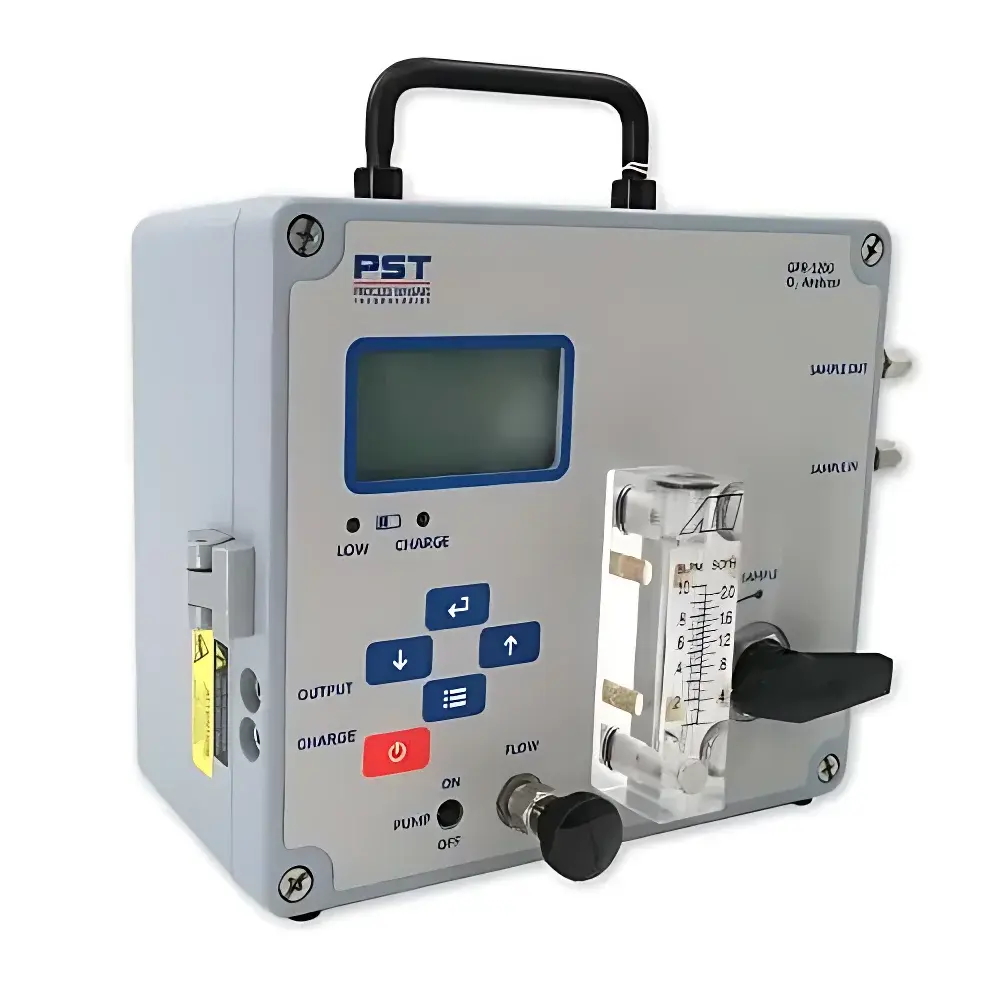
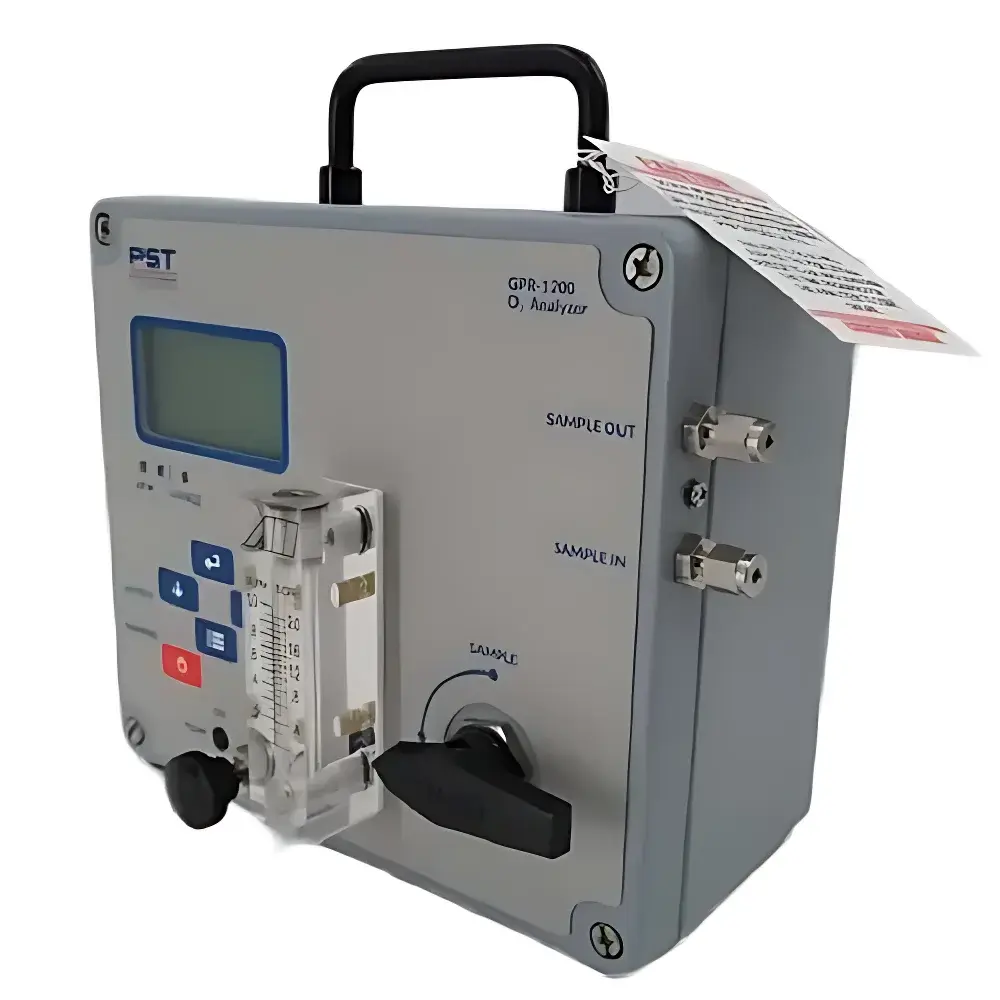
AII GPR-1200 High-Precision Portable Oxygen Analyzer
| Brand | AII |
|---|---|
| Origin | USA |
| Model | GPR-1200 |
| Weight | 5.4 kg (12 lbs) |
| Measurement Range | 0–1 ppm to 0–100% O₂ |
| Accuracy | <2% of reading or 0.2 ppm (whichever is greater) |
| Response Time (T90) | <13 s |
| Detection Limit | 0.05 ppm |
| Sensor Lifetime | 24–32 months @ 25°C / 1 atm |
| Battery Life | Up to 30 days (standby), 40 hours (with internal pump active) |
| Operating Temperature | 5–45°C (GPR sensor) |
| Enclosure | Painted aluminum, NEMA 4X rated |
| Gas Inlet | 1/8" compression fitting |
| Pressure Range | 0.34–2 barg (5–30 psig) with vent |
| Output | 0–1 V analog |
| Compliance | ATEX Ex II 2 G Ex ib IIC T4 Gb, Tamb 5°C to +45°C |
Overview
The AII GPR-1200 High-Precision Portable Oxygen Analyzer is an electrochemical trace oxygen measurement system engineered for laboratory, industrial, and field applications requiring reliable, quantitative analysis of oxygen at parts-per-trillion to percent-level concentrations. Utilizing proprietary galvanic cell technology with temperature- and pressure-compensated signal processing, the GPR-1200 delivers high reproducibility and long-term stability in demanding environments—particularly where inert gas purity, blanketing integrity, or process gas qualification must be verified. Unlike conventional paramagnetic or zirconia-based analyzers, the GPR-1200 employs a zero-current, self-powered electrochemical sensor that eliminates drift associated with polarization effects and provides true linear output across its full dynamic range. Its compact, ruggedized chassis enables deployment in mobile QC workflows—including tank truck audits, semiconductor purge validation, fermentation headspace monitoring, and nitrogen generator commissioning—without compromising metrological rigor.
Key Features
- Electrochemical sensor architecture with intrinsic zero-point stability: output defaults to 0 nA in oxygen-free environments, enabling single-point span calibration for most routine applications.
- XLT sensor option available for measurements in CO₂-rich matrices (>0.5% CO₂), featuring acid-resistant electrolyte formulation and extended low-temperature operation down to –10°C.
- Integrated four-way sampling valve minimizes sensor exposure to ambient air during transport and sampling—extending functional lifetime and reducing recalibration frequency.
- NEMA 4X-rated painted aluminum enclosure ensures resistance to dust, water ingress, and mechanical impact in industrial settings.
- Onboard rechargeable lead-acid battery supports up to 30 days of intermittent use (or 40 hours continuous operation with internal pump enabled), eliminating dependency on external power sources during site surveys.
- Real-time analog 0–1 V output compatible with data loggers, PLCs, and SCADA systems; optional internal sample pump for active draw applications.
- Graphical LCD display (7 × 3.5 cm) with configurable resolution (0.001 ppm for trace modes; 0.1% for high-range configurations) and dual LED status indicators for low-battery warning (72-hour advance alert) and charging state.
Sample Compatibility & Compliance
The GPR-1200 is validated for use with inert gases (N₂, Ar, He), carbon dioxide, oxygen-enriched mixtures, and purified process streams where background CO₂ content does not exceed 5% (XLT variant required above 0.5%). All wetted components—including flow path, valve body, and sensor housing—are constructed from 316 stainless steel to prevent catalytic interference or surface adsorption artifacts. The analyzer complies with ATEX Directive 2014/34/EU for Zone 2 hazardous areas (Ex II 2 G Ex ib IIC T4 Gb), with operational ambient temperature limits defined per sensor type (5–45°C standard; –10–45°C for XLT). While not certified to ISO/IEC 17025 or FDA 21 CFR Part 11 out-of-the-box, its deterministic calibration traceability, audit-ready calibration logs (via optional software), and stable baseline behavior support integration into GLP- and GMP-aligned quality systems when deployed with documented SOPs.
Software & Data Management
Although the GPR-1200 operates as a standalone instrument, AII provides optional PC-based configuration and data acquisition software (AII ConfigTool v3.x) supporting USB connectivity. This utility enables firmware updates, sensor parameter customization (e.g., response damping, alarm thresholds), and timestamped export of measurement sessions in CSV format. Calibration events—including date, span gas concentration, operator ID, and post-calibration verification values—are stored in non-volatile memory and retrievable via serial interrogation. For regulated environments, users may implement external electronic lab notebooks (ELNs) or LIMS interfaces using the 0–1 V analog output paired with time-synchronized DAQ hardware, satisfying requirements for data integrity under ALCOA+ principles.
Applications
- Verification of nitrogen or argon purge efficacy in semiconductor fabrication tools and vacuum chambers.
- Periodic auditing of liquid nitrogen or liquid argon delivery tanks for residual oxygen contamination prior to transfer.
- Top-space O₂ monitoring in bioreactors, wine fermenters, and pharmaceutical lyophilization cycles.
- Leak detection in gloveboxes, inert-atmosphere welding enclosures, and battery dry rooms.
- Commissioning and preventive maintenance of on-site oxygen generators and membrane-based nitrogen separators.
- Field validation of cryogenic gas cylinder purity per ASTM D7251 and ISO 8573-1 Class 1 specifications.
FAQ
What sensor technologies are supported by the GPR-1200?
The base GPR-1200 uses the MS-2 sensor for general-purpose trace O₂ measurement (0–1000 ppm). For applications involving CO₂-rich backgrounds (>0.5%), the XLT-12-333 sensor is recommended due to its chemically stabilized electrolyte.
Is the GPR-1200 suitable for high-pressure gas sampling?
Yes—the instrument accepts inlet pressures up to 248.2 barg (3600 psig) when equipped with the high-pressure vent option; standard operation is specified for 0.34–2 barg (5–30 psig) with atmospheric venting.
How often must the sensor be calibrated?
AII recommends calibration every 30 days under typical operating conditions; however, interval extension is permissible if historical data demonstrates stability per internal QA protocols.
Can the GPR-1200 measure oxygen in hydrogen or helium carrier gases?
Yes—provided the background gas is dry and free of reactive contaminants (e.g., H₂S, Cl₂), the MS-2 and XLT sensors maintain accuracy across non-corrosive, non-reactive binary mixtures.
Does the unit include temperature and pressure compensation?
Yes—built-in sensors automatically correct raw signal output for ambient temperature (5–45°C) and barometric pressure variations, ensuring consistent readings across geographic and seasonal conditions.
Related Products







