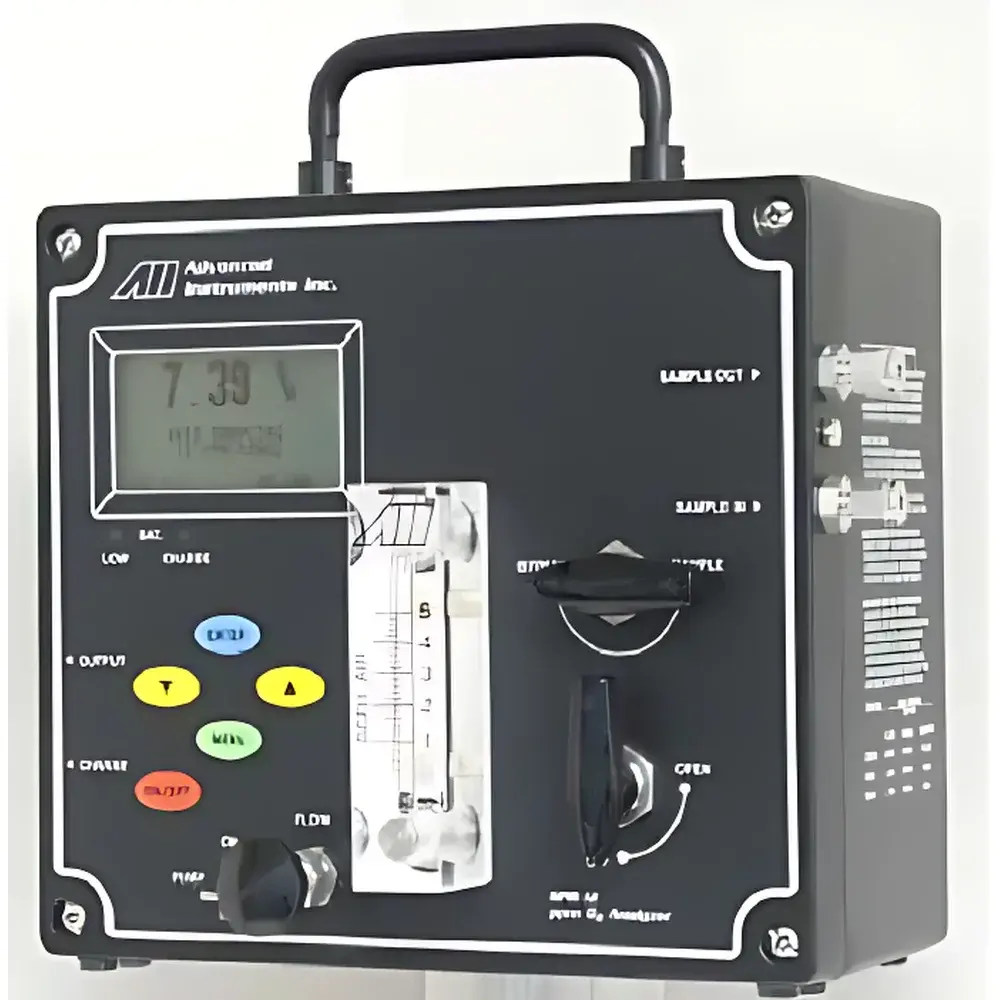
AII GPR-1200 Intrinsically Safe Oxygen Analyzer
| Brand | AII |
|---|---|
| Origin | USA |
| Model | GPR-1200 |
| Measurement Range (Standard) | 0–10 ppm, 0–100 ppm, 0–1,000 ppm, 0–1%, 0–25% |
| Detection Limit | <100 ppb |
| Certifications | Class I, Division 1, Groups A–D (UL/CSA) |
| Housing Material | 316 Stainless Steel |
| Power | Rechargeable Battery (60-day runtime after overnight charge) |
| Optional Accessories | Integrated Sample Pump, Coalescing Filter, H₂S Scrubber, Portable Carrying Case |
| Auto-ranging, Zero Calibration & System Diagnostics | Yes |
Overview
The AII GPR-1200 Intrinsically Safe Oxygen Analyzer is a high-stability, electrochemical trace oxygen measurement system engineered for continuous, real-time monitoring in hazardous industrial environments. It employs a proprietary, long-life galvanic fuel cell sensor with diffusion-limited current detection — a principle grounded in Faraday’s law of electrolysis — to deliver stable, low-drift measurements across ultra-trace to percent-level oxygen concentrations. Unlike paramagnetic or zirconia-based analyzers, the GPR-1200’s electrochemical architecture eliminates the need for sample heating, pressure regulation, or carrier gases, enabling rapid response (<15 s T₉₀) and minimal maintenance in unattended field deployments. Its intrinsic safety certification (UL/CSA Class I, Division 1, Groups A–D) permits direct installation in explosive atmospheres commonly found in petrochemical refineries, hydrogen production units, semiconductor gas cabinets, and inert blanketing systems.
Key Features
- Intrinsically safe design certified for Class I, Division 1, Groups A–D hazardous locations — no external barriers or purging required.
- Proprietary galvanic oxygen sensor with sub-100 ppb detection limit and proven stability over 24 months under continuous operation.
- Full stainless steel (316 SS) bypass sampling manifold integrated into the analyzer housing — minimizes particulate ingress, reduces condensation risk, and extends sensor service life by up to 3× compared to standard flow-through configurations.
- Intelligent auto-ranging electronics that dynamically switch between five factory-configurable ranges: 0–10 ppm, 0–100 ppm, 0–1,000 ppm, 0–1% O₂, and 0–25% O₂ — ensuring optimal signal-to-noise ratio across applications without manual range selection.
- Onboard zero calibration routine with automatic validation and diagnostic logging — supports scheduled maintenance compliance per ISO 9001 and API RP 14C protocols.
- Rechargeable lithium-thionyl chloride battery pack providing up to 60 days of continuous operation on a single 8-hour charge — ideal for remote or mobile monitoring where AC power is unavailable.
Sample Compatibility & Compliance
The GPR-1200 is optimized for dry, non-corrosive process streams with dew points below –40 °C. It tolerates trace hydrocarbons (<10 ppm v/v), CO₂ (<5%), and N₂-rich matrices without cross-sensitivity. For sour gas applications, optional H₂S scrubbers remove sulfides prior to sensor exposure, preventing electrode poisoning. The coalescing filter (optional) removes aerosols down to 0.3 µm, while the integrated sample pump (optional) enables negative-pressure sampling from pipelines or vessels with backpressure up to 15 psig. All firmware and calibration records comply with FDA 21 CFR Part 11 requirements for electronic audit trails, including user authentication, change history, and tamper-evident timestamps — supporting GLP/GMP-regulated environments such as pharmaceutical nitrogen purge validation and bioreactor headspace monitoring.
Software & Data Management
The analyzer includes an embedded RS-485 Modbus RTU interface and optional Ethernet/IP or HART 7 connectivity for integration into DCS, SCADA, or MES platforms. Local configuration and diagnostics are accessible via a backlit LCD with intuitive menu navigation — no PC required. All calibration events, sensor health metrics (e.g., open-circuit voltage, load resistance), and alarm logs are timestamped and exportable in CSV format. Firmware updates are performed securely via signed binary files, maintaining integrity verification per IEC 62443-3-3 Annex A. Data retention spans ≥12 months at 1-minute intervals, satisfying ISO 50001 energy management reporting and EPA Method 205 trace gas verification requirements.
Applications
- Monitoring residual O₂ in high-purity nitrogen, argon, or helium blanketing systems for chemical reactors and storage tanks.
- Leak detection and integrity verification of inerted enclosures in aerospace composite curing ovens and semiconductor wafer fabrication tools.
- Process control of deaeration units in boiler feedwater treatment and thermal power generation facilities.
- Quality assurance of modified atmosphere packaging (MAP) gases in food processing lines.
- Hydrogen purity verification in PEM electrolyzer off-gas streams prior to venting or reuse.
FAQ
What is the recommended calibration frequency for the GPR-1200 in continuous operation?
Calibration is recommended every 30 days using certified zero gas (nitrogen with <10 ppb O₂) and span gas traceable to NIST standards — though extended intervals up to 90 days are permissible with documented sensor drift trending per ASTM D6299.
Can the GPR-1200 measure oxygen in hydrogen-rich streams?
Yes — the sensor exhibits negligible interference from H₂ up to 100% concentration; however, an H₂S scrubber is mandatory if total sulfur content exceeds 1 ppm to prevent irreversible electrode sulfidation.
Is the stainless steel sampling system compatible with chlorinated solvents?
No — exposure to chlorine, ClO₂, or organic chlorides will accelerate passivation layer breakdown; use only with clean, dry, non-oxidizing carrier gases or ambient air.
Does the analyzer support remote firmware updates over Modbus?
Firmware updates require physical USB connection and authenticated credentials; remote update capability is intentionally disabled to meet IEC 61511 functional safety requirements for SIL-2 capable devices.
Related Products