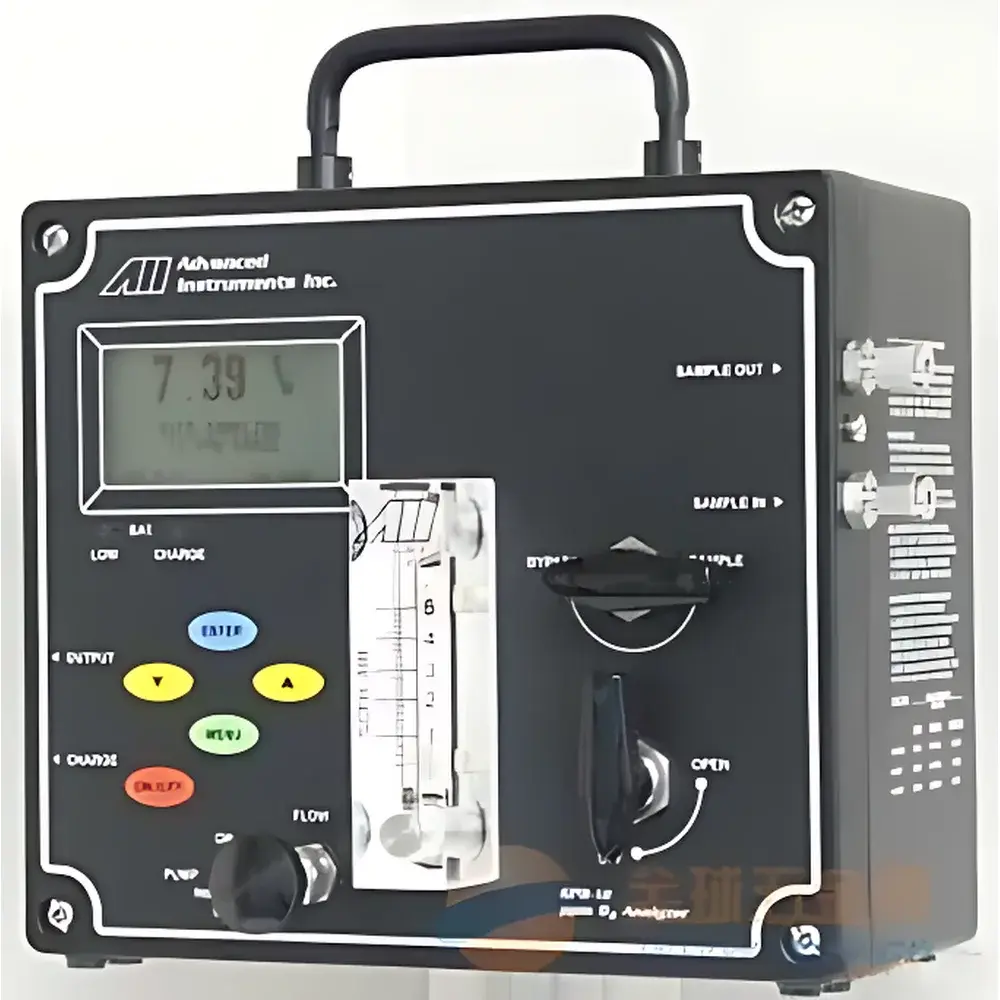
AII GPR-1200 Portable Trace Oxygen Analyzer
| Brand | AII |
|---|---|
| Origin | USA |
| Model | GPR-1200 |
| Principle | Galvanic Electrochemical Sensor |
| Measurement Range | 0–10 / 0–100 / 0–1000 ppm O₂ (auto/manual switchable) |
| Accuracy | ±1% of full scale (at 25°C, 1 atm) |
| Resolution | 0.1% of minimum selected range |
| Linearity | R² > 0.995 |
| Response Time (t₉₀) | 10 s |
| Recovery Time | 60 min (from air to 10 ppm) |
| Sensor Lifetime | >24 months (at 1000 ppm O₂) |
| Enclosure Rating | NEMA 4X, IP66 |
| Explosion Protection | Class I, Division 1, Groups A, B, C, D (intrinsically safe) |
| Operating Temperature | 5–45°C with built-in temperature compensation |
| Sample Flow Rate | 0.5–5 SCFH (recommended: 2 SCFH ≈ 1 L/min) |
| Inlet Pressure | 5–100 psig (vacuum operation requires optional vacuum pump) |
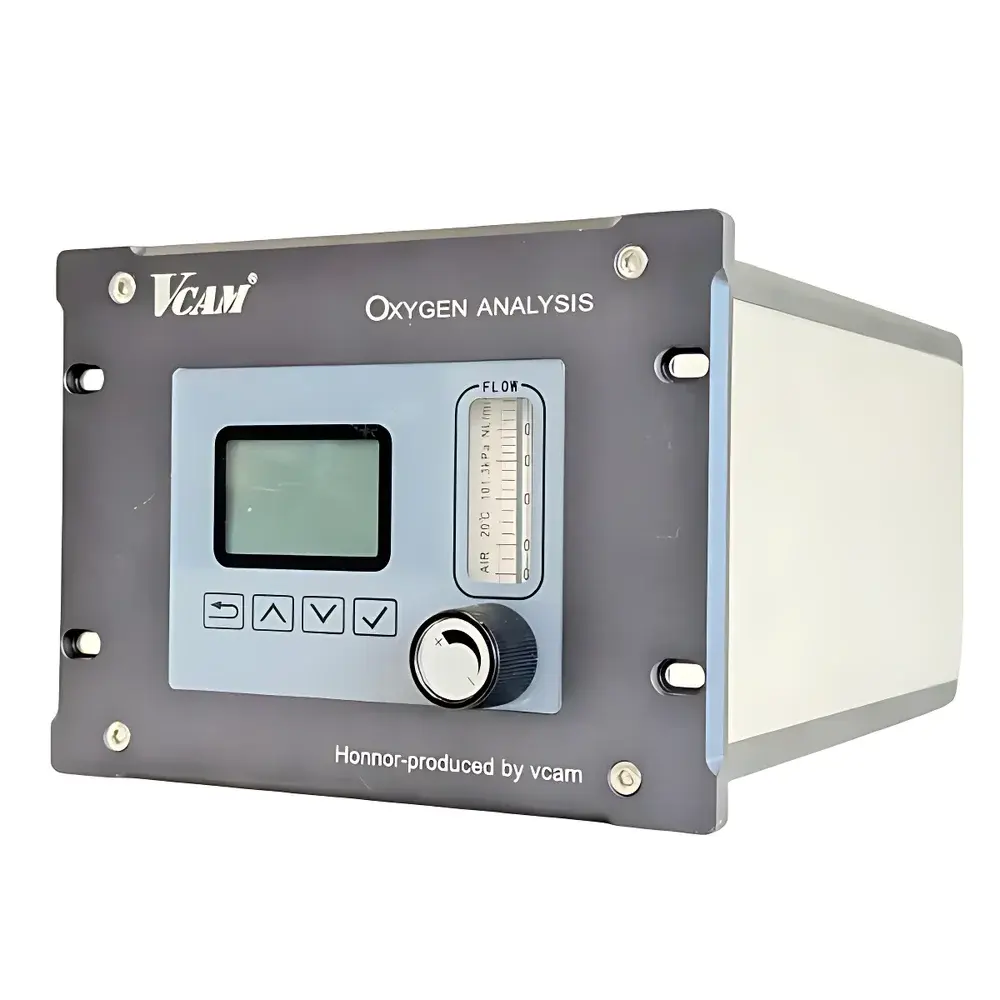
| Display | Backlit LCD showing real-time O₂ concentration, sample pressure & temperature |
| Power | Rechargeable battery |
| Output | 0–1 V analog output |
| Certifications | CE, ISO 9001 |
| Optional Accessories | Integrated vacuum pump, acid-gas sensor (for CO₂/H₂S-containing streams), particulate filter unit, custom calibration gases |
Overview
The AII GPR-1200 Portable Trace Oxygen Analyzer is an intrinsically safe, field-deployable electrochemical instrument engineered for high-reliability measurement of oxygen concentrations in the sub-part-per-million (ppm) range. Utilizing a proprietary galvanic (self-powered) electrochemical sensing principle—distinct from polarographic or zirconia-based technologies—the GPR-1200 delivers stable, drift-free performance without external bias voltage or frequent recalibration. Its core sensor (GPR-12-333) operates via spontaneous redox reaction between ambient O₂ and a consumable metal anode, generating a current linearly proportional to O₂ partial pressure. This design ensures zero power consumption at the sensor level, contributing to extended battery life and inherent safety in hazardous environments. The analyzer is optimized for applications demanding trace-level oxygen monitoring where inertness, purity verification, or process stoichiometry control is critical—including semiconductor fabrication, high-purity gas certification, vacuum leak detection, controlled-atmosphere heat treatment, and low-oxygen combustion optimization.
Key Features
- Intrinsically safe construction certified to Class I, Division 1, Groups A, B, C, D—enabling direct use in explosive atmospheres without external barriers.
- Five preconfigured, user-selectable measurement ranges (0–10, 0–100, 0–1000 ppm O₂) with automatic range switching and manual override capability.
- NEMA 4X-rated aluminum enclosure with IP66 ingress protection, featuring a ruggedized, waterproof keypad and corrosion-resistant stainless-steel sampling hardware.
- Integrated temperature and pressure compensation algorithms ensure measurement integrity across variable process conditions (5–45°C; 5–100 psig).
- Real-time LCD display simultaneously shows O₂ concentration, sample pressure, and temperature—eliminating need for external transducers.
- Onboard 0–1 V analog output supports integration into DCS/PLC systems; configurable alarm thresholds for low-battery, over-range, and sensor fault conditions.
- Self-contained rapid-purge sampling system with 4-way protective valve, precision flow control, and calibrated rotameter (1/8″ Swagelok® stainless-steel fittings included).
Sample Compatibility & Compliance
The GPR-1200 is validated for continuous analysis of non-corrosive and mildly acidic gas matrices—including H₂, He, N₂, Ar, CO₂, CH₄, and mixed industrial gases—provided appropriate sensor configuration is selected (e.g., acid-resistant variant for streams containing H₂S or elevated CO₂). It complies with ISO 9001:2015 quality management requirements and bears CE marking per EU Directive 2014/34/EU (ATEX) and 2014/30/EU (EMC). While not explicitly FDA 21 CFR Part 11 compliant out-of-the-box, its audit-ready calibration log (timestamped, operator-ID-capable via optional software interface) supports GLP/GMP-aligned documentation workflows in regulated manufacturing settings. All factory calibrations are traceable to NIST-certified standard gases.
Software & Data Management
Though primarily a stand-alone instrument, the GPR-1200 supports optional PC-based configuration and data logging via RS-232 serial interface (USB adapter available). The companion AII Configurator software enables secure parameter setting—including alarm setpoints, auto-zero intervals, and analog output scaling—as well as export of time-stamped measurement logs in CSV format. Raw sensor diagnostics (e.g., baseline offset, response slope, internal resistance) are accessible for predictive maintenance planning. For continuous process validation, users may integrate the 0–1 V analog output with third-party SCADA systems equipped with 16-bit ADC resolution and cold-junction compensation for thermocouple-derived temperature inputs.
Applications
- High-Purity Gas Certification: Verification of argon, nitrogen, helium, and hydrogen purity in semiconductor fab gas delivery systems (per SEMI F57-0301 specification).
- Vacuum Integrity Testing: Detection of minute air ingress during chamber evacuation—particularly effective in radiofrequency (RF) plasma environments where residual O₂ degrades thin-film adhesion.
- Controlled-Atmosphere Processing: Monitoring residual O₂ in sintering furnaces, brazing ovens, and ceramic kilns operating under <100 ppm O₂ to prevent oxidation of refractory metals and advanced ceramics.
- Combustion Optimization: Tuning burner air-to-fuel ratios in industrial boilers and thermal oxidizers to minimize excess O₂ while maintaining complete combustion—reducing NOₓ formation and fuel consumption.
- Research & Development: Quantifying dissolved O₂ in glovebox atmospheres during battery electrode synthesis or catalyst activation studies requiring <1 ppm O₂ stability.
FAQ
What is the recommended calibration frequency?
Annual calibration is advised under normal operating conditions; however, calibration before each critical measurement campaign—or after exposure to >1000 ppm O₂—is strongly recommended to maintain ±1% FS accuracy.
Can the GPR-1200 measure oxygen in hydrogen-rich streams?
Yes—its galvanic sensor exhibits minimal cross-sensitivity to H₂, and the standard configuration is approved for use in H₂ backgrounds up to 100% concentration when operated within specified flow and pressure parameters.
Is temperature compensation fully automatic?
Yes—integrated Pt100 RTD and microprocessor-based compensation correct for thermal effects across the full 5–45°C operating range without user intervention.
How does sensor lifetime vary with exposure concentration?
Sensor longevity is inversely proportional to cumulative O₂ exposure; operation at ≤100 ppm average concentration typically extends service life beyond 30 months, whereas continuous exposure near full-scale (1000 ppm) aligns with the rated 24-month minimum.
Does the instrument support remote diagnostics?
While no built-in Ethernet or wireless module is included, the RS-232 port allows connection to networked serial servers for remote access to real-time readings and basic status flags (battery, alarm, sensor health) via Modbus RTU protocol.