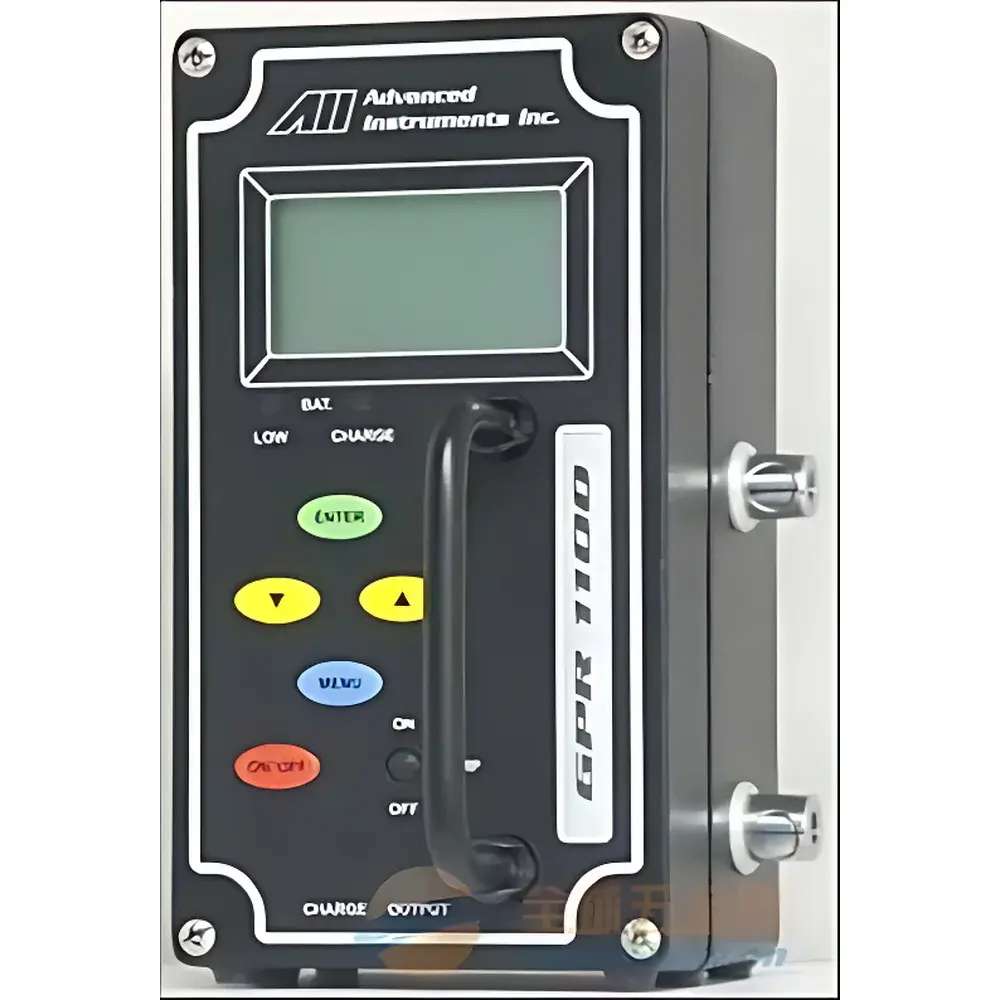
AII GPR-1500 Trace Oxygen Analyzer
| Brand | AII |
|---|---|
| Origin | USA |
| Model | GPR-1500 |
| Measurement Principle | Electrochemical Fuel Cell |
| Range | 0–10 / 100 / 1000 ppm, 0–1% / 25% FS |
| Accuracy | <1% FS (at ambient temperature and pressure) |
| Sensor Life | 24 months (GPR-12-333 fuel cell) |
| Linearity | >0.995 |
| Response Time | 10 s (T₉₀) |
| Sensitivity | 0.5% FS |
| Pressure Range | 5–30 psig (inlet), atmospheric (outlet) |
| Flow Rate | 0.5–5 SCFH (recommended: 2 SCFH) |
| Temperature Range | 5–45°C (GPR sensor) |
| Compensation | Automatic temperature and barometric pressure compensation |
| Output Signal | 4–20 mA |
| Display Resolution | 0.01 ppm |
| Enclosure Rating | NEMA 4X (aluminum-coated) |
| Ingress Protection | IP66 |
| Electrical Interface | Waterproof membrane keypad |
| Gas Connection | 1/8" Swagelok® compression fitting |
| Certifications | CE, ISO 9001 |
| Hazardous Area Options | Intrinsically safe configuration available with approved safety barrier for Class 1, Division 1, Groups A–D (per UL 913 & CSA C22.2 No. 157) |
Overview
The AII GPR-1500 Trace Oxygen Analyzer is a precision-engineered electrochemical instrument designed for continuous, real-time measurement of trace-level oxygen concentrations in industrial process gas streams. Utilizing a proprietary, long-life fuel cell sensor (GPR-12-333), the analyzer operates on the principle of galvanic oxygen reduction—where O₂ diffuses through a selective membrane and undergoes an electrochemical reaction proportional to its partial pressure. This method delivers high selectivity for molecular oxygen without cross-sensitivity to CO₂, H₂, He, or common acid gases (e.g., HCl, SO₂), making it suitable for demanding applications in semiconductor purge lines, inert blanketing systems, hydrogen production monitoring, and high-purity gas manufacturing. Unlike paramagnetic or zirconia-based analyzers, the GPR-1500 requires no consumables, zero calibration gas during normal operation, and exhibits exceptional stability over its rated 24-month service life under typical operating conditions.
Key Features
- Five factory-configurable measurement ranges (0–10 ppm, 0–100 ppm, 0–1000 ppm, 0–1% FS, 0–25% FS), selectable via intuitive menu-driven interface
- True maintenance-free operation: no electrolyte refills, no pump wear, no optical alignment—only periodic zero/span verification per QA protocols
- NEMA 4X aluminum-coated enclosure rated IP66 for outdoor or washdown environments; stainless steel wetted parts compatible with aggressive process media
- Integrated temperature and barometric pressure compensation ensures measurement integrity across variable ambient conditions without external transmitters
- Standard 4–20 mA analog output with HART® compatibility (optional) for integration into DCS, PLC, or SCADA systems with full range scaling and fault diagnostics
- Intrinsically safe configuration available with certified safety barrier (UL 913, CSA C22.2 No. 157) for deployment in Class 1, Division 1, Groups A–D hazardous locations
Sample Compatibility & Compliance
The GPR-1500 is validated for use with inert carrier gases (N₂, Ar), reducing atmospheres (H₂, forming gas), noble gases (He, Ne), and mixed process streams containing up to 0.5% CO₂. For applications exceeding this CO₂ threshold, the optional XLT-12-333 low-temperature fuel cell sensor is recommended to mitigate carbonate formation and ensure signal fidelity. All configurations comply with CE marking requirements (EMC Directive 2014/30/EU, RoHS 2011/65/EU) and are manufactured under ISO 9001:2015 quality management systems. The analyzer supports GLP/GMP-aligned operational practices, including audit-trail-capable calibration logging when paired with AII’s optional PC-based configuration software.
Software & Data Management
While the GPR-1500 operates autonomously via front-panel controls, optional AII ConfigTool™ software enables remote configuration, firmware updates, and data export via USB or RS-232. Calibration events—including date, operator ID, standard gas concentration, and pre/post-calibration readings—are timestamped and stored in non-volatile memory. When integrated into regulated environments (e.g., pharmaceutical nitrogen validation per USP or semiconductor SEMI F57), the system supports 21 CFR Part 11-compliant electronic records when deployed with validated IT infrastructure and role-based access control.
Applications
- Monitoring residual O₂ in semiconductor process tool purge lines (≤10 ppm specification)
- Verification of inert atmosphere integrity in gloveboxes, dry rooms, and battery electrode drying ovens
- Quality assurance of high-purity argon/helium used in welding, metallurgy, and additive manufacturing
- Hydrogen purity testing in PEM electrolyzer and fuel cell stack feed streams
- Leak detection and integrity verification in vacuum chamber backfilling and cryogenic storage systems
- Continuous compliance monitoring for FDA-regulated nitrogen blanket systems in API synthesis
FAQ
What is the expected service life of the GPR-12-333 sensor under continuous operation?
The sensor is rated for 24 months of continuous exposure to target gas at ambient conditions (23°C, 1 atm). Actual longevity may extend beyond this under low-oxygen, low-flow, or intermittent-use scenarios.
Can the GPR-1500 measure oxygen in CO₂-rich streams such as biogas or fermentation off-gas?
Standard GPR-12-333 sensors are not recommended above 0.5% CO₂ due to potential carbonate interference. The XLT-12-333 low-temperature variant is required for reliable performance in such matrices.
Is field calibration possible without external gas standards?
Zero calibration can be performed using certified nitrogen (99.999% purity); span calibration requires a certified O₂-in-N₂ standard at ~80% of selected full-scale value. No internal zero gas generator is included.
Does the analyzer support Modbus RTU or Ethernet/IP communication protocols?
The base unit provides only 4–20 mA output. Digital protocol support (Modbus RTU over RS-485, optional) is available via the AII DIO-1500 interface module.
What mechanical protection is provided against condensation or particulate ingress?
The NEMA 4X-rated enclosure prevents water ingress from hose-directed spray; however, inlet gas must be filtered to ≤1 µm and dried to a dew point ≥10°C below ambient to prevent sensor membrane fouling or electrolyte dilution.
Related Products