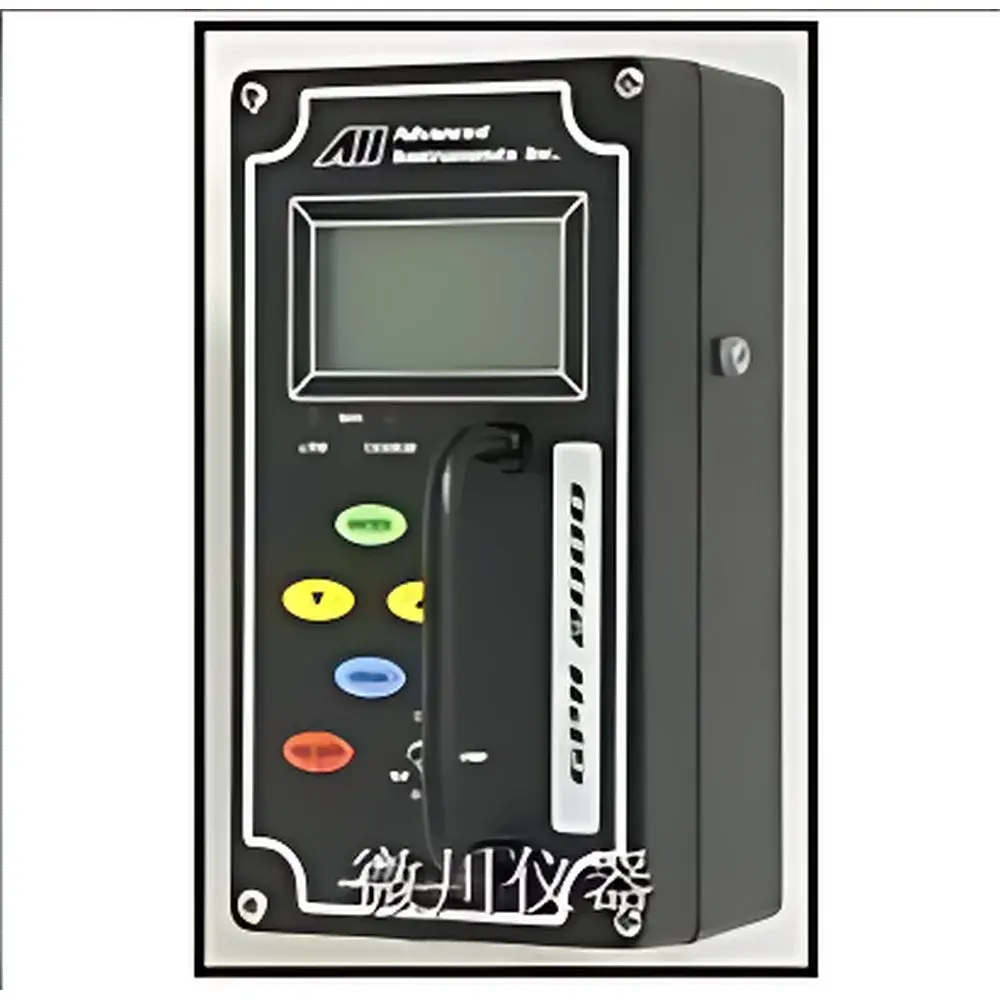
AII GPR-2000 Percent Oxygen Analyzer
| Brand | AII |
|---|---|
| Origin | USA |
| Model | GPR-2000 |
| Measurement Range | 0–1%, 0–5%, 0–10%, 0–25% (user-selectable) |
| Full-Scale Accuracy | <1% FS |
| Resolution | 0.001% O₂ |
| Response Time (t₉₀) | 10 s |
| Operating Temperature | –10°C to +45°C (GPR sensor), –20°C to +45°C (XLT sensor) |
| Sample Pressure | 5–30 psig inlet, vent to atmosphere |
| Flow Rate | 0.25–2.5 L/min (recommended: 1.0 L/min) |
| Output Signal | 0–1 V analog |
| Sensor Lifetime | 36 months (GPR-11-32-RT, 25°C) |
| Enclosure Rating | NEMA 4X |
| Weight | 8 lbs |
| Dimensions | 4" × 9" × 3" |
| Certifications | CE, ATEX/IECEx compliant for Class I, Div. 1, Groups A, B, C, D (intrinsically safe) |
Overview
The AII GPR-2000 Percent Oxygen Analyzer is a field-deployable, intrinsically safe electrochemical analyzer engineered for continuous, high-stability measurement of oxygen concentration across a wide dynamic range—from trace-level detection at 500 ppm up to full-scale 100% O₂ in non-corrosive industrial gas streams. It employs a proprietary, gold-plated electrochemical sensor (GPR-11-32-RT) operating on the principle of galvanic oxygen reduction, delivering stable, drift-free output without external power applied to the sensing element. Unlike paramagnetic or zirconia-based analyzers, the GPR-2000 leverages temperature-compensated diffusion-limited current generation, enabling robust performance in inert carrier gases (N₂, Ar), hydrocarbon mixtures (CH₄, C₂H₆), hydrogen, helium, and CO₂—environments where catalytic poisons or thermal gradients commonly degrade alternative technologies. Its compact NEMA 4X enclosure, integrated rechargeable battery (60-day standby, 24-hour operation with internal pump), and intrinsic safety certification make it suitable for hazardous locations per NEC Class I, Div. 1 and ATEX Zone 1 requirements.
Key Features
- Intrinsically safe design certified for Class I, Div. 1, Groups A, B, C, D — fully compliant with IEC 60079-0/-11 and UL 913 standards
- User-selectable measurement ranges: 0–1%, 0–5%, 0–10%, and 0–25% O₂, each optimized for linearity (>0.995 R²) and repeatability
- High-resolution 2.75″ × 1.375″ LCD display showing real-time O₂ %, temperature, pressure, battery status, and diagnostic flags
- Automated zero and span calibration routines with built-in system diagnostics; calibration performed using certified reference gas at ≥80% of selected range
- Integrated temperature compensation algorithm minimizing thermal drift across –10°C to +45°C ambient (GPR sensor)
- 0–1 V analog output with 12-bit DAC resolution for seamless integration into DCS, PLC, or SCADA systems
- Modular sensor architecture supporting field-replaceable GPR-11-32-RT (36-month life) or optional XLT-11-24-RT (24-month extended-life variant)
Sample Compatibility & Compliance
The GPR-2000 is validated for use with dry, non-condensing process gases including nitrogen, argon, helium, hydrogen, carbon dioxide, methane, ethane, and other saturated hydrocarbons. It is not intended for use with corrosive gases (e.g., Cl₂, HCl, SO₂), solvent vapors, or aerosol-laden streams without upstream coalescing filtration. All wetted materials consist of chemically resistant plastics (e.g., PTFE, PVDF) and 316 stainless steel fittings, ensuring long-term compatibility with aggressive gas matrices. The analyzer meets CE marking requirements under the EU ATEX Directive 2014/34/EU and carries full documentation for GLP/GMP environments—including audit-ready calibration logs, sensor replacement records, and firmware revision tracking. While not FDA 21 CFR Part 11–certified out-of-the-box, its data logging and user-access control architecture supports validation protocols required for pharmaceutical inerting and packaging applications.
Software & Data Management
The GPR-2000 operates autonomously without host software; however, its analog output and onboard diagnostics support integration into third-party data acquisition platforms. Internal memory stores up to 100 calibration events, 50 system fault logs, and real-time timestamped O₂ readings at 1-second intervals (when configured with optional data logger module). All calibration actions require operator authentication via membrane keypad, generating immutable audit trails. Firmware updates are performed via USB interface using AII’s secure, version-controlled utility—each release accompanied by a formal change control document traceable to ISO 9001:2015 clause 8.5.1. For regulated industries, optional RS-485 Modbus RTU communication enables remote configuration, alarm threshold setting, and diagnostic polling compatible with ISA-88/ISA-95 infrastructure.
Applications
- Inert gas blanketing monitoring in chemical reactors, storage tanks, and distillation columns
- Oxygen purity verification in on-site nitrogen or argon generators (PSA/VSA systems)
- Process validation during thermal annealing, brazing, and sintering in controlled-atmosphere furnaces
- Quality assurance in food packaging lines utilizing modified atmosphere (MAP) with N₂/CO₂ blends
- Safety interlock verification for hydrogen handling systems and fuel cell test benches
<liLeak detection in gloveboxes, vacuum chambers, and semiconductor fabrication enclosures
FAQ
What is the recommended sample flow rate?
The optimal flow rate is 1.0 L/min, with acceptable operation between 0.25 and 2.5 L/min. Excessive flow may induce pressure drop-induced measurement artifacts; insufficient flow delays response time.
Can the GPR-2000 measure below 500 ppm O₂?
No—it is designed for percent-level analysis (0.05%–100%). For sub-ppm detection, AII recommends the GPR-1000 series with paramagnetic or laser-based sensors.
Is the internal battery replaceable in the field?
Yes—the sealed lead-acid battery is user-serviceable with standard Torx tools and requires no recalibration after replacement.
Does the analyzer support automatic pressure compensation?
No—pressure compensation is not implemented; accurate operation requires stable inlet pressure between 5–30 psig as specified in the installation manual.
How often does the sensor require recalibration?
A minimum quarterly calibration is recommended under normal operating conditions; frequency increases with exposure to high-O₂ or high-humidity environments per ASTM D6299 guidance.
Related Products