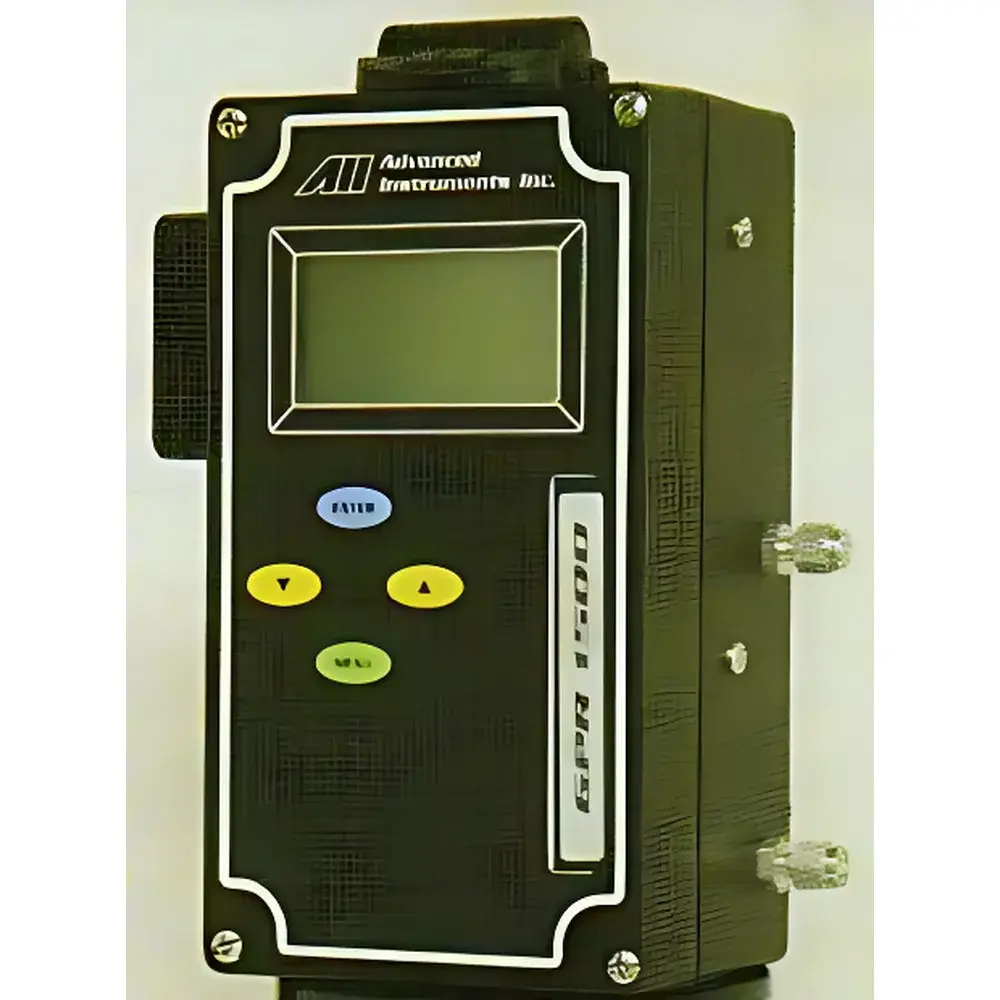
AII GPR-2500 Percent Oxygen Analyzer
| Brand | AII |
|---|---|
| Origin | USA |
| Model | GPR-2500 |
| Measurement Principle | Electrochemical Fuel Cell |
| Range Options | 0–1%, 0–5%, 0–10%, 0–25% O₂ by volume (FS) |
| Accuracy | < ±1% of full scale |
| Resolution | 0.001% O₂ |
| Response Time (T₉₀) | ≤10 seconds |
| Linearity | R² > 0.995 |
| Operating Temperature | –10°C to +45°C (GPR sensor) |
| Pressure Range | 5–30 psig inlet |
| Flow Rate | 0.5–5 SCFH (recommended: 2 SCFH) |
| Compensation | Automatic temperature and barometric pressure compensation |
| Output Signal | 4–20 mA analog (isolated) |
| Enclosure Rating | NEMA 4X aluminum housing |
| Electrical Interface | 12–28 VDC |
| Ingress Protection | IP66 |
| Compliance | CE-marked, ISO 9001 certified, compatible with IS barrier for Class I, Division 1, Groups A–D (per UL 913/IEC 60079-11) |
| Sensor Lifetime | 36 months typical (GPR-11-32-4 fuel cell) |
| Optional Sensor | XLT-11-24-4 (for CO₂-rich environments >0.5% CO₂) |
| Calibration Gas Recommendation | 80% FS O₂ in inert balance |
Overview
The AII GPR-2500 Percent Oxygen Analyzer is a fixed-mount, industrial-grade electrochemical analyzer engineered for continuous, high-stability measurement of oxygen concentration across multiple process gas streams. Utilizing a solid-polymer electrolyte fuel cell sensor, the instrument delivers trace-to-percent-level O₂ quantification without consumable reagents or routine electrolyte refills. Its measurement principle relies on the electrochemical oxidation of oxygen at the cathode, generating a current linearly proportional to partial pressure—ensuring robust performance in inert, reducing, and mildly acidic gas matrices including helium, hydrogen, nitrogen, argon, and CO₂-containing mixtures. Designed for integration into plant-wide control systems, the GPR-2500 operates continuously under varying ambient conditions while maintaining metrological integrity through real-time temperature and barometric pressure compensation.
Key Features
- Long-life electrochemical fuel cell sensor (GPR-11-32-4) with nominal 36-month operational lifetime and zero maintenance requirements
- Four factory-configurable full-scale ranges: 0–1%, 0–5%, 0–10%, and 0–25% O₂ by volume—switchable manually or via external signal
- NEMA 4X anodized aluminum enclosure rated IP66 for outdoor or washdown environments
- True analog 4–20 mA output with galvanic isolation, compatible with DCS, PLC, and SCADA architectures
- Integrated environmental monitoring: real-time display of local temperature and atmospheric pressure
- Intrinsic safety compatibility via optional UL-listed IS barrier for hazardous locations (Class I, Division 1, Groups A–D)
- High-resolution LCD interface with 0.001% O₂ readability and intuitive menu-driven calibration and diagnostics
- Wide operating voltage range (12–28 VDC), supporting both loop-powered and externally powered configurations
Sample Compatibility & Compliance
The GPR-2500 is validated for use with non-corrosive and mildly acidic process gases—including high-purity inert carriers (N₂, Ar, He), hydrogen, synthetic air blends, and CO₂-diluted streams up to 0.5% CO₂ (with standard GPR sensor). For applications exceeding 0.5% CO₂, the optional XLT-11-24-4 sensor variant provides enhanced stability and reduced cross-sensitivity. All sensor variants are calibrated using NIST-traceable standard gases, and the analyzer meets CE marking requirements for electromagnetic compatibility (EMC Directive 2014/30/EU) and low-voltage safety (LVD Directive 2014/35/EU). The system supports audit-ready operation per GLP and GMP frameworks when paired with compliant data logging infrastructure; though not natively 21 CFR Part 11-certified, its analog output and deterministic response behavior enable validation within regulated manufacturing environments (e.g., pharmaceutical purge verification, semiconductor annealing atmosphere monitoring).
Software & Data Management
The GPR-2500 operates as a stand-alone field instrument with no embedded firmware-based data storage or network connectivity. Configuration, calibration, and diagnostic functions are executed locally via front-panel membrane keys and the built-in LCD. While it does not include onboard software or cloud interfaces, its 4–20 mA output is fully compatible with third-party historian systems (e.g., OSIsoft PI, Emerson DeltaV, Honeywell Experion) for time-series trending, alarm management, and SPC analysis. Calibration events—date, operator ID (manually entered), span gas concentration, and post-calibration deviation—are retained in non-volatile memory for up to 100 cycles and can be reviewed on-screen. The device supports periodic verification per ASTM D6299 and ISO 8573-7 protocols when integrated with certified gas delivery modules.
Applications
- Control of inerting atmospheres in chemical reactors, distillation columns, and storage tanks
- Monitoring of purge gas purity in semiconductor fabrication tools (e.g., CVD, ALD chambers)
- Verification of oxygen removal in food packaging headspace and modified-atmosphere processing lines
- Leak detection and integrity testing of sealed enclosures and gloveboxes
- Quality assurance in metal heat-treating furnaces and vacuum brazing systems
- Regulatory compliance monitoring for USP water-for-injection (WFI) nitrogen blanket systems
FAQ
What is the recommended calibration frequency?
AII recommends quarterly calibration using an 80% FS certified standard gas in the intended measurement range. More frequent calibration may be required in high-contamination or high-flow environments.
Can the GPR-2500 measure oxygen in hydrogen-rich streams?
Yes—the GPR-11-32-4 fuel cell exhibits minimal interference from H₂ and is routinely deployed in PEM electrolyzer off-gas monitoring and hydrogen purification loops.
Is temperature compensation automatic or manual?
Fully automatic: integrated Pt100 RTD and barometric sensor provide real-time compensation across the full operating range.
Does the unit support Modbus or HART communication?
No—only isolated 4–20 mA analog output is provided. Digital protocols require external signal converters.
What is the minimum detectable oxygen level in the 0–1% range?
The resolution is 0.001% O₂, with sensitivity better than 0.5% of full scale—translating to sub-ppm effective detection capability at low concentrations.
Related Products