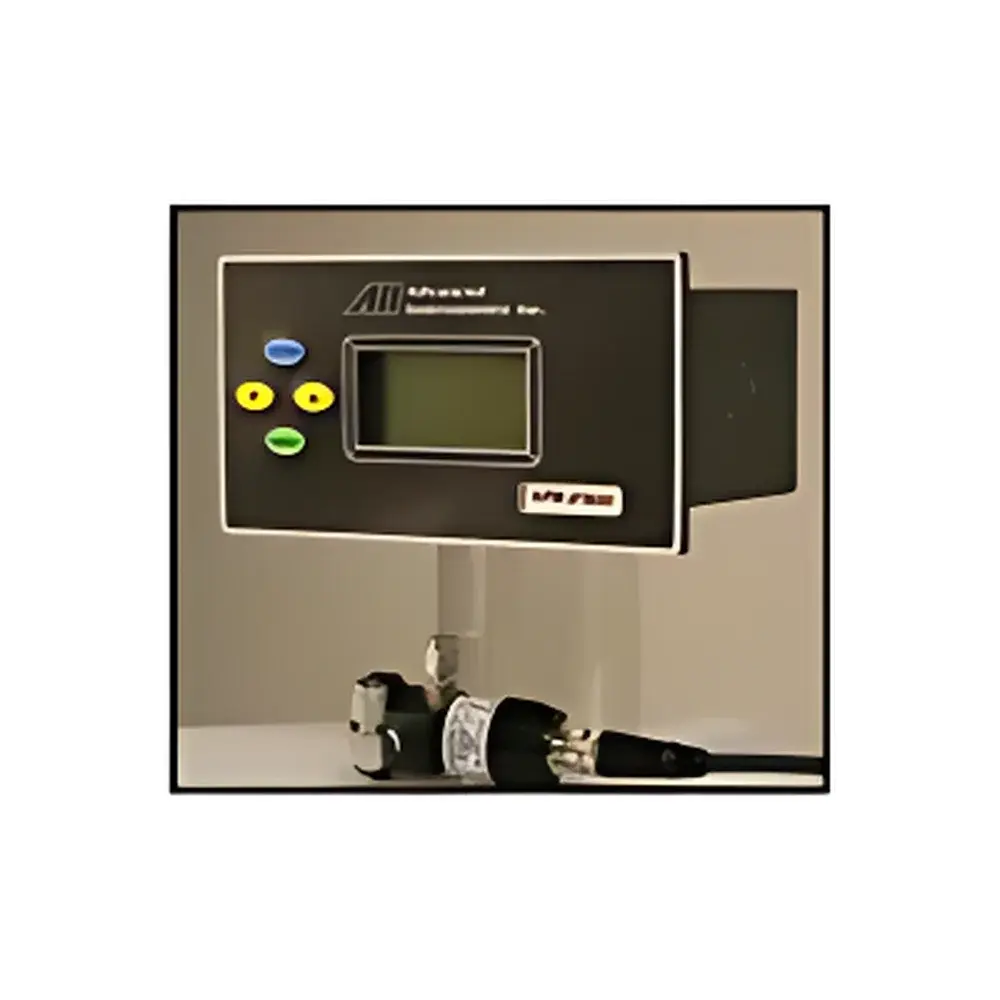
AII GPR-2900 Online Oxygen Analyzer
| Brand | AII |
|---|---|
| Origin | USA |
| Model | GPR-2900 |
| Measurement Principle | Electrochemical Fuel Cell |
| Range Options | 0–1%, 0–5%, 0–10%, 0–25% O₂ by volume (FS) |
| Accuracy | < ±1% FS |
| Linearity | >0.995 |
| Response Time (t₉₀) | ≤10 seconds |
| Sensitivity | <0.5% FS |
| Pressure Range (Inlet) | 5–30 psig (max 100 psig) |
| Outlet Pressure | Ambient |
| Flow Rate | 1–5 SCFH (recommended: 2 SCFH) |
| Temperature Range (Sensor) | GPR-11-60-4: –10 to +45°C |
| XLT-11-24-4 | –20 to +45°C |
| Compensation | Automatic temperature and barometric pressure compensation |
| Output Signals | 0–1 VDC analog + isolated 4–20 mA |
| Display Resolution | 0.001% O₂ |
| Enclosure | Anodized aluminum panel-mount housing |
| Certifications | CE, ISO 9001 |
| Compliance | Designed for general-purpose industrial environments per IEC 61000-6-2/6-4 and EN 61326-1 |
Overview
The AII GPR-2900 Online Oxygen Analyzer is an industrial-grade electrochemical fuel cell-based analyzer engineered for continuous, real-time measurement of oxygen concentration in inert, reducing, and mildly acidic gas streams—including helium, hydrogen, nitrogen, argon, and CO₂-containing mixtures. Unlike paramagnetic or zirconia-based analyzers, the GPR-2900 employs a galvanic fuel cell sensor that generates a current proportional to O₂ partial pressure—offering inherent stability, zero power consumption at the sensing element, and immunity to flow rate fluctuations within its specified range. Its architecture supports uninterrupted operation in non-hazardous process environments, with no requirement for consumable electrolytes or periodic membrane replacement. The analyzer is calibrated for trace-to-percent-level oxygen detection across four factory-configurable full-scale ranges, making it suitable for applications demanding long-term drift stability and minimal intervention—such as blanketing gas monitoring, controlled atmosphere furnaces, semiconductor purge verification, and pharmaceutical inerting validation.
Key Features
- Electrochemical fuel cell sensor (GPR-11-60-4) with 60-month nominal service life and zero routine maintenance
- Four selectable full-scale ranges: 0–1%, 0–5%, 0–10%, and 0–25% O₂—switchable manually or automatically via internal logic
- Integrated temperature and barometric pressure compensation algorithms to maintain accuracy across ambient variations
- Dual independent alarm relays (capacitive type), configurable for high/low O₂ thresholds, sensor signal degradation, power failure, and system fault conditions
- Large backlit LCD display showing real-time O₂ reading (0.001% resolution), ambient temperature, and local barometric pressure
- Front-panel membrane keypad with intuitive menu navigation for calibration, range selection, alarm setup, and system diagnostics
- Isolated 4–20 mA output and 0–1 V analog output—both scalable and independently configurable for integration into DCS, PLC, or SCADA systems
- RS-232 serial interface supporting Modbus RTU protocol for remote configuration, data logging, and firmware updates
- Robust anodized aluminum panel-mount enclosure rated for industrial control room or on-skid mounting (IP65 front rating)
Sample Compatibility & Compliance
The GPR-2900 is validated for use with non-corrosive and mildly acidic process gases, including N₂, Ar, He, H₂, and CO₂-rich mixtures up to 25% v/v. For applications where CO₂ exceeds 0.5%, the optional XLT-11-24-4 low-temperature sensor variant is recommended to mitigate cross-sensitivity and extend sensor longevity. Gas inlet conditioning—including particulate filtration, moisture removal, and optional heated sample lines—is supported via field-installable accessories. The analyzer complies with CE marking requirements under the EMC Directive 2014/30/EU and Low Voltage Directive 2014/35/EU. It is manufactured under an ISO 9001-certified quality management system. While not intrinsically safe, the unit meets general-purpose classification per IEC 60079-0 and is intended for installation in non-classified areas. It supports documentation traceability required for GMP-aligned processes when paired with external audit-ready data loggers.
Software & Data Management
The GPR-2900 does not include embedded data storage but provides direct analog and digital outputs compatible with third-party historian systems (e.g., OSIsoft PI, Ignition SCADA). Through its RS-232 port, users may implement automated calibration logging, alarm event timestamping, and sensor health diagnostics using custom scripts or commercial communication gateways. The device supports standard Modbus RTU register mapping for read/write access to measured values, alarm states, sensor voltage, temperature, pressure, and calibration timestamps. When integrated into validated environments, the 4–20 mA output can be configured with NIST-traceable scaling and assigned to specific instrument tags compliant with ISA-5.1 and ISA-84 nomenclature. Optional data acquisition modules enable time-stamped CSV export of up to 10,000 data points for offline trend analysis and regulatory reporting.
Applications
- Continuous monitoring of O₂ in nitrogen blanketing systems for chemical reactors and storage tanks
- Inert atmosphere verification in heat-treating furnaces and sintering ovens
- Purge gas qualification in pharmaceutical isolators and lyophilization chambers
- Leak detection in sealed gloveboxes and vacuum transfer systems
- Quality assurance of modified atmosphere packaging (MAP) gas mixtures
- Process safety interlocks for hydrogen or ammonia synthesis loops
- Environmental chamber O₂ control in materials testing laboratories
FAQ
What calibration gases are recommended for routine verification?
A certified 80% of full-scale oxygen standard (e.g., 8.0% O₂ in N₂ for the 0–10% range) is recommended for span calibration. Zero calibration is performed using high-purity inert gas (e.g., 99.999% N₂ or Ar).
Can the GPR-2900 operate on DC power?
Yes—the analyzer accepts 18–36 VDC input via terminal block, enabling deployment in mobile or battery-backed installations without AC infrastructure.
Is the sensor replaceable in the field?
Yes—sensor modules (GPR-11-60-4 or XLT-11-24-4) are user-swappable without tools; calibration coefficients are stored in the sensor’s EEPROM and auto-loaded upon insertion.
Does the unit support FDA 21 CFR Part 11 compliance?
The GPR-2900 itself does not provide electronic signatures or audit trails, but its analog/digital outputs and RS-232 interface are fully compatible with Part 11-compliant data acquisition systems when deployed with appropriate validation protocols.
What is the maximum allowable inlet pressure?
The sensor housing is rated for continuous operation at 5–30 psig; transient exposure up to 100 psig is permissible if limited to less than 5 minutes and followed by pressure relief.
Related Products