
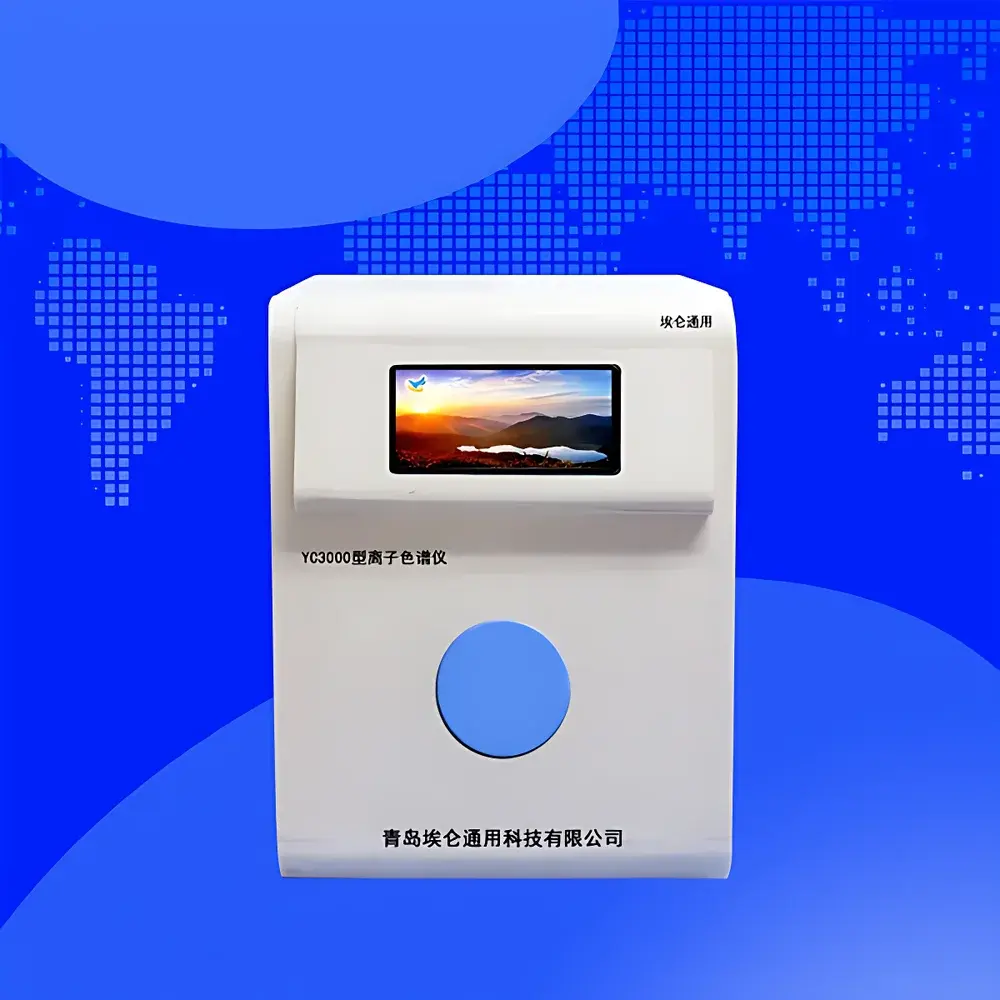
Ailun YC3000 Ion Chromatograph
| Brand | Ailun General / Qingdao Ailun |
|---|---|
| Origin | Shandong, China |
| Manufacturer Type | Authorized Distributor |
| Regional Classification | Domestic (PRC) |
| Model | YC3000 |
| Price Range | USD 14,000–28,000 |
| Instrument Type | Laboratory Benchtop |
| Application Scope | General-Purpose Ion Analysis |
| Pump Pressure Range | 0–42 MPa |
| Flow Rate Range | 0.001–9.999 mL/min |
| Eluent Flow Rate (Typical) | 1.5 mL/min |
| Maximum Operating Pressure | 42 MPa |
| Operating Temperature Range | 0–65 °C |
| Temperature Reproducibility | ±0.2 °C |
| Eluent Concentration Range | 0.1–60 mM |
Overview
The Ailun YC3000 Ion Chromatograph is a benchtop, general-purpose analytical system engineered for high-precision separation and quantification of inorganic anions and cations in aqueous matrices. Based on suppressed conductivity detection coupled with high-pressure ion exchange chromatography, the YC3000 employs a dual-piston reciprocating pump, PEEK-based high-pressure six-port valve, and a patented integrated degassing–gas–liquid separation module to ensure baseline stability and long-term operational robustness. Designed for compliance with routine regulatory workflows—including those aligned with EPA Methods 300.0, 300.1, and ISO 10304-1—the instrument delivers reproducible retention times and peak symmetry across diverse sample types, from drinking water and environmental extracts to industrial process streams and clinical saline solutions.
Key Features
- Modular detector architecture supporting interchangeable conductivity detection cells optimized for both anion and cation analysis—enabling single-instrument deployment across dual-mode applications.
- Dual-piston reciprocating pump controlled by embedded microprocessor with real-time pulse damping algorithms, achieving flow pulsation <0.1% RSD at 1.5 mL/min.
- Imported PEEK high-pressure six-port valve with automatic signal acquisition and continuous-flow capability during valve actuation—minimizing column equilibration delays and improving method transfer fidelity.
- Patented positive-pressure degassing system integrated with gas–liquid phase separator, eliminating baseline drift induced by dissolved CO₂ or O₂ fluctuations in eluent streams.
- Integrated column–detector oven with intelligent power modulation: maintains setpoint temperature (0–65 °C) with ±0.2 °C reproducibility while operating under uninterrupted electrical current—ensuring thermal equilibrium without interrupting data acquisition.
- 24-bit analog-to-digital converter with digital USB 2.0 interface; supports real-time parameter monitoring (pressure, conductivity, current, flow, range) via backlit LCD touchscreen with tactile feedback keys.
Sample Compatibility & Compliance
The YC3000 accommodates direct injection of clarified aqueous samples with total suspended solids <1 µm and organic content <5% v/v. It is validated for use with standard anion-exchange columns (e.g., AS23, AS19) and cation-exchange columns (e.g., CS12A, CS16), compatible with carbonate/bicarbonate, hydroxide, and methanesulfonic acid eluents. System architecture meets mechanical and electromagnetic compatibility requirements per IEC 61326-1 (industrial environments) and supports audit-ready operation under GLP and GMP frameworks. While not pre-certified for 21 CFR Part 11, its digital signal chain and timestamped raw data output are fully compatible with third-party electronic lab notebook (ELN) and LIMS integration for full traceability.
Software & Data Management
Instrument control, sequence definition, peak integration, and report generation are managed via Ailun IC-Studio software (v3.2+), a Windows-based application supporting multi-user permission levels, method validation templates, and customizable reporting formats (PDF, CSV, XML). Raw chromatograms are stored in vendor-neutral .cdf format compliant with ASTM E1947-17. All acquisition parameters—including pressure logs, conductivity baselines, and temperature profiles—are time-stamped and archived alongside processed results. Software includes built-in calibration curve fitting (linear, quadratic, weighted), limit-of-detection estimation per ICH Q2(R2), and batch-level QC flagging based on user-defined acceptance criteria.
Applications
- Environmental monitoring: Quantification of F⁻, Cl⁻, NO₂⁻, NO₃⁻, SO₄²⁻, ClO₂⁻, ClO₃⁻, Br⁻, BrO₃⁻, and PO₄³⁻ in surface water, groundwater, and wastewater per ISO 10304-1 and EPA Method 300.1.
- Drinking water safety: Routine surveillance of Li⁺, Na⁺, K⁺, Mg²⁺, and Ca²⁺ in municipal supply networks, including compliance verification against WHO Guidelines and GB 5749-2022.
- Industrial quality control: Anion impurity profiling in semiconductor-grade ultrapure water, battery electrolyte solutions, and pharmaceutical excipients.
- Public health laboratories: Rapid screening of disinfection by-products (e.g., chlorate, perchlorate) in treated water and food extracts.
- Academic and governmental research: Method development for speciation analysis of transition metal ions and oxyanions in geochemical and nuclear waste simulants.
FAQ
What eluent concentration ranges does the YC3000 support?
The system is calibrated for eluent concentrations between 0.1 mM and 60 mM, covering common carbonate, hydroxide, and methanesulfonic acid gradients used in both anion and cation separations.
Is the YC3000 compatible with USP/Ph. Eur. monographs requiring ion chromatography?
Yes—when operated with validated methods and appropriate columns, it fulfills the instrumental performance criteria outlined in USP <1058> and Ph. Eur. 2.2.46 for conductivity detection-based assays.
Can the instrument operate unattended for extended sequences?
Yes—integrated autosampler compatibility (optional), pressure fault auto-shutdown, and real-time leak detection enable overnight and weekend runs with full event logging.
Does the system support post-run column regeneration protocols?
Yes—software-controlled gradient elution, flow reversal, and high-concentration flush sequences can be programmed directly into method files.
What maintenance intervals are recommended for the suppressor and detector cell?
Suppressor lifespan exceeds 2,000 injections under typical conditions; detector cell cleaning is recommended every 500 injections or when baseline noise increases >15% above initial specification.




