
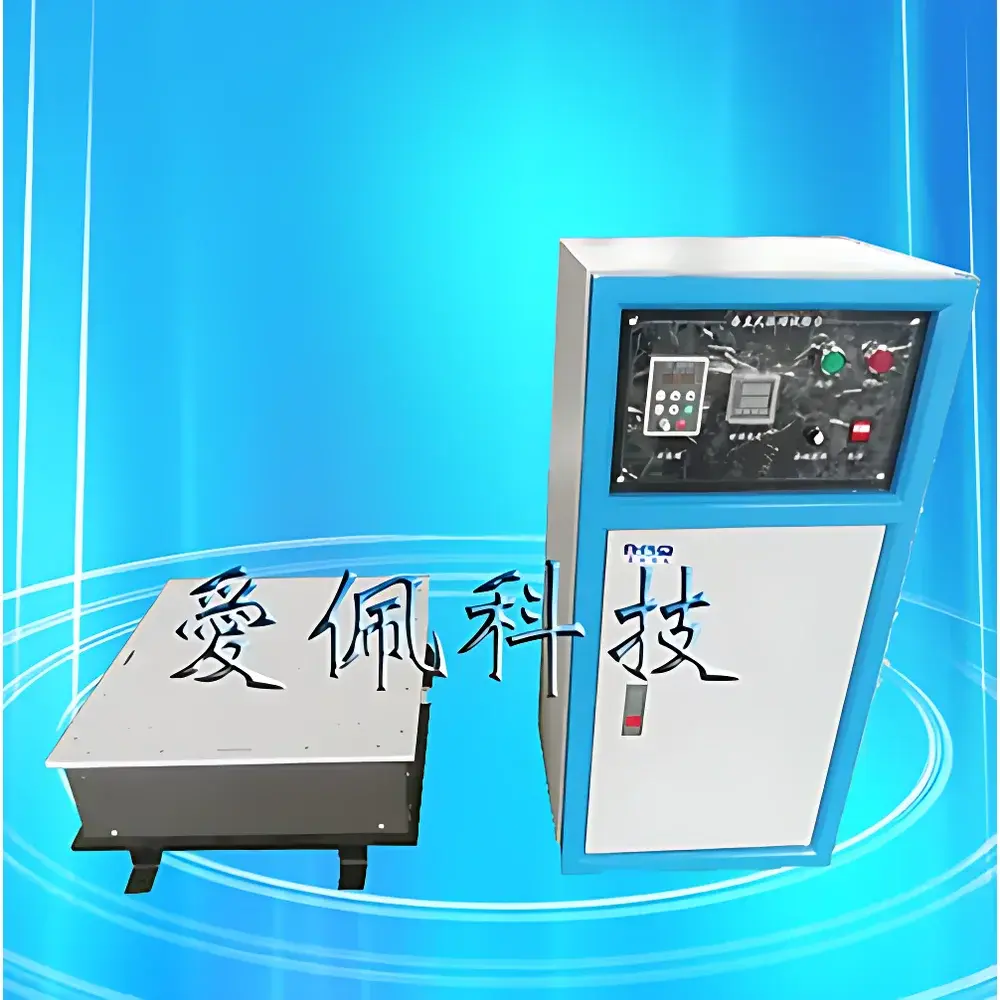
Aipu Technology AP-DC-HF Electromagnetic Vibration Test System
| Brand | Aipu Technology (APKJ) |
|---|---|
| Origin | Guangdong, China |
| Manufacturer Type | Direct Manufacturer |
| Model | AP-DC-HF |
| Frequency Range | 1–5000 Hz |
| Max. Acceleration | 20 g |
| Peak-to-Peak Displacement | 0–5 mm |
| Sweep/Programmable Mode | 15-segment, up to 65,500 s/segment, repeatable |
| Waveform | Sine (full/half cycle) |
| Control Precision | ±0.1 Hz (display resolution 0.01 Hz) |
| Input Power | 2.2 kW |
| Voltage | 220 V ±20% |
| Max. Current | 7 A |
| Table Size | 500 × 500 mm |
| Max. Load Capacity | 100 kg |
Overview
The Aipu Technology AP-DC-HF Electromagnetic Vibration Test System is an engineered-for-precision electrodynamic shaker designed to perform controlled mechanical vibration testing in accordance with international reliability and qualification standards. Utilizing electromagnetic force generation via voice-coil actuator technology, this system delivers high-fidelity sinusoidal excitation across a broad frequency spectrum (1–5000 Hz), enabling accurate simulation of real-world dynamic environments encountered during transportation, operational use, or service life. Its core function is to assess structural integrity, identify latent defects, verify design robustness, and support failure mode analysis—critical requirements for industries subject to stringent quality assurance protocols, including aerospace, defense, automotive electronics, telecommunications, and consumer appliance manufacturing. The system operates on the principle of Lorentz force actuation, where current-driven coil motion within a permanent magnetic field produces reproducible acceleration profiles with minimal harmonic distortion and thermal drift.
Key Features
- Electrodynamic shaker architecture with optimized magnetic circuit design for stable force output and low impedance thermal management.
- High-resolution frequency control (0.01 Hz display resolution, ±0.1 Hz accuracy) supporting precise resonance tracking and dwell verification.
- Dual-mode operation: fixed-frequency sine, swept-sine (linear/logarithmic), and programmable multi-segment profiles (up to 15 segments, each configurable for duration, amplitude, and frequency sweep rate).
- 500 × 500 mm aluminum alloy test table with T-slot configuration for secure fixture mounting and modal consistency across load conditions.
- Robust power amplifier (2.2 kW) delivering peak acceleration up to 20 g at 100 kg payload, compliant with ISO 5344 and ASTM D999 vibration test boundary conditions.
- Integrated LED-based controller with real-time monitoring of displacement (p-p), acceleration (g RMS/g peak), and velocity; supports manual override and emergency stop per IEC 60204-1 safety standards.
Sample Compatibility & Compliance
The AP-DC-HF accommodates rigid and semi-rigid test specimens up to 100 kg, including PCB assemblies, enclosures, sensor modules, automotive ECUs, and small mechanical subassemblies. Fixture design must ensure rigid coupling without resonant amplification below 500 Hz; Aipu provides fixture validation guidelines aligned with MIL-STD-810H Method 514.7 and IEC 60068-2-6. The system meets CE marking requirements for electromagnetic compatibility (EN 61000-6-3/6-4) and functional safety (EN ISO 13857). While not inherently 21 CFR Part 11 compliant, its data logging interface supports external audit-trail-capable software for GLP/GMP-regulated environments when integrated with validated third-party acquisition platforms.
Software & Data Management
The AP-DC-HF operates via embedded firmware with local parameter storage and time-stamped test log export (CSV format) for post-processing in MATLAB, Python, or commercial signal analysis tools. Optional RS-232/USB interfaces enable remote command execution using SCPI-like syntax. All test configurations—including sweep rates, dwell times, amplitude profiles, and segment sequencing—are stored with timestamped revision history. For regulated laboratories, the system can be paired with vendor-validated PC-based control software offering electronic signatures, user role management, and audit trail generation per FDA 21 CFR Part 11 Annex 11 requirements.
Applications
- Structural durability assessment under simulated road transport, rail transit, or airborne vibration spectra.
- Resonance search and residence testing to identify critical natural frequencies and verify damping performance.
- Screening of solder joint integrity, connector retention, and mechanical fastener security in electronic assemblies.
- Early-life failure detection (burn-in screening) via stress-induced defect activation before product shipment.
- Verification of packaging system performance against ISTA 3A/3E and ASTM D4169 distribution profiles.
- Material fatigue evaluation under controlled cyclic loading, particularly for polymer housings and elastomeric mounts.
FAQ
What standards does the AP-DC-HF support for vibration testing?
It is compatible with test methods defined in ISO 5344, IEC 60068-2-6, MIL-STD-810H Method 514.7, and ASTM D999. Custom profiles may be implemented to meet internal OEM specifications.
Can the system perform random vibration testing?
The base AP-DC-HF model supports only deterministic waveforms (sine, swept-sine, programmable sine sequences). Random vibration capability requires optional hardware upgrade (digital signal processor + broadband amplifier) and dedicated control software.
Is fixture design assistance available?
Yes—Aipu provides mechanical interface drawings, modal analysis recommendations, and fixture validation checklists upon request. Customers are responsible for final fixture fabrication and modal verification.
What maintenance is required for long-term calibration stability?
Annual verification of accelerometer sensitivity and shaker force linearity is recommended using NIST-traceable reference equipment. Internal amplifier calibration is performed during factory service intervals.
Does the system include data acquisition hardware?
No—the AP-DC-HF is a closed-loop shaker controller. External data acquisition (DAQ) systems—such as those from National Instruments or Dewesoft—are required for synchronized multi-channel measurement and spectral analysis.



