
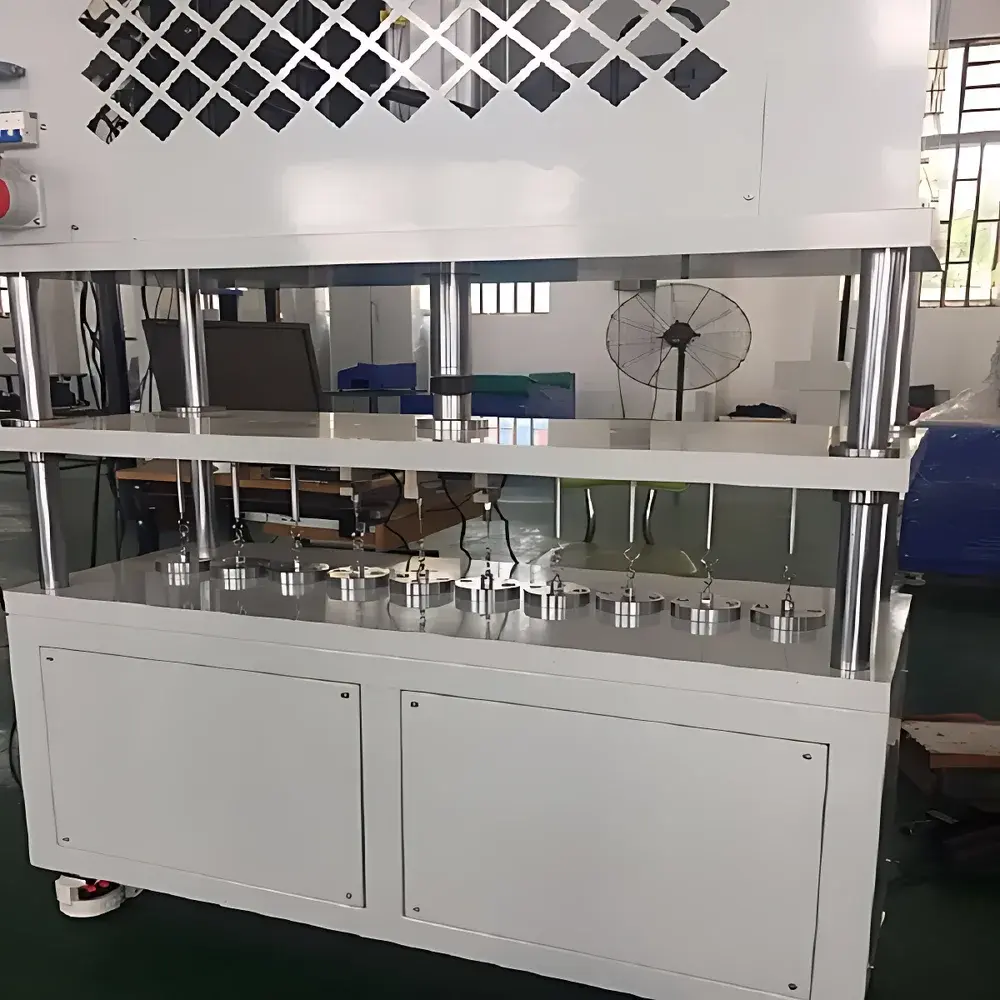
Air Spring Fatigue Testing Machine QJPL
| Origin | Shanghai, China |
|---|---|
| Manufacturer Type | Authorized Distributor |
| Origin Category | Domestic (China) |
| Model | QJPL |
| Price | ¥120,000 |
| Max Test Force Range | 0.2%–100% of Full Scale |
| Force Accuracy | ±0.5% of reading (0.2%–100% FS) |
| Tensile Stroke | 50 mm |
| Compression Stroke | 50 mm |
| Displacement Resolution | 1/30,000 FS |
| Displacement Accuracy | ±0.002 mm |
| Speed Control Range | 0.001–50 mm/min (fully adjustable) |
| Speed Control Accuracy | Grade 0.5 |
| Load Capacity | 3 kN |
| Frequency Range | 0.001–10 Hz (amplitude-dependent) |
| Amplitude Range | 0.001–50 mm (adjustable) |
| Deformation Measurement Accuracy | ±1% of reading |
| Effective Test Width | 60 mm per station |
| Max Spring OD | ≤60 mm |
| Max Free Length | ≤240 mm |
| Power Supply | 220 V AC, 2 kW |
| Net Weight | ~850 kg |
Overview
The QJPL Air Spring Fatigue Testing Machine is a high-precision electro-mechanical fatigue system engineered for controlled cyclic loading of pneumatic and mechanical elastic components under axial tension-compression conditions. It operates on a servo-controlled linear actuation principle, delivering programmable sinusoidal, trapezoidal, or arbitrary waveform displacement profiles to simulate real-world service conditions—including vehicle suspension dynamics, industrial vibration isolation, and rail transit air spring duty cycles. Designed in accordance with fundamental principles of mechanical endurance testing, the system enables quantitative evaluation of fatigue life, hysteresis behavior, stiffness degradation, and permanent set accumulation over thousands to millions of cycles. Its modular architecture supports multi-station parallel testing—up to six identical or heterogeneous air springs simultaneously—ensuring statistically robust data acquisition for quality assurance, design validation, and regulatory compliance workflows.
Key Features
- High-resolution force measurement with 1/30,000 full-scale resolution and ±0.5% accuracy across 0.2%–100% of 3 kN capacity—no range switching required
- Bi-directional linear actuator with 50 mm stroke, precise displacement control (±0.002 mm), and programmable amplitude (0.001–50 mm) and frequency (0.001–10 Hz)
- Multi-channel synchronized data acquisition at up to 10 kHz sampling rate for dynamic force-displacement loop analysis
- Dual-speed test table operation (fast positioning + fine-adjustment mode) with jog functionality and end-limit safety protection
- Automatic return-to-origin function post-test and manual override capability for rapid setup and maintenance
- Overload protection triggered at 110% of rated load; integrated thermal and current monitoring for motor and drive stability
- Robust structural frame (≈850 kg) with 60 mm inter-station clearance, optimized for repeatable alignment of custom spring fixtures
Sample Compatibility & Compliance
The QJPL system accommodates a broad spectrum of axial elastic elements, including but not limited to automotive air springs, rail suspension bellows, industrial pneumatic isolators, and cylindrical/helical mechanical springs with outer diameters up to 60 mm and free lengths within 240 mm. Fixture kits (10 sets included) are fully customizable per client-provided dimensional specifications—ensuring secure clamping without stress concentration or buckling artifacts. The machine meets mechanical safety requirements per GB/T 2611–2007 (General Requirements for Testing Machines) and supports traceable calibration in accordance with ISO 7500-1:2018 (Static Calibration of Uniaxial Testing Machines). While not certified to ISO 17025, its measurement uncertainty budget is documented for internal GLP-aligned validation protocols used by R&D labs and third-party inspection bodies.
Software & Data Management
Bundled control and analysis software provides intuitive test configuration via graphical waveform editors, real-time monitoring of force-displacement loops, cycle counting with failure threshold logic (e.g., stiffness drop >15%, displacement drift >0.1 mm), and automated report generation in PDF/CSV formats. All raw data streams—including time-stamped force, position, velocity, and derived hysteresis metrics—are stored with metadata (operator ID, sample ID, environmental notes) and support audit-trail review. Software adheres to basic data integrity principles aligned with FDA 21 CFR Part 11 expectations—user authentication, electronic signatures for test initiation/report approval, and immutable archival on local storage or network drives. Backup media (DVD-ROM) ensures long-term reproducibility of test methods and firmware versions.
Applications
- Endurance qualification of OEM air springs per SAE J2471 and DIN 70020-2 test protocols
- Comparative fatigue benchmarking of alternative elastomer compounds or bladder geometries
- Validation of finite element models (FEM) through correlation of experimental hysteresis loops and stiffness decay curves
- Root cause analysis of field failures via accelerated life testing under combined amplitude-frequency stress spectra
- QC release testing in high-volume spring manufacturing environments with pass/fail criteria embedded in test scripts
- Academic research on viscoelastic aging mechanisms in rubber-to-metal bonded systems under cyclic compression
FAQ
What types of springs can be tested on the QJPL system?
The machine is optimized for axial air springs, pneumatic isolators, and metallic coil/helical springs with OD ≤60 mm and free length ≤240 mm. Custom fixtures enable adaptation to non-standard geometries.
Does the system support real-time data export during testing?
Yes—raw analog and digital channels stream continuously via USB 2.0 or Ethernet to host PC memory, enabling live plotting and external process control integration.
Is calibration documentation provided with delivery?
A factory calibration certificate (traceable to CNAS-accredited standards) is supplied, along with instructions for user-performed verification using certified reference load cells and displacement gauges.
Can the software generate statistical summaries across multiple specimens?
Yes—batch reporting includes Weibull distribution fitting, mean cycles to failure, standard deviation, and confidence intervals at 90% reliability levels.
What maintenance is required to sustain measurement accuracy?
Annual verification of load cell linearity, actuator repeatability, and encoder resolution is recommended; no routine lubrication or consumable replacement is needed within the first 5 years of operation.



