
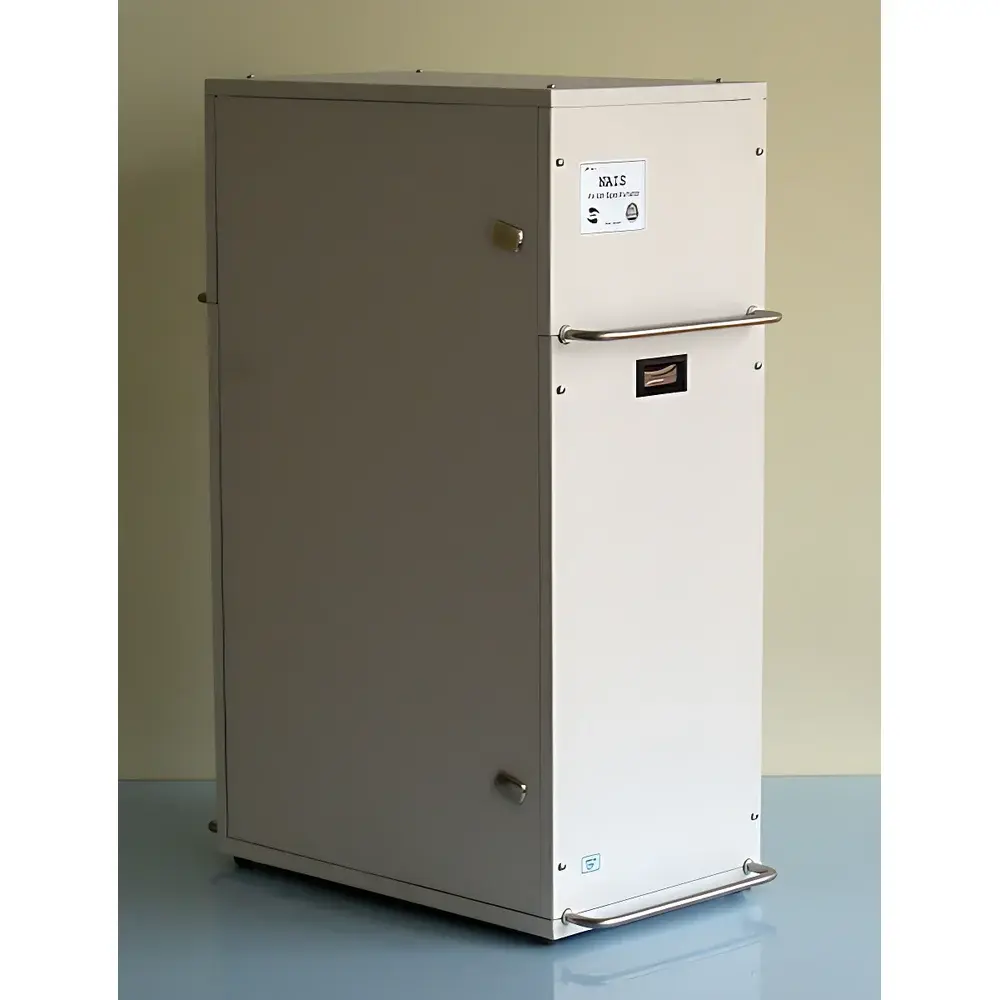
Airel NAIS Neutral Cluster and Air Ion Spectrometer
| Brand | Airel |
|---|---|
| Origin | Estonia (Designed & Developed at University of Tartu) |
| Model | NAIS |
| Principle | Scanning Mobility Particle Sizing (SMPS) with Dual-Polarity Differential Mobility Analysis |
| Sampling Flow Rate | 54 L/min |
| Size Range | 0.8–40 nm |
| Counting Range | 100–10,000,000 particles/L |
| Size Channels | ≤150 |
| Particle Mass Concentration Capability | Not applicable (mass output not supported) |
Overview
The Airel NAIS (Neutral Cluster and Air Ion Spectrometer) is a dual-polarity, high-resolution scanning mobility particle spectrometer engineered for quantitative characterization of atmospheric and laboratory-generated nanoscale aerosol populations—including both charged air ions and neutral molecular clusters. Developed at the University of Tartu (Estonia), the NAIS implements a tandem differential mobility analyzer (DMA) architecture: one positive-polarity analyzer column and one negative-polarity column operate in parallel, enabling simultaneous, time-synchronized measurement of positive and negative ion size distributions. Its core principle relies on electrophoretic mobility separation—particles are classified by electrical mobility (Zp, in cm²/V·s), which is inversely related to particle diameter under defined temperature and pressure conditions. The NAIS covers an exceptionally wide mobility range of 3.2 × 10⁻⁴ to 1.2 × 10⁻¹ cm²/V·s, corresponding to a calibrated physical diameter range of 0.8–40 nm. This enables direct observation of nucleation-mode aerosols, including the critical sub-2 nm cluster regime where new particle formation (NPF) initiates. Unlike conventional SMPS systems optimized for larger particles (>3 nm), the NAIS maintains high sensitivity and resolution down to the thermal motion-dominated cluster boundary, making it uniquely suited for fundamental studies of atmospheric nucleation kinetics, ion-induced nucleation, and cluster thermodynamics.
Key Features
- Dual-column differential mobility analysis: Independent, synchronized positive and negative polarity channels eliminate cross-polarity interference and enable direct charge polarity asymmetry quantification.
- High-temporal-resolution scanning: Full 0.8–40 nm size distribution acquisition in ≤6 minutes (configurable scan duration), supporting time-resolved NPF event tracking.
- Integrated laminar-flow, low-loss inlet system: Optimized 54 L/min total sampling flow ensures representative aerosol capture while minimizing diffusion losses for sub-2 nm species.
- Electrostatic classification with precision voltage control: High-stability high-voltage power supplies (<0.1% drift over 1 h) ensure reproducible mobility selection across all size channels (≤150 user-definable bins).
- Robust architecture for field deployment: Designed for unattended operation in remote atmospheric observatories, clean rooms, and chamber experiments; operates continuously at ambient T/P with integrated temperature/pressure monitoring.
- No radioactive or optical ionization source: Relies on natural atmospheric ionization or optional soft corona sources—ensuring compliance with radiation safety regulations and avoiding photochemical artifacts.
Sample Compatibility & Compliance
The NAIS is compatible with ambient air, filtered laboratory air, and controlled atmosphere chamber effluents (e.g., smog chambers, flow reactors). It measures both naturally occurring air ions and neutral clusters formed via homogeneous nucleation or ion-mediated pathways. No sample preparation or derivatization is required. The instrument meets mechanical and electromagnetic compatibility requirements per IEC 61326-1:2013 for laboratory and industrial environments. Data acquisition and storage comply with GLP principles; raw mobility scans and calibrated size distributions are timestamped and logged with full metadata (T, P, RH, flow rate, HV settings). While not certified to ISO 29463 or ASTM D6670, its methodology aligns with recommendations in ISO/TC 24/SC 4/WG 12 for nanoparticle size distribution metrology and is routinely cited in peer-reviewed publications adhering to FAIR data principles.
Software & Data Management
The NAIS is operated via Airel’s proprietary NAIS Control Suite (Windows-based), providing real-time visualization of bipolar mobility spectra, automated calibration routines (using reference monodisperse ions), and batch processing of time-series datasets. All raw data (voltage steps, CPC counts per polarity) are stored in HDF5 format with embedded metadata for traceability. Export options include ASCII (tab-delimited) and NetCDF for interoperability with Python (scikit-learn, xarray), MATLAB, and R workflows. The software supports audit-trail logging per FDA 21 CFR Part 11 requirements when configured with user authentication and electronic signatures. Calibration certificates, instrument logs, and QA/QC reports (e.g., zero-air checks, mobility resolution verification) are generated automatically and archived alongside measurement files.
Applications
- Atmospheric new particle formation (NPF) studies: Resolving growth rates, nucleation precursors, and ion–cluster interaction dynamics in boreal forests, marine boundary layers, and urban plumes.
- Chamber-based aerosol process studies: Quantifying ion-induced nucleation efficiency under controlled VOC/O3/SO2 conditions; validating quantum-chemical cluster stability predictions.
- Indoor air quality research: Characterizing ultrafine particle emissions from printers, cooking, and laser printers—distinguishing neutral vs. charged fractions.
- Nanomaterial safety assessment: Monitoring neutral cluster release during nanomaterial synthesis or handling, prior to charging or coagulation.
- Instrument intercomparison campaigns: Serving as a reference for calibrating other nano-aerosol spectrometers (e.g., PSM, DMPS) in the sub-3 nm range.
FAQ
Does the NAIS require radioactive ionization sources?
No—the NAIS operates without 210Po or other radioactive sources. It detects naturally occurring air ions or utilizes optional non-radioactive soft corona discharge for controlled ion generation.
Can the NAIS measure particle composition?
No—it provides size and charge-state distribution only. Composition analysis requires coupling with mass spectrometry (e.g., CI-APi-TOF) or spectroscopic techniques.
Is the 0.8 nm lower detection limit physically resolved or extrapolated?
The 0.8 nm value represents the validated lower limit of reliable electrospray-calibrated mobility classification under standard operating conditions (25°C, 1013 hPa); it is not an extrapolation but a metrologically verified cutoff based on instrumental transfer function characterization.
How is neutral cluster detection achieved without charging?
Neutral clusters are detected indirectly via thermal charging in the high-humidity, turbulent mixing zone of the NAIS inlet—where collisions with ambient ions induce stochastic charging, enabling subsequent mobility classification. This mechanism is well-characterized and accounted for in inversion algorithms.
What maintenance is required for long-term field operation?
Routine maintenance includes weekly inlet cleaning, quarterly DMA electrode inspection, annual CPC calibration, and biannual high-voltage supply verification—documented in the NAIS Maintenance Protocol (Rev. 4.2, University of Tartu).
Related Products







