
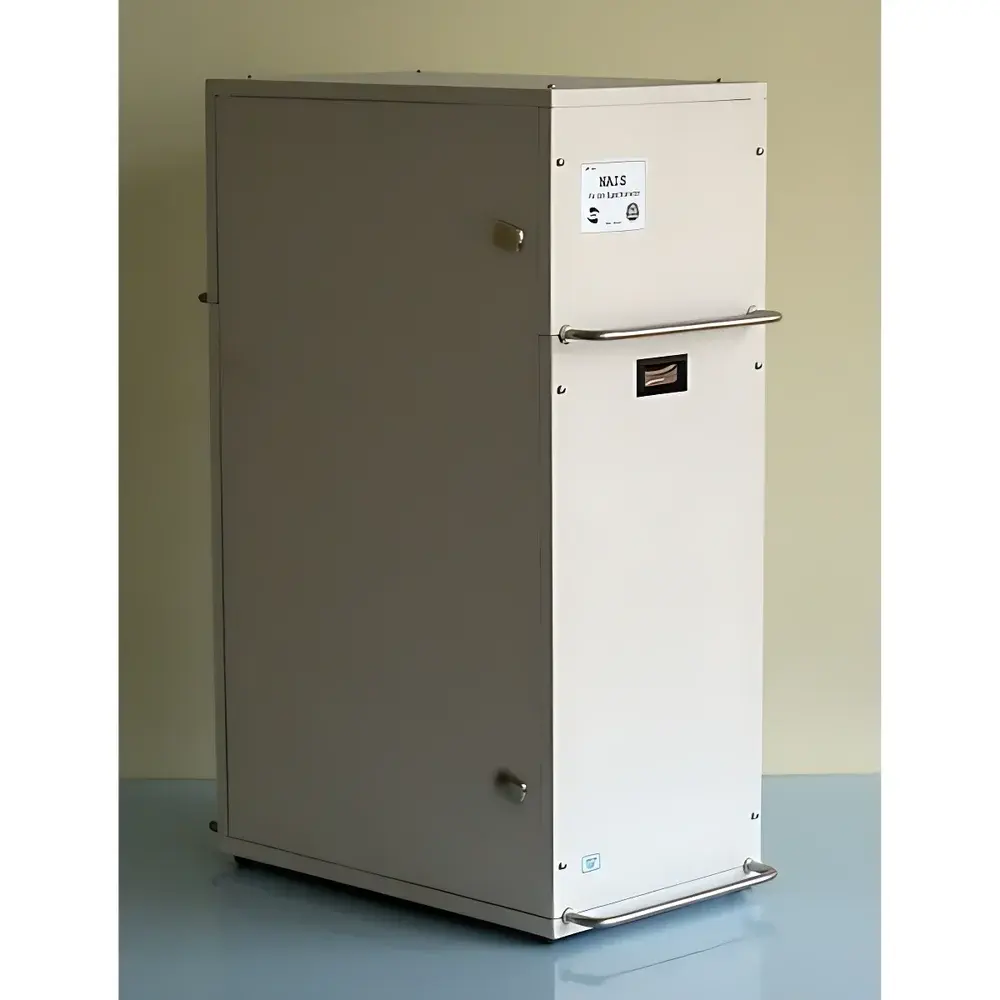
Airel NAIS Neutral Cluster and Air Ion Spectrometer
| Brand | Airel |
|---|---|
| Origin | Estonia |
| Manufacturer Type | Distributor |
| Origin Category | Imported |
| Model | NAIS |
| Price | Upon Request |
Overview
The Airel NAIS (Neutral Cluster and Air Ion Spectrometer) is a high-resolution, dual-mode atmospheric instrumentation platform engineered for simultaneous, quantitative characterization of both charged air ions and neutral nanoclusters in ambient and controlled laboratory environments. Developed at the University of Tartu (Estonia), the NAIS represents a functional evolution of the earlier Air Ion Spectrometer (AIS), integrating parallel differential mobility analysis (DMA) with multi-channel electrostatic detection to resolve particles across an exceptionally broad size range—from molecular clusters (~0.8 nm) up to coarse-mode aerosols (40 µm). Its core measurement principle relies on electrophoretic mobility classification under laminar flow conditions, followed by charge-sensitive current measurement via parallel electrometers. Unlike conventional scanning DMAs, the NAIS employs a fixed-voltage, multi-stage parallel DMA architecture—enabling true real-time, second-resolved acquisition without mechanical scanning delays. This architecture supports two primary operational modes: (1) *Ion Mode*, where only naturally charged species are analyzed without external charging; and (2) *Particle Mode*, which incorporates a non-radioactive, single-stage corona charger and electrostatic filter array to quantify neutral aerosol populations through controlled bipolar charging and mobility-based separation.
Key Features
- Integrated monolithic design: All critical components—including dual parallel DMA units, corona charger, electrostatic filters, 16-channel electrometer array, and flow control system—are housed within a single 60 kg chassis (310 × 580 × 820 mm), requiring only power supply (220 V AC) and USB/Ethernet interface to a host PC.
- Intelligent volumetric flow regulation: Maintains precise 54 L/min total sampling flow (27 L/min per DMA branch) via feedback-controlled mass flow controllers that dynamically compensate for ambient pressure fluctuations and inlet filter loading resistance.
- Corona charger optimization: Software-driven voltage modulation mitigates performance drift caused by needle contamination, preserving stable charging efficiency across extended unattended deployments.
- High temporal resolution: Delivers fully processed size-distribution spectra at 1 Hz native time resolution, with raw electrometer data logged synchronously for post-acquisition reprocessing.
- Robust mechanical architecture: Features internal vibration-damping mounts and reinforced structural framing, validated for mobile operation in vehicle-mounted and airborne atmospheric research platforms.
- Low consumables dependency: Requires no radioactive sources, replacement filters (beyond standard inlet pre-filters), or gas supplies—only stable mains power and periodic calibration verification.
Sample Compatibility & Compliance
The NAIS is designed for direct sampling of ambient air, indoor air, combustion exhaust streams, and chamber-generated aerosols without dilution or conditioning (except optional heated inlet for volatile removal). It complies with fundamental metrological requirements outlined in ISO 27891:2019 (ambient aerosol measurement) and supports traceable calibration protocols aligned with CEN/TS 16976:2016 (electrical mobility spectrometry). While not certified for regulatory compliance per se, its architecture enables adherence to GLP and GMP-aligned data integrity practices when deployed with audit-trail-enabled software configurations. The non-radioactive corona charging system satisfies IEC 61000-4-2 ESD immunity standards and eliminates licensing constraints associated with radioactive ionizers.
Software & Data Management
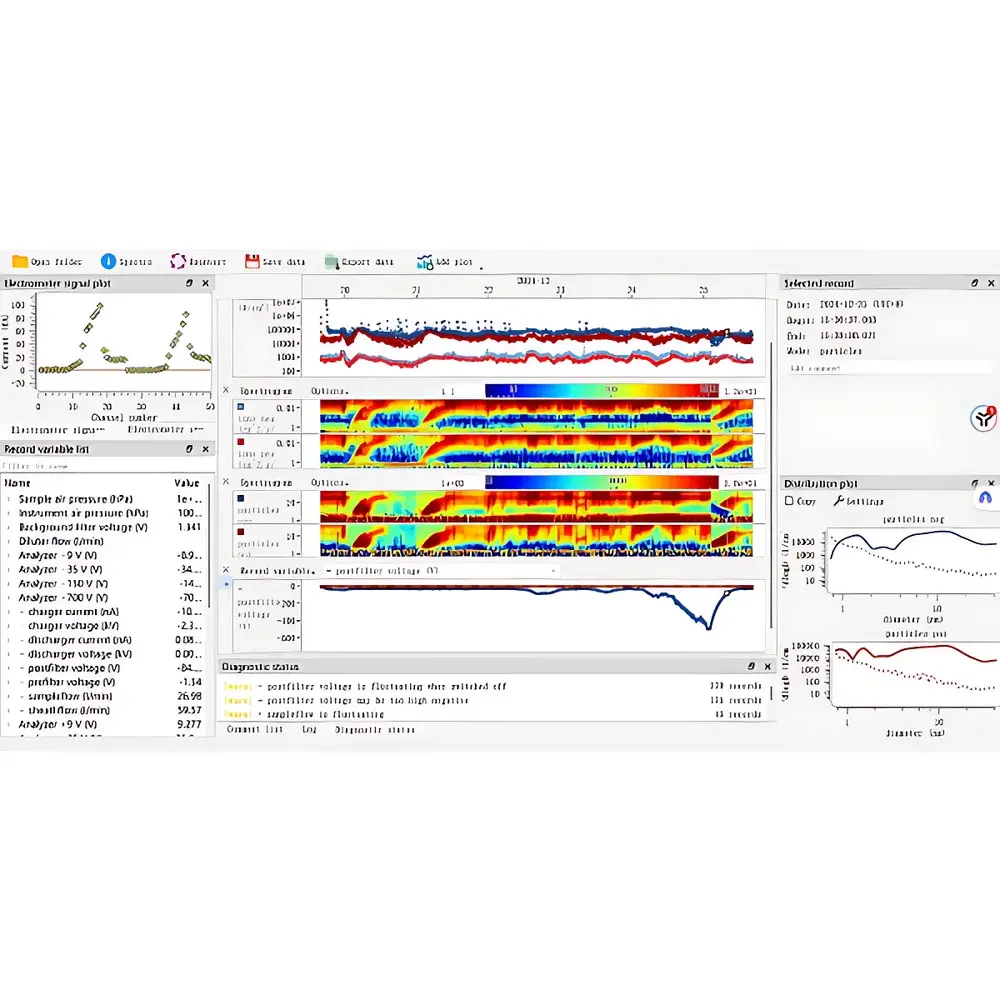
Control, acquisition, and real-time processing are managed via the proprietary NAIS Control Suite (Windows-based), providing graphical configuration of mode selection, voltage ramping, electrometer gain settings, and diagnostic monitoring. Raw electrometer currents, DMA voltages, flow sensor outputs, and environmental metadata (T, P, RH) are timestamped and stored in HDF5 format—ensuring long-term readability and compatibility with Python/Matlab analysis pipelines. The software implements automated baseline correction, mobility-to-diameter inversion using Fuchs’ correction factors, and optional charge-state deconvolution. For regulated environments, optional add-ons support 21 CFR Part 11-compliant user authentication, electronic signatures, and immutable audit logs.
Applications
- Atmospheric new particle formation (NPF) studies: Resolving nucleation-mode dynamics (<3 nm) and growth rates of neutral and charged clusters during boundary-layer events.
- Indoor air quality assessment: Quantifying ultrafine particle emissions from printers, cooking appliances, and HVAC systems under realistic occupancy conditions.
- Combustion aerosol characterization: Measuring size-resolved charge distributions from diesel engines, biomass burners, and aircraft turbine exhausts.
- Chamber-based process validation: Investigating ion-induced nucleation mechanisms, surface charging effects, and bipolar coagulation kinetics under controlled RH and VOC exposure.
- Mobile monitoring networks: Supporting ground-based transect surveys and UAV-integrated payloads for spatially resolved aerosol mapping.
FAQ
What distinguishes NAIS from conventional scanning mobility particle sizers (SMPS)?
Unlike SMPS systems that sequentially scan voltage to build size distributions over tens of seconds, the NAIS uses parallel fixed-voltage DMAs to acquire full spectra every second—preserving transient nucleation events and enabling direct correlation with fast-changing meteorological parameters.
Does NAIS require radioactive sources for particle charging?
No. It employs a maintenance-optimized corona discharge charger compliant with EU RoHS and IEC 61000-3-2 harmonic emission limits.
Can NAIS measure both positive and negative ions simultaneously?
Yes. Its dual electrometer arrays and polarity-switchable DMA voltages enable concurrent detection of bipolar ion populations across the entire 0.8 nm–40 µm range.
Is the instrument suitable for unattended field deployment?
Yes. With its self-regulating flow system, low-power electronics, and embedded watchdog timer, the NAIS has demonstrated >30-day continuous operation in remote atmospheric observatories.
How is size calibration performed?
Calibration is conducted using NIST-traceable polystyrene latex (PSL) nanoparticles and singly charged ammonium sulfate clusters generated in a nano-DMA reference system; mobility diameter assignments follow the ISO 15900:2020 standard.
Related Products







