
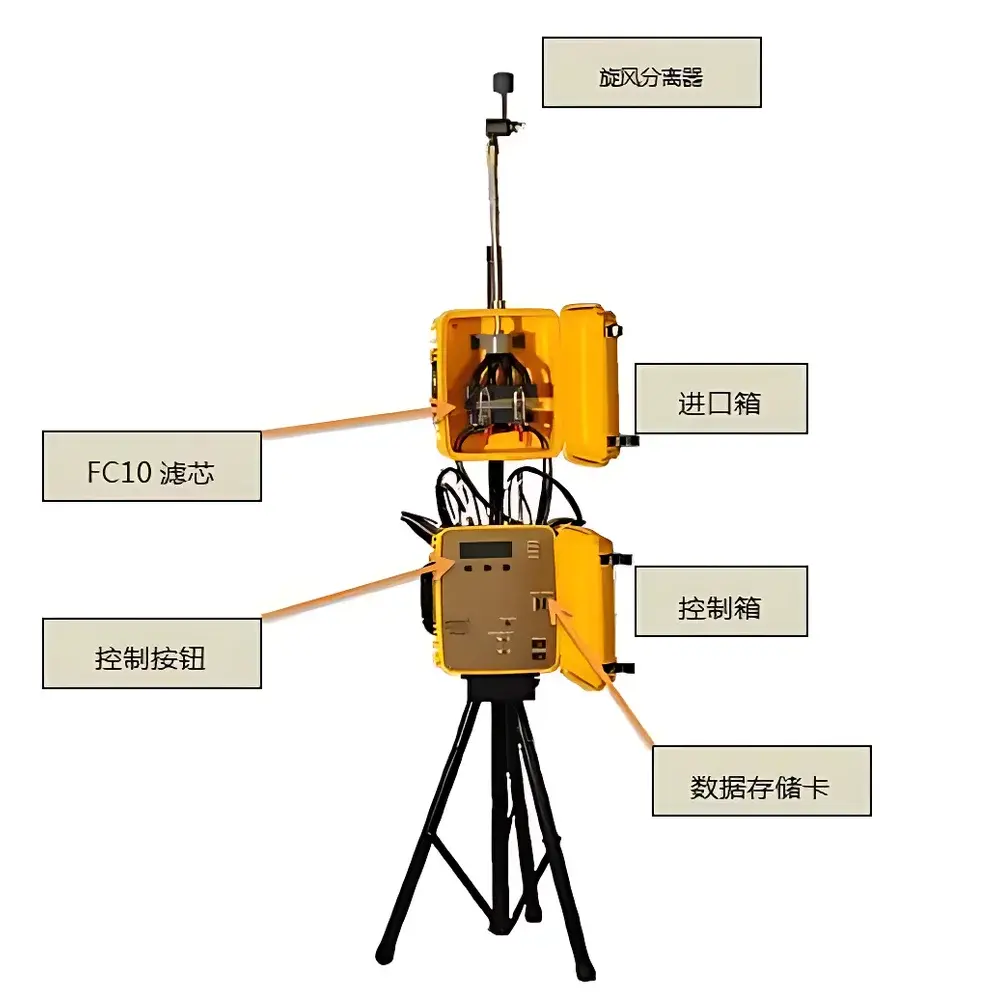
Airphoton AeroExplorer Automated Particulate Sampling Station
| Brand | AirPhoton |
|---|---|
| Origin | USA |
| Manufacturer Type | Authorized Distributor |
| Origin Category | Imported |
| Model | Airphoton AeroExplorer |
| Pricing | Available Upon Request |
Overview
The Airphoton AeroExplorer Automated Particulate Sampling Station is a field-deployable, programmable ambient air monitoring system engineered for gravimetric and compositional analysis of airborne particulate matter (PM). It operates on the principle of size-selective inertial separation—using cyclonic pre-separation followed by controlled isokinetic filtration—to collect mass-resolved PM fractions onto interchangeable filter substrates. Designed for long-term unattended operation in outdoor environments, the system integrates an intake/filter unit (SS5i-PMx) and a microprocessor-controlled electronics enclosure (SS5e), enabling precise temporal resolution of PM1, PM2.5, PM4, and PM10 mass concentrations. Its architecture supports both single-stage and dual-stage filtration configurations without hardware modification, allowing simultaneous collection of coarse (PM2.5–PM10) and fine (PM1–PM2.5) fractions on separate filter media—critical for source apportionment, receptor modeling, and regulatory compliance reporting.
Key Features
- Fully programmable sampling scheduler: define custom cycles in minutes, hours, or days; set start/stop times per cycle; configure automatic filter slot rotation across all 8 FC10 filter positions.
- Adjustable volumetric flow control: 1.5–7 L/min range with high-stability mass-flow regulation—optimized for cyclone cut-point calibration per ISO 25242, EN 12341, and US EPA Method PS-11.
- Modular cyclone compatibility: supports interchangeable PM10, PM4, PM2.5, and PM1 impactor/cyclone modules mounted upstream of the FC10 filter cartridge.
- Dual-stage filtration capability: software-enabled flow diversion enables sequential or concurrent coarse/fine fractionation using internal valving—no external plumbing or controller reconfiguration required.
- Ruggedized outdoor enclosure design: IP65-rated SS5i-PMx intake unit and SS5e control box feature hermetic sealing, corrosion-resistant aluminum housings, and thermal management for operation at –20 °C to +50 °C.
- Integrated data infrastructure: SD card-based local storage with automatic redundancy; timestamped metadata logging (flow rate, pressure drop, temperature, relative humidity via optional sensor input).
Sample Compatibility & Compliance
The AeroExplorer accommodates standard 47-mm circular filter media—including quartz fiber (for OC/EC analysis), Teflon® (for ICP-MS or ion chromatography), and cellulose ester (for microscopy)—compatible with ASTM D1357, ISO 12103-1, and US EPA Methods IO-3.1 and TO-13A. The FC10 8-slot carousel allows sequential multi-day sampling under GLP-aligned protocols, with audit-trail-capable parameter logging traceable to NIST-traceable flow calibrators. System firmware supports configurable alarm thresholds for flow deviation (>±5%), filter saturation (ΔP > 250 Pa), and power interruption—ensuring data integrity for regulatory submissions under 40 CFR Part 58 and EU Directive 2008/50/EC.
Software & Data Management
The embedded SS5e controller runs deterministic real-time firmware with a tactile membrane keypad interface—requiring no PC for routine operation. All configuration parameters (cycle duration, slot dwell time, flow setpoints, valve sequencing) are stored in non-volatile memory. Raw data—including cumulative volume, elapsed time per slot, and analog sensor inputs—are written to FAT32-formatted SD cards in CSV format with ISO 8601 timestamps. Optional RS-232/RS-485 and Ethernet interfaces enable integration into centralized SCADA or LIMS platforms. When paired with AirPhoton’s AeroExplorer Nephelometer (via SS5e’s dedicated digital I/O port), co-located scattering coefficient (bscat) and gravimetric mass data are synchronized in a shared database schema compliant with EPA AirData and EEA Air Quality e-Reporting standards.
Applications
- Ambient air quality monitoring networks requiring PM speciation for compliance with WHO Air Quality Guidelines and national standards (e.g., China GB 3095-2012, India NAAQS).
- Source characterization studies: stack emission testing, fugitive dust profiling, and urban roadside aerosol dynamics using time-resolved coarse/fine partitioning.
- Health effects research: coordinated collection of PM filters for toxicological assays (e.g., oxidative potential, endotoxin content) alongside parallel optical property measurements.
- Climate-relevant aerosol studies: long-term deposition flux estimation via weekly integrated sampling on pre-weighed filters, referenced to NIST SRM 2783.
- Calibration and validation of low-cost sensor networks: high-accuracy reference-grade mass data used to train correction algorithms for optical PM sensors.
FAQ
What filter media are supported by the FC10 cartridge?
Standard 47-mm diameter filters including quartz fiber (QMA/QMB), PTFE, polycarbonate, and mixed cellulose ester—compatible with gravimetric, elemental, and organic carbon analysis.
Can the system operate autonomously on solar power?
Yes—the SS5e accepts 12–24 VDC input and includes low-power sleep modes; typical daily consumption is <12 Wh when sampling at 2.5 L/min for 22 hrs.
How is flow calibration performed and maintained?
Factory-calibrated thermal mass flow sensors are traceable to NIST standards; users may perform field verification using a primary calibrator (e.g., DryCal DC-Lite) connected via the SS5e’s analog input port.
Is remote configuration possible without physical access?
Remote parameter updates and data retrieval require optional cellular or Ethernet telemetry modules; local configuration remains fully functional via front-panel controls.
Does the system meet requirements for U.S. Federal Reference Methods (FRM)?
While not certified as an FRM sampler, its flow accuracy (±2% full scale), isokinetic inlet design, and PM size-cut fidelity align with the technical specifications outlined in 40 CFR Part 53 for candidate equivalent methods.
Related Products







