
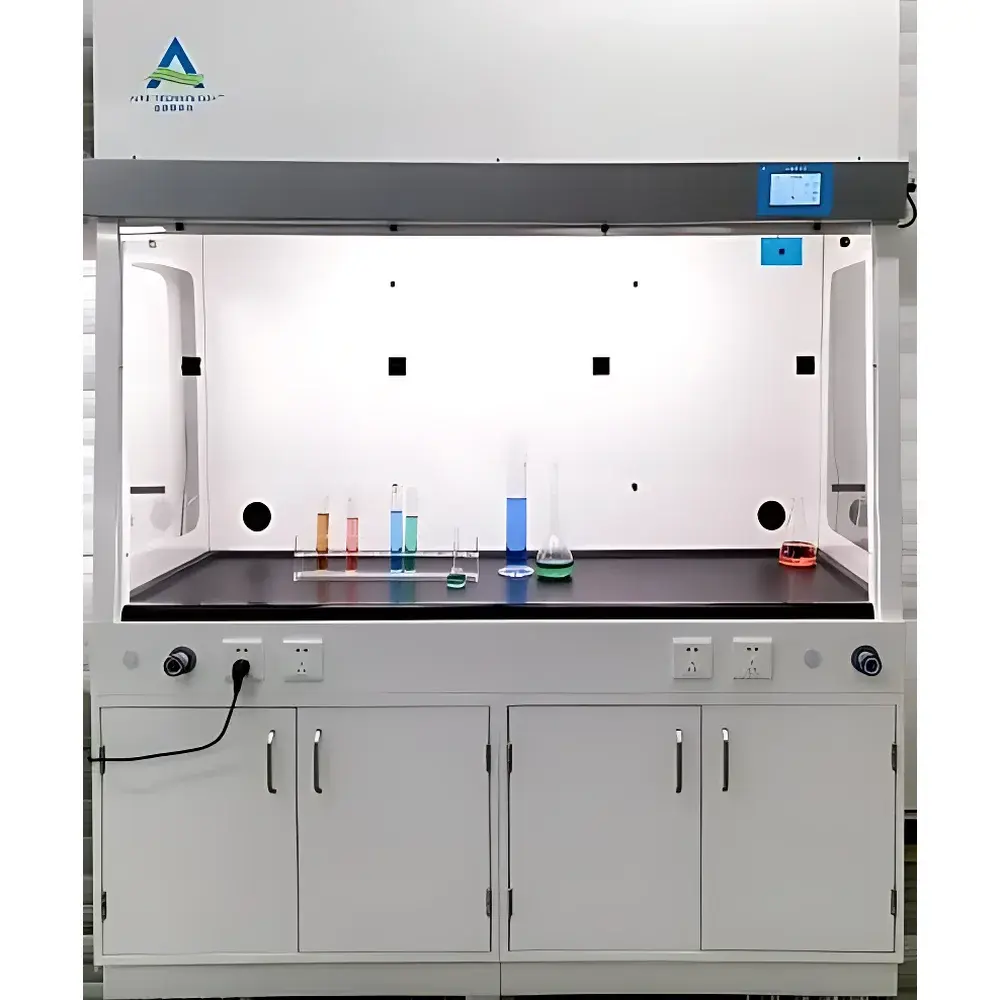
Airs AFH Series Ductless Fume Hood
| Brand | Airs |
|---|---|
| Model | AFH |
| Type | Ductless (Recirculating) Fume Hood |
| Construction Material | Polypropylene (PP) |
| Origin | Shanghai, China |
| Airflow Capacity | 210–840 m³/h (model-dependent) |
| Filter Modules | 1–4 modular activated carbon + particulate filter units |
| Real-time Monitoring | Face velocity, fan status, filter saturation, ambient temperature & humidity |
| Control System | Airs-Touch intelligent touchscreen interface |
| Compliance | Designed for ISO 15195:2013-compliant laboratory environments |
Overview
The Airs AFH Series Ductless Fume Hood is an engineered solution for localized containment of airborne chemical vapors and particulates in laboratories where ducted exhaust infrastructure is unavailable, impractical, or cost-prohibitive. Unlike conventional canopy hoods or bench-top extractors, the AFH operates on a closed-loop recirculation principle: ambient air is drawn across the work surface at a controlled face velocity (typically 0.4–0.5 m/s), passed through multi-stage filtration modules—comprising high-efficiency particulate air (HEPA) or ULPA pre-filters and tailored activated carbon beds—and returned to the lab environment after ≥99.99% removal efficiency for target contaminants. This design eliminates structural modifications, reduces HVAC load, and supports flexible lab reconfiguration. The AFH series is not intended for use with perchloric acid, hydrofluoric acid, radioactive materials, or uncharacterized high-hazard compounds per ANSI/ASHRAE 110-2016 and EN 14175-3:2022 guidance.
Key Features
- Modular filtration architecture: Configurable with 1 to 4 independent filter columns, each housing replaceable, application-specific carbon media (e.g., impregnated coconut-shell carbon for aldehydes, amine-functionalized carbon for acidic gases) plus particulate pre-filtration
- Real-time operational telemetry: Integrated sensors continuously monitor face velocity (±0.02 m/s accuracy), motor RPM, cumulative airflow volume, ambient temperature (±0.5°C), relative humidity (±3% RH), and estimated filter saturation via pressure differential tracking
- Airs-Touch intelligent control panel: 7-inch capacitive touchscreen with intuitive icon-based navigation, multilingual UI (English, German, French, Spanish), event logging, and configurable alarm thresholds (audible/visual alerts for low face velocity, filter end-of-life, or thermal overload)
- Polypropylene (PP) monocoque construction: Chemically inert, seamless welded chassis resistant to corrosion from organic solvents, weak acids/bases, and halogenated compounds; non-porous surface minimizes residue retention and simplifies decontamination
- Integrated utility integration: Pre-routed conduits for power (2× 10A GFCI outlets), data (RJ45), and optional gas lines (1/4″ NPT); compatible with bench-mounted instrumentation including rotary evaporators, microwave digesters, and automated SPE workstations
Sample Compatibility & Compliance
The AFH series is validated for routine handling of low-to-medium volatility organic solvents (e.g., methanol, acetone, ethyl acetate, hexane), aqueous reagents, and solid-phase manipulations (weighing, pipetting, titration). It meets the performance criteria outlined in ISO 15195:2013 for laboratory ventilation devices used in analytical chemistry settings and aligns with the risk-assessment framework of EU Directive 2004/40/EC on electromagnetic fields and occupational exposure. While not certified to NFPA 45 or OSHA 1910.1450 as a primary containment system for highly toxic substances, it supports secondary containment when used in conjunction with procedural controls (e.g., closed-vessel digestion, sealed weighing protocols). Filter replacement intervals are determined by usage profile and must be documented per GLP Annex 13 requirements.
Software & Data Management
Operational data—including timestamped face velocity logs, filter runtime hours, temperature/humidity trends, and alarm events—is stored locally on an embedded industrial-grade micro-SD card (8 GB, encrypted FAT32). Export is supported via USB-C port in CSV format for integration into LIMS or electronic lab notebooks (ELN). The Airs-Touch firmware supports remote diagnostics via optional Ethernet/Wi-Fi module (IEEE 802.11ac), enabling IT-administered firmware updates and centralized device health monitoring across multi-site facilities. Audit trails comply with FDA 21 CFR Part 11 principles: all parameter changes require operator authentication (PIN or RFID badge), and logs retain immutable timestamps and user IDs.
Applications
- Pre-analytical sample preparation: Solvent-based extraction, dilution series generation, solid-phase extraction (SPE), and derivatization reactions under visual observation
- Instrument ancillary protection: Safe operation of benchtop rotary evaporators, microwave-assisted digestion systems, and parallel synthesis reactors without external ductwork
- Mobile and field-deployable labs: Lightweight PP structure and self-contained airflow enable installation in shipping-container labs, vehicle-mounted analytical platforms, and temporary research trailers
- Teaching laboratories: Low-noise (<52 dB[A] at 1 m), energy-efficient operation supports extended student use during quantitative analysis exercises (e.g., gravimetric analysis, volumetric titrations)
- Quality control environments: Integration with QC workflows for pharmaceutical excipient testing, food additive screening, and environmental water sample processing where volatile organic compound (VOC) exposure must remain below OEL thresholds
FAQ
What types of chemicals are appropriate for use in the AFH ductless fume hood?
The AFH is validated for low-to-moderate volatility organic solvents, aqueous solutions, and particulate-generating procedures. It is not rated for perchloric acid, hydrogen sulfide, mercury vapor, or unknown mixtures without prior filter compatibility assessment.
How often must the filters be replaced?
Filter service life depends on total airflow volume, contaminant concentration, and molecular weight/volatility. Typical replacement intervals range from 3–12 months; real-time saturation indicators and pressure drop monitoring provide objective maintenance triggers.
Can the AFH be integrated into a building’s BMS?
Yes—via optional Modbus TCP or BACnet/IP gateway module, enabling status reporting (fan on/off, alarm states, filter status) and setpoint adjustment through enterprise-level building management systems.
Is the AFH compliant with ISO/IEC 17025 requirements for accredited testing labs?
While the hood itself is not a measurement instrument, its documented performance verification (face velocity mapping, filter efficiency validation reports) and audit-ready operational logs support clause 6.3.2 (environmental conditions) and clause 6.4.2 (equipment management) of ISO/IEC 17025:2017.
Does the unit require external electrical grounding beyond standard lab outlet provision?
No—the PP chassis is non-conductive; internal components meet IEC 61000-6-3 EMC emission limits and are grounded via the supplied 3-prong IEC 60320 C14 inlet. No supplemental earth rod is required.



