
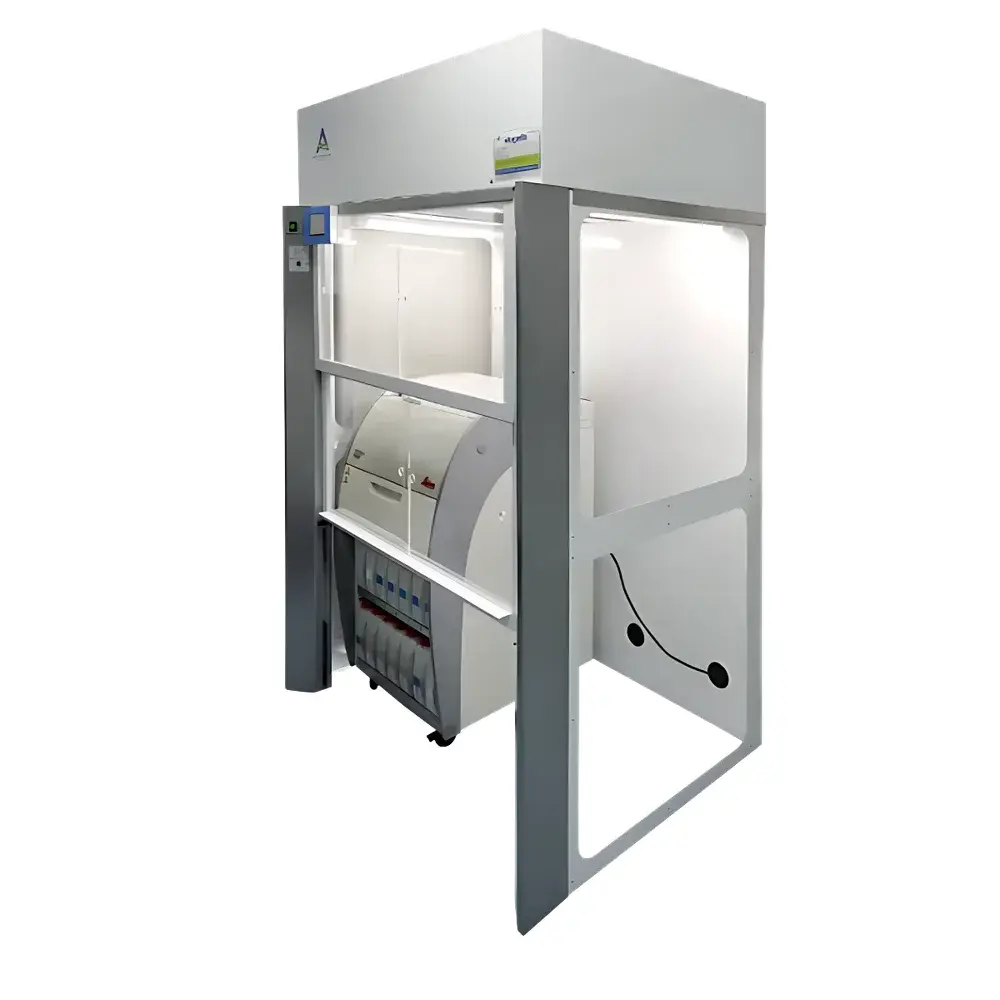
Airs AWIH1803 Walk-In (Floor-Standing) Instrument Safety Enclosure
| Brand | Airs |
|---|---|
| Origin | Shanghai, China |
| Manufacturer Type | Direct Manufacturer |
| Country of Origin | China |
| Model | AWIH1803 |
| Pricing | Available Upon Request |
Overview
The Airs AWIH1803 Walk-In Instrument Safety Enclosure is an engineered containment solution designed specifically for floor-standing analytical instruments—such as ICP-MS, GC-MS, XRD systems, and large-scale spectrophotometers—that emit low-to-moderate levels of volatile organic compounds (VOCs), acidic vapors, or particulate byproducts during operation. Unlike conventional ducted fume hoods, the AWIH1803 operates on a recirculating filtration principle grounded in ASHRAE 110–compliant airflow dynamics and ISO 14644–class 8 cleanroom-compatible internal air management. Its fully enclosed, walk-in architecture accommodates instruments up to 1.8 m (W) × 0.9 m (D) × 2.1 m (H), with structural integrity verified per EN 14175–3 for static load capacity and fire-retardant panel compliance (UL 94 V–0). The enclosure maintains negative pressure relative to the lab environment at all operational states, ensuring vapor containment without reliance on building exhaust infrastructure.
Key Features
- Modular walk-in design with customizable internal dimensions—standard configuration supports instruments up to 1800 mm (W) × 900 mm (D) × 2100 mm (H); dimensional adaptation available per client specification.
- Dual-axis access system: vertically sliding sash (motor-assisted, 200–1200 mm travel range) integrated with lateral sliding side windows (±150 mm stroke), enabling simultaneous vertical and horizontal aperture adjustment for ergonomic instrument loading and peripheral access.
- Integrated dual-stage filtration: pre-filter (G4 class, EN 779) captures coarse particulates; main filter comprises activated carbon (≥800 g/m³ iodine number ≥1100 mg/g) and HEPA H14 (EN 1822–1, ≥99.995% @ 0.1 µm) for VOC and aerosol retention.
- Airs–Touch intelligent control panel with real-time monitoring of internal temperature (±0.5 °C accuracy), relative humidity (±3% RH), differential pressure (±1 Pa resolution), and cumulative filter service life (calculated via airflow decay modeling).
- IoT-enabled connectivity: embedded Wi-Fi 6 module supports remote status viewing, alarm notification (SMS/email), and firmware updates via AirsLink mobile application (iOS/Android); data logs exportable in CSV/Excel format compliant with GLP audit trails.
- Energy-efficient DC brushless blower system (EC motor, 300–600 m³/h adjustable airflow, <55 dB(A) at 1 m), eliminating need for external ductwork and reducing HVAC load by up to 40% compared to traditional ducted enclosures.
Sample Compatibility & Compliance
The AWIH1803 is validated for continuous-duty operation with instruments generating emissions within defined thresholds: VOC concentrations ≤100 ppm (as methanol equivalent), acid vapors ≤5 ppm (as HCl), and non-hazardous particulates ≤0.1 mg/m³. It meets CE marking requirements under Machinery Directive 2006/42/EC and Low Voltage Directive 2014/35/EU. Filtration performance aligns with DIN 12924–2 for recirculating enclosures, and internal airflow uniformity complies with ISO 10793–2 Annex B for laminarized containment zones. Optional documentation packages include Factory Acceptance Test (FAT) reports, filter certification (ASTM D5227–22), and third-party validation against USP Analytical Instrument Qualification protocols.
Software & Data Management
The Airs–Touch OS v3.2 provides role-based access control (administrator/operator modes), configurable alarm thresholds (e.g., filter saturation >90%, temp >35 °C), and timestamped event logging with 12-month local storage (microSD backup). All operational data—including fan speed, pressure differentials, temperature/humidity trends, and filter usage metrics—are synchronized to the AirsCloud secure portal (AES–256 encrypted), supporting FDA 21 CFR Part 11–compliant electronic signatures and audit trail generation. Exported datasets retain ISO/IEC 17025–required metadata (instrument ID, operator ID, calibration timestamps).
Applications
- Containment of thermal desorption units and pyrolysis–GC systems emitting benzene, toluene, and PAHs.
- Safe operation of benchtop X-ray fluorescence (XRF) analyzers with beryllium window components requiring controlled ambient humidity.
- Enclosure for automated titrators and Karl Fischer moisture analyzers using hygroscopic reagents (e.g., imidazole-based titrants).
- Integration with robotic sample handling platforms where spatial access and vibration isolation are critical.
- Compliance support for ISO/IEC 17025 accredited laboratories seeking documented risk mitigation for instrument-related exposure pathways.
FAQ
Does the AWIH1803 require external ducting or building exhaust modification?
No. It operates as a self-contained, ductless recirculating system with onboard filtration and pressure-balanced airflow management.
What is the recommended filter replacement interval?
Under typical lab conditions (8 h/day, moderate VOC load), carbon filters require replacement every 6–12 months; HEPA filters every 18–24 months—automatically tracked and alerted via Airs–Touch interface.
Can the enclosure be integrated into an existing laboratory BMS?
Yes. Modbus TCP and BACnet/IP communication protocols are supported via optional gateway module for integration with Siemens Desigo, Honeywell WEBs, or Tridium Niagara Framework.
Is the unit suitable for use with flammable solvents?
It is not rated for Class I, Division 1 hazardous locations. Use with flammable vapors requires prior risk assessment per NFPA 45 and supplemental explosion-proof accessories (available upon request).
What validation documentation is provided with delivery?
Standard package includes Installation Qualification (IQ) checklist, Operational Qualification (OQ) test report, filter certification, and electrical safety test records per IEC 61010–1.
Related Products



