
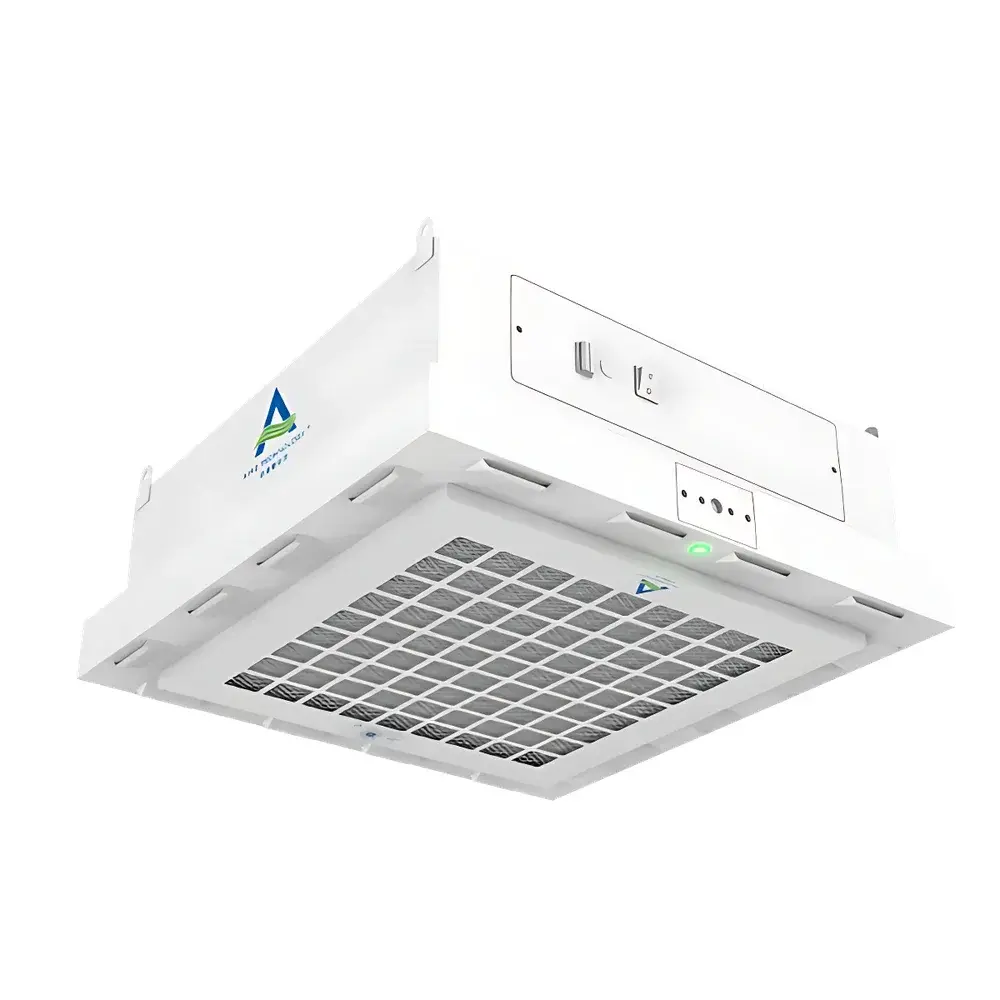
Airs TA900 Ceiling-Mounted Air Purification Unit
| Brand | Airs |
|---|---|
| Origin | Shanghai, China |
| Manufacturer Type | Direct Manufacturer |
| Country of Origin | China |
| Model | TA900 |
| Pricing | Available Upon Request |
Overview
The Airs TA900 Ceiling-Mounted Air Purification Unit is an engineered solution for continuous, passive air quality management in laboratory environments where localized chemical vapor containment and background air purification are critical. Designed specifically for integration into the ceiling plenum or suspended grid systems, the TA900 operates on a negative-pressure principle—drawing ambient air downward through high-efficiency filtration media before recirculating purified air back into the lab space. Unlike conventional HVAC-driven ventilation strategies, the TA900 functions as a terminal-stage air treatment device within a multi-tiered laboratory air safety architecture. It complements primary containment systems—including fume hoods, glove boxes, and reagent storage cabinets—by capturing fugitive volatile organic compounds (VOCs), acid vapors, aldehydes, and particulate matter that may escape during routine cabinet operation or sample handling. Its deployment reduces reliance on high-volume mechanical air exchange, thereby lowering energy demand associated with conditioned outdoor air introduction while maintaining ISO 14644-1 Class 8 (100,000) background particulate levels and meeting OSHA PEL and ACGIH TLV exposure thresholds for common lab solvents.
Key Features
- Ceiling-integrated modular design compatible with standard 600 × 600 mm suspended ceiling grids or custom mounting brackets
- Dual-stage filtration system: pre-filter (G4 synthetic mesh) for coarse particulates + activated carbon/impregnated alumina composite bed for broad-spectrum chemical adsorption
- Variable-speed EC centrifugal fan with closed-loop feedback control, operating range 120–350 m³/h at static pressure up to 120 Pa
- 5-inch medical-grade capacitive touchscreen interface with IP65 front panel rating, supporting real-time display of PM2.5, TVOC, temperature, humidity, fan speed, and filter saturation status
- Embedded Wi-Fi 802.11n module enabling remote monitoring and configuration via secure HTTPS web portal or native iOS/Android application
- Comprehensive audit trail functionality: timestamped event logging (filter replacement alerts, fan fault codes, airflow deviation >10% from setpoint) compliant with GLP documentation requirements
- Low-noise operation (<42 dB(A) at 1 m), suitable for quiet-zone laboratories and analytical instrument rooms
Sample Compatibility & Compliance
The TA900 is validated for continuous-duty operation in ambient laboratory conditions (15–35°C, 30–80% RH, non-condensing). It demonstrates effective removal efficiency (>90% single-pass) for representative challenge agents including acetone (100 ppm), formaldehyde (1 ppm), hydrochloric acid vapor (5 ppm), and dioctyl phthalate (DOP) aerosol (0.3 µm). Filtration performance data align with EN 1822-1:2020 (for particulate retention) and ASTM D5212-17 (for gaseous contaminant removal testing protocols). The unit meets CE marking requirements under the EU Machinery Directive 2006/42/EC and Electromagnetic Compatibility Directive 2014/30/EU. Electrical safety certification complies with IEC 61000-6-3 and IEC 61000-6-4. Optional factory calibration certificates traceable to NIM (National Institute of Metrology, China) are available upon request.
Software & Data Management
The TA900’s embedded firmware supports local data storage (16 GB internal flash) for ≥12 months of 1-minute interval environmental logs. All operational parameters—including cumulative runtime, filter service hours, VOC concentration trends, and fan power consumption—are exportable in CSV format via USB-C port or encrypted cloud sync. Remote access implements TLS 1.2 encryption and role-based user authentication (admin/operator/viewer tiers). Audit logs satisfy FDA 21 CFR Part 11 requirements for electronic records and signatures when configured with time-stamped digital signatures and operator ID binding. Integration with existing BMS platforms is supported via Modbus TCP (port 502) or optional MQTT broker interface.
Applications
- Supplemental air cleaning in analytical chemistry labs using GC-MS, HPLC, and ICP-OES instrumentation
- Background air polishing in cell culture suites and PCR preparation areas to minimize airborne contamination risk
- Fugitive emission control adjacent to open-front reagent storage cabinets and solvent dispensing stations
- Energy-efficient air quality maintenance in LEED-certified laboratory buildings targeting reduced air change rates per ASHRAE 110-2016
- Post-fume hood retrofit solution where ducted exhaust capacity is constrained or infrastructure renovation is cost-prohibitive
FAQ
What is the recommended ceiling height for optimal TA900 performance?
The unit is optimized for installation in rooms with ceiling heights between 2.6 m and 4.2 m. At heights below 2.6 m, airflow patterns may induce localized drafts; above 4.2 m, capture efficiency for buoyant vapors decreases without supplemental directional nozzles.
How often must the composite filter be replaced?
Filter service intervals depend on VOC loading but typically range from 6 to 12 months under average lab usage (8 hrs/day, moderate solvent handling). The system triggers visual and remote alerts when pressure drop exceeds 80 Pa across the carbon bed.
Does the TA900 require ductwork or external exhaust?
No. It is a self-contained recirculating unit and does not connect to building exhaust systems. All filtration occurs internally, with purified air discharged downward into the occupied zone.
Can multiple TA900 units be synchronized for coordinated control?
Yes. Up to 32 units can be grouped into a single logical zone via the central web dashboard, enabling synchronized fan speed ramping, unified alarm thresholds, and collective filter life tracking.
Is third-party validation data available for specific chemical challenges?
Airs provides application-specific test reports upon request, including breakthrough curves for target analytes such as ammonia, hydrogen sulfide, and chlorinated solvents, generated in accordance with ISO 10121-1:2013 protocols.



