
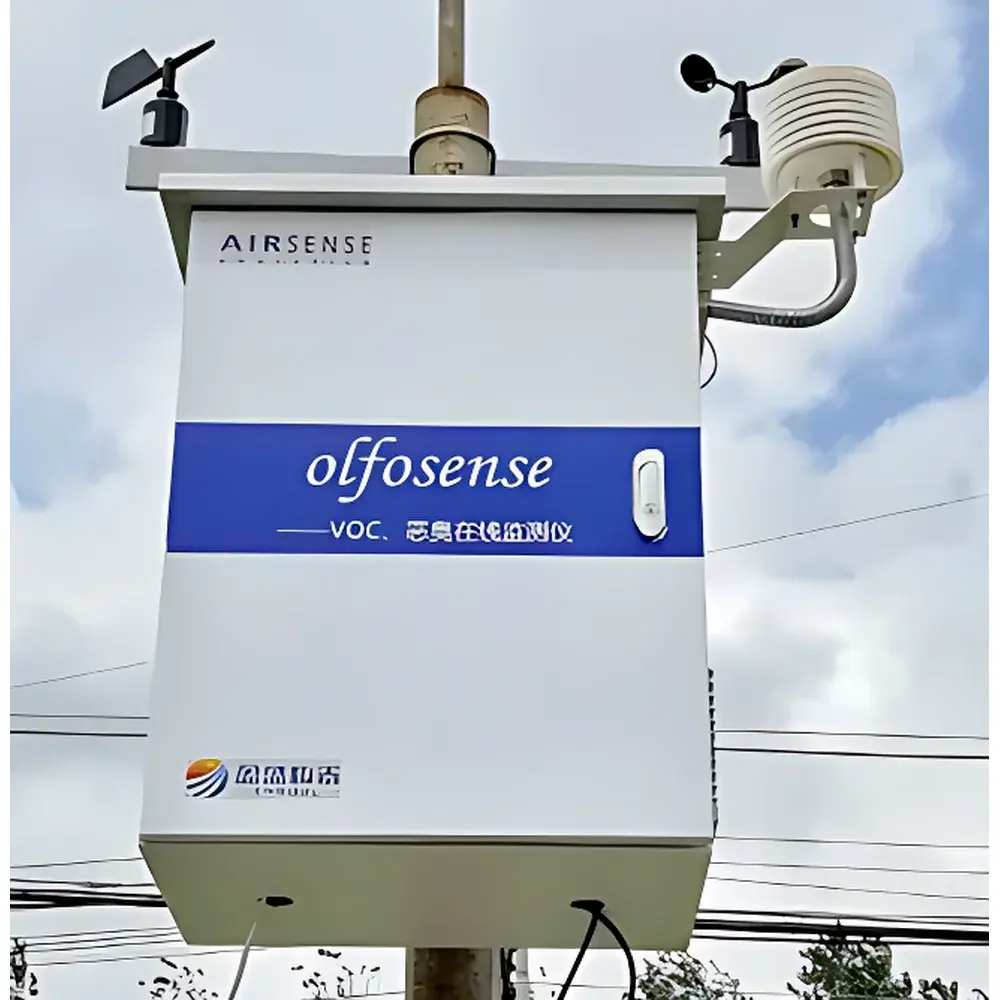
AIRSENSE Olfosense Online Odor Monitoring System
| Brand | AIRSENSE |
|---|---|
| Origin | Germany |
| Model | Olfosense |
| Instrument Type | Online |
| Detection Principle | Hybrid Sensor Array (Metal Oxide Semiconductor, Photoionization Detector, Electrochemical Sensors) |
| Accuracy | ±1–2% |
| Flow Rate Range | 10–400 mL/min |
| Response Time | <1 second |
| Operating Temperature | −30°C to +100°C |
| Operating Humidity | 0–90% RH |
| Sensor Configuration | 4× MOS, 1× PID, 2–4× electrochemical sensors |
| Output Parameters | H₂S, NH₃, TVOC concentrations, user-selectable odorant(s) (1–2), and dimensionless odor unit (OU) values |
| Connectivity | WiFi/GSM/GPRS/3G |
| Data Integration | Open API, Modbus TCP/RTU, MQTT |
| Compliance | Designed for EN 13725-compliant odor assessment workflows |
Overview
The AIRSENSE Olfosense Online Odor Monitoring System is an industrial-grade, real-time environmental monitoring platform engineered for continuous, unattended measurement of complex odor emissions in ambient air. Unlike single-gas analyzers, Olfosense employs a multi-modal hybrid sensor array—comprising four distinct metal oxide semiconductor (MOS) sensors, one photoionization detector (PID), and two to four electrochemical (EC) sensors—to capture broad-spectrum volatile organic compound (VOC) and inorganic odorant signatures. Its core measurement paradigm aligns with the principles of electronic nose (e-nose) technology: pattern recognition across cross-sensitive sensor responses, calibrated against reference odor standards and validated per EN 13725 (odor concentration determination by dynamic olfactometry). The system computes both quantitative gas-specific concentrations (e.g., H₂S, NH₃, TVOC) and dimensionless odor units (OU/m³), enabling regulatory-compliant odor impact assessment at municipal landfills, wastewater treatment plants, composting facilities, rendering operations, and food processing sites.
Key Features
- Modular hybrid sensor architecture: Four MOS sensors provide differential sensitivity to aldehydes, sulfur compounds, amines, and hydrocarbons; one 10.6 eV PID delivers real-time total VOC response; two to four EC sensors target specific toxic or odorous gases including hydrogen sulfide and ammonia.
- Sub-second response time (<1 s) ensures detection of transient emission events—critical for compliance-triggered alarm activation and process feedback control.
- Wide environmental operating envelope: Functional from −30°C to +100°C ambient temperature and 0–90% relative humidity (non-condensing), supporting deployment in harsh outdoor enclosures or unheated utility sheds without active climate control.
- Flexible output configuration: Simultaneous reporting of up to two user-defined target odorants (e.g., dimethyl sulfide, skatole), plus H₂S, NH₃, TVOC, and EN 13725-derived OU values—all timestamped and traceable.
- Multi-protocol connectivity: Native support for WiFi, GSM, GPRS, and 3G cellular backhaul; configurable Modbus TCP/RTU and MQTT interfaces enable seamless integration into SCADA, DCS, or cloud-based IoT platforms.
- Scalable network topology: Systems deploy as standalone units or form geographically distributed monitoring networks—unlimited node count, synchronized time-stamping, and centralized data aggregation via secure TLS-encrypted channels.
Sample Compatibility & Compliance
Olfosense is optimized for continuous sampling of ambient air streams within defined flow constraints (10–400 mL/min), accommodating both passive diffusion and active pumped configurations. It meets functional requirements for routine odor surveillance under EU Directive 2010/75/EU (IED) and national implementations requiring periodic odor concentration reporting. While not a certified olfactometer replacement for EN 13725 laboratory testing, its sensor-derived OU values are traceable to field-calibrated reference standards and intended for trend analysis, early-warning notification, and spatial mapping—not statutory compliance certification. Optional meteorological modules (wind speed/direction, temperature, humidity, pressure) allow dilution-corrected plume modeling and source attribution per VDI 3940 guidance. All firmware and data logs maintain audit-ready timestamps and user-accessible revision history for GLP-aligned operational records.
Software & Data Management
The Olfosense software suite includes web-based dashboard access (HTML5), native iOS and Android applications, and optional desktop analytics tools. Real-time data streams populate interactive Google Maps overlays showing georeferenced OU gradients, historical heatmaps, and temporal concentration profiles. Trend analysis modules support rolling 7-day/30-day odor index calculations, exceedance event logging, and automated PDF report generation compliant with ISO/IEC 17025 documentation expectations. Cloud-hosted database options include encrypted storage with role-based access control (RBAC), API-driven export to third-party LIMS or ERP systems, and configurable alert thresholds with SMS/email/push notifications. All data transactions adhere to GDPR-compliant anonymization protocols where applicable.
Applications
- Municipal solid waste management: Fence-line monitoring at landfill boundaries and leachate collection points.
- Wastewater infrastructure: Real-time tracking of odorant spikes at headworks, sludge dewatering, and biosolids storage areas.
- Agricultural biogas and manure handling: Emission verification during anaerobic digestion off-gas treatment and field application.
- Food and beverage manufacturing: Process emission verification at rendering, fish meal production, and fermentation facilities.
- Regulatory support: Supplemental data collection for permitting, community complaint investigations, and odor management plan (OMP) validation.
FAQ
Does Olfosense meet EN 13725 certification requirements for official odor concentration reporting?
No—Olfosense is a screening and trend-monitoring tool. EN 13725-compliant odor concentration values require dynamic olfactometry performed in accredited laboratories. Olfosense-derived OU values are semi-quantitative and intended for operational insight, not statutory submission.
Can the system operate without internet connectivity?
Yes—local data logging to internal SD card or external USB drive is supported. All measurements are timestamped and retained for offline retrieval; connectivity resumes synchronization upon reconnection.
Is calibration traceable to NIST or PTB standards?
Field calibration uses certified gas standards traceable to national metrology institutes (e.g., PTB Germany). Full calibration certificates—including uncertainty budgets—are provided with each service event.
What maintenance intervals are recommended?
Sensor modules require annual functional verification; MOS arrays benefit from quarterly zero/span checks using synthetic air and certified odor standard blends. PID lamps have a typical service life of 12–18 months under continuous operation.
How is data security managed in cloud deployments?
Cloud instances employ AES-256 encryption at rest and TLS 1.2+ in transit. Multi-factor authentication (MFA), session timeouts, and granular permission sets comply with ISO 27001-aligned information security policies.
Related Products







