
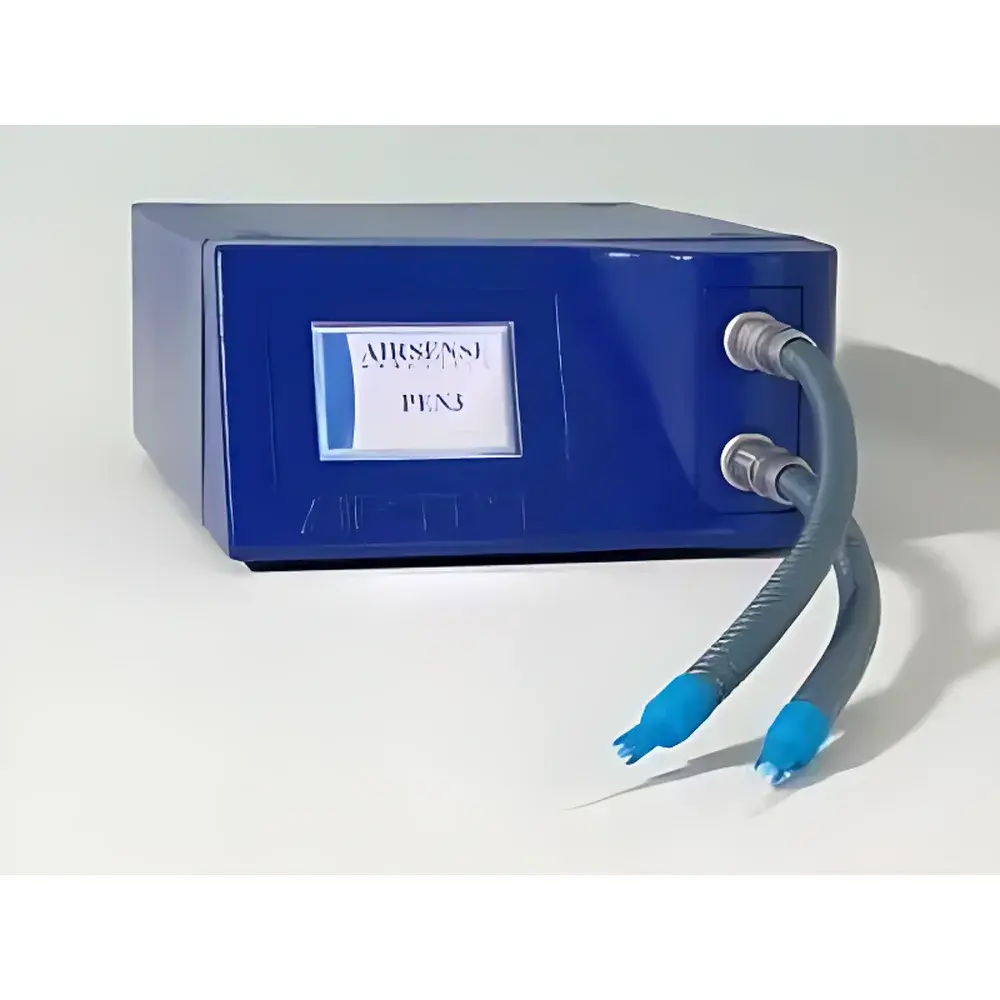
AIRSENSE PEN 3.5 Portable Electronic Nose System
| Brand | AIRSENSE |
|---|---|
| Origin | Germany |
| Model | PEN 3.5 |
| Sensor Array | 10 metal oxide semiconductor (MOS) sensors |
| Sensor Volume | 1.8 mL |
| Operating Temperature | 110 °C (sensor tube) |
| Response Time | < 1 s |
| Measurement Cycle | ~60 s (20 s exposure + 40 s recovery) |
| Sampling Flow Rate | 10–400 mL/min (integrated mass flow control) |
| Built-in Pumps | 2 (sample + zero air) |
| Zero Air Source | Activated charcoal-filtered ambient air or zero-air generator |
| Display | Integrated LCD panel |
| Interface | USB and/or RS232 |
| Digital I/O | TTL and digital signal ports |
| Operating Ambient | 0–40 °C, 5–95% RH (non-condensing) |
| Power | 30 W, 110–230 V AC or optional 12 V DC |
| Weight | 2.3 kg |
| Dimensions | 255 × 190 × 92 mm |
| Safety Compliance | IEC 61010-1 |
| Detection Limits | 0.1–5 ppm (general VOCs), 0.1 ppm (H₂S), 1 ppm (benzene) |
| Software Platform | WinMuster v5.x (supports PCA, LDA, DFA, K-NN, PLS, BP-ANN) |
| Data Integrity | Audit-trail enabled |
Overview
The AIRSENSE PEN 3.5 Portable Electronic Nose System is a field-deployable, real-time odor and volatile organic compound (VOC) analysis platform engineered for environmental monitoring, industrial hygiene, and process control applications. Unlike conventional gas chromatography or spectroscopic methods, the PEN 3.5 operates on bio-inspired pattern recognition principles: it employs an array of ten distinct metal oxide semiconductor (MOS) sensors whose collective resistance changes form unique response fingerprints upon exposure to complex gaseous mixtures. These transient signals are digitized and processed using multivariate statistical algorithms—enabling discrimination, classification, and semi-quantitative assessment of odor profiles without prior knowledge of individual analyte identities. Designed for ambient-pressure, ambient-temperature sampling using clean air as the baseline matrix, the system establishes direct methodological correlation with human olfactory perception—making it uniquely suitable for regulatory odor impact assessments aligned with EN 13725 and ASTM D6798 standards.
Key Features
- Compact, battery-compatible portable architecture (2.3 kg) optimized for field deployment, mobile lab use, and fixed-site continuous monitoring.
- Patented dual-pump gas handling system with integrated mass flow control ensures stable, reproducible sample delivery across variable environmental conditions—including open-air sampling and duct-mounted configurations.
- High-temperature sensor tubes (110 °C operating, up to 500 °C desorption) enable rapid sensor regeneration (<1 s response, ~60 s full cycle), minimizing carryover and extending operational lifetime.
- Automated dilution, zero-point correction, and adaptive gain adjustment eliminate manual calibration drift during extended unattended operation.
- Dual-purpose inlet design supports direct ambient sampling, connection to thermal desorption units (e.g., EDU concentrators), or coupling with GC-MS systems for hybrid analytical workflows.
- Comprehensive digital I/O (TTL and discrete logic signals) enables seamless integration into SCADA, PLC, or building management systems for automated alarm triggering and process feedback loops.
Sample Compatibility & Compliance
The PEN 3.5 is validated for analysis of complex odorant matrices including hydrogen sulfide, ammonia, mercaptans, aldehydes, ketones, aromatic hydrocarbons (e.g., benzene, toluene), terpenes, and short-chain fatty acids—common in wastewater treatment plants, landfill sites, composting facilities, agricultural operations, and petrochemical installations. Its measurement protocol conforms to the fundamental requirements of EN 13725:2022 (odor concentration determination via dynamic olfactometry correlation), supporting development of instrument-based odor equivalency models acceptable to EU environmental authorities. The system meets IEC 61010-1 safety standards for laboratory and industrial environments and supports audit-ready data acquisition under GLP and GMP frameworks when configured with WinMuster’s 21 CFR Part 11-compliant software module (electronic signatures, change logs, user access controls).
Software & Data Management
WinMuster v5.x serves as the embedded and PC-based control and analytics environment. It provides real-time visualization of sensor kinetics, raw signal normalization, and advanced chemometric modeling—including Principal Component Analysis (PCA) for exploratory pattern mapping, Linear Discriminant Analysis (LDA) and Discriminant Function Analysis (DFA) for supervised classification, Partial Least Squares (PLS) regression for semi-quantitative estimation, and Backpropagation Artificial Neural Networks (BP-ANN) for nonlinear pattern learning. All processing steps are fully traceable: raw voltage traces, preprocessed features, model parameters, and classification outcomes are stored in hierarchical HDF5 archives with metadata tagging (operator ID, timestamp, location GPS, ambient T/RH). Export options include CSV, MATLAB .mat, and ASTM E2935-compliant XML formats for third-party validation and regulatory submission.
Applications
- Real-time odor plume tracking and boundary delineation during episodic emission events (e.g., biogas leaks, sewage overflow incidents).
- Long-term trend analysis of odor emissions from municipal wastewater treatment plants, aligning with ISO 16000-30 and national odor management plans.
- Performance evaluation of biological odor abatement systems (e.g., biofilters, bioscrubbers) via dynamic load-response profiling.
- VOC screening in ambient air near industrial zones, enabling early detection of fugitive emissions prior to exceedance of WHO or EU Air Quality Directive thresholds.
- Process optimization in fertilizer production, food processing, and pharmaceutical manufacturing where volatile amine or sulfur compounds indicate quality deviations.
- Method development for replacing sensory panels in routine odor compliance testing—reducing inter-laboratory variability and accelerating reporting cycles.
FAQ
Can the PEN 3.5 quantify individual VOCs like GC-MS?
No—it provides pattern-based classification and relative intensity scoring rather than compound-specific quantification. For speciated analysis, it is intended for tandem use with GC-MS or FTIR.
Is external calibration gas required for routine operation?
Not for qualitative screening; however, certified odor reference standards (e.g., n-butanol dilutions per EN 13725) are recommended for periodic performance verification and regulatory correlation studies.
How does the system handle humidity interference?
Integrated temperature- and humidity-compensated flow control, plus sensor-specific baseline drift correction algorithms, maintain stability across 5–95% RH without condensation.
What maintenance is required beyond annual sensor replacement?
Quarterly zero-air filter replacement, biannual pump diaphragm inspection, and routine validation using certified reference odors constitute the preventive maintenance schedule.
Does the PEN 3.5 support remote data transmission?
Yes—via optional Ethernet/WiFi dongle or cellular modem add-on; data streams can be routed to cloud platforms (e.g., AWS IoT Core, Azure IoT Hub) using MQTT or HTTP(S) protocols with TLS 1.2 encryption.
Related Products







