
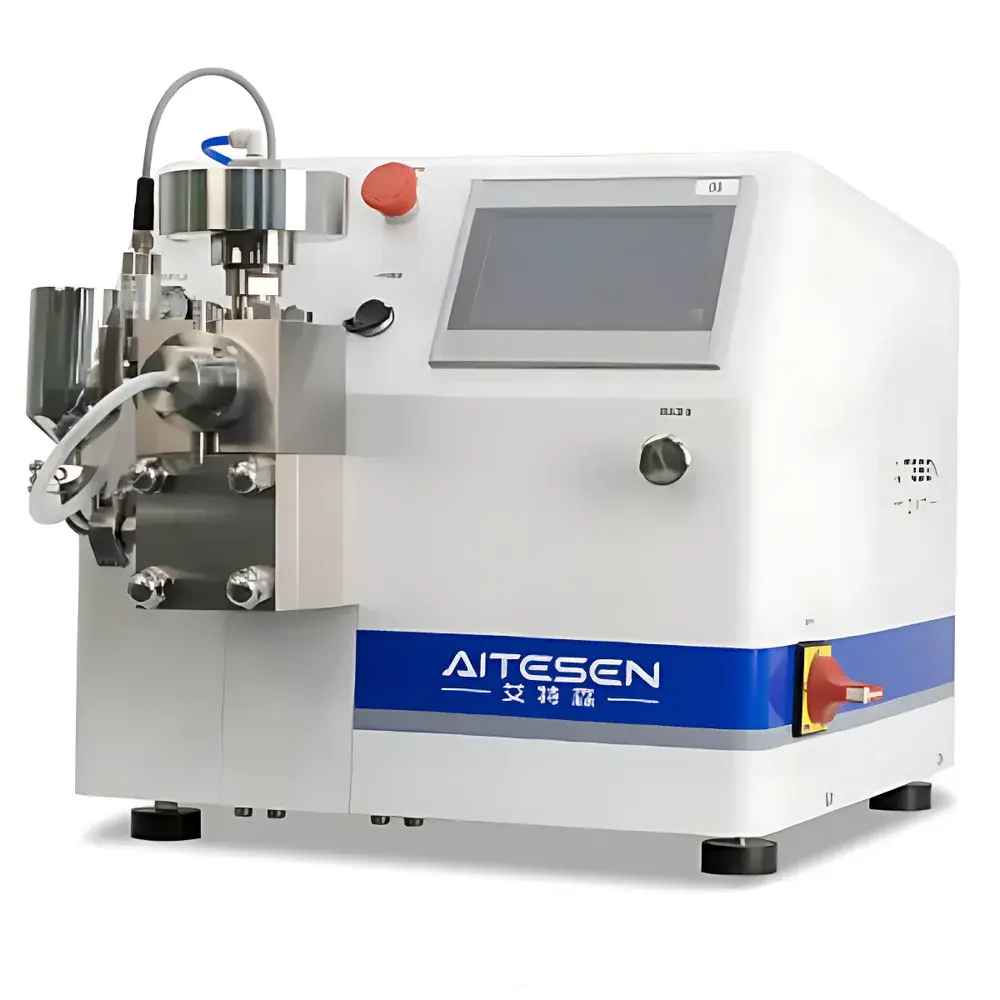
Aitesen HPH-L2 High-Pressure Homogenizer
| Brand | Aitesen |
|---|---|
| Origin | Jiangsu, China |
| Model | HPH-L2 |
| Maximum Pressure | 2000 bar |
| Maximum Feed Particle Size | 500 µm |
| Flow Rate | 5–15 L/h |
| Minimum Sample Volume | 15 mL |
| Noise Level | 65 dB |
| Power | 1.5 kW |
| Dimensions (L×W×H) | 545 × 755 × 494 mm |
| Weight | 140 kg |
| Material | SAF2507 duplex stainless steel |
| Homogenization Valve | High-efficiency safety valve with manual pressure adjustment |
| Control Interface | Touchscreen panel with real-time pressure display, data logging, export capability, and programmable safety cutoff |
| Compliance | Manufactured per EU Machinery Directive 98/37/EC (MD) |
Overview
The Aitesen HPH-L2 is a laboratory- to pilot-scale high-pressure homogenizer engineered for reproducible, scalable cell disruption and nanoemulsion formation under strictly controlled mechanical stress conditions. It operates on the principle of turbulent shear, cavitation, and impact forces generated when a pressurized fluid stream is forced through a narrow, precision-machined homogenization valve. This physical lysis mechanism ensures consistent subcellular particle size reduction without thermal or chemical denaturation—critical for preserving labile biomolecules such as membrane proteins, nucleic acids, and extracellular vesicles. Designed for GMP-aligned workflows, the HPH-L2 delivers stable pressure output across its full 2000 bar operating range, enabling reliable process transfer from benchtop development to clinical manufacturing of lipid nanoparticles (LNPs), liposomes, and sterile injectables.
Key Features
- Robust pump head assembly constructed entirely from SAF2507 super duplex stainless steel—resistant to chloride-induced stress corrosion cracking and compatible with aggressive biological buffers and organic solvents.
- High-efficiency homogenization valve with dual-stage geometry, optimized for low dead-volume operation and minimal sample loss during small-volume processing (≥15 mL).
- Touchscreen HMI interface supporting real-time pressure monitoring, user-defined pressure ramping profiles, and automatic shutdown upon exceeding preset safety thresholds.
- Integrated data logging system compliant with ALCOA+ principles: timestamps, operator ID, pressure curves, and event logs are exportable in CSV format for audit trail reconstruction.
- Modular architecture supporting optional upgrades including variable-frequency flow control, automated pressure ramping, PLC-based sequence logic, jacketed temperature-controlled feed lines, and multi-pass recirculation manifolds.
Sample Compatibility & Compliance
The HPH-L2 accommodates viscous, particulate-laden, and shear-sensitive suspensions—including bacterial cultures (E. coli, Bacillus spp.), yeast (S. cerevisiae), mammalian cells, lipid dispersions, and nanomaterial slurries (e.g., graphene oxide, cellulose nanocrystals). Its wetted-path design meets ISO 13485 requirements for medical device manufacturing environments and supports cleaning-in-place (CIP) and steam-in-place (SIP) validation protocols. All pressure components conform to PED 2014/68/EU standards; electrical safety complies with IEC 61000-6-2/6-4. The system is routinely deployed in laboratories adhering to USP , FDA 21 CFR Part 11 (with optional electronic signature module), and GLP/GMP documentation frameworks.
Software & Data Management
The embedded firmware enables deterministic pressure control via closed-loop feedback from a calibrated piezoresistive transducer (accuracy ±0.5% FS). Process parameters—including pressure setpoint, hold time, number of passes, and inlet temperature—are stored per batch ID. Exported datasets include full pressure-time waveforms, allowing post-hoc analysis of energy dissipation profiles using computational fluid dynamics (CFD) correlation models. For regulated environments, optional software packages provide role-based access control, electronic signatures, and 21 CFR Part 11-compliant audit trails with immutable log files.
Applications
- Biopharmaceutical processing: Lysis of Gram-negative bacteria for inclusion body recovery; preparation of mRNA-LNP formulations meeting ICH Q5A quality attributes.
- Parenteral formulation development: Sterile-grade fat emulsions (e.g., propofol analogs), liposomal doxorubicin analogs, and nanocrystalline suspensions for IV administration.
- Nanomaterial synthesis: Exfoliation of 2D materials (graphene, MoS₂), dispersion stabilization of carbon nanotubes, and production of uniform cellulose nanofibril gels.
- Cosmeceutical R&D: Submicron emulsification of active ingredients (retinoids, peptides) into thermodynamically stable oil-in-water systems.
- Academic research: Mechanistic studies of membrane protein extraction efficiency vs. homogenization energy input; comparative evaluation of LNP encapsulation yield across pressure gradients.
FAQ
What is the minimum viable sample volume for reproducible homogenization?
The HPH-L2 achieves consistent particle size distribution down to 15 mL total volume when operated with the standard recirculation loop and pre-chilled feed reservoir.
Can the system be validated for sterile processing?
Yes—its fully drainable flow path, SA2507 wetted surfaces, and compatibility with SIP at 121°C/15 psi enable full sterilization cycle validation per ISO 13408-1.
Is remote monitoring supported?
The base model includes RS485 Modbus RTU; Ethernet/IP and OPC UA interfaces are available as factory-installed options for integration into MES/SCADA platforms.
How does the HPH-L2 compare to microfluidizers in terms of scalability?
Unlike fixed-geometry microfluidizers, the HPH-L2’s adjustable valve clearance and modular pump configuration allow direct linear scale-up from 15 mL to >50 L batches while maintaining identical specific energy input (kJ/L) and shear rate profiles.
Does it support continuous processing modes?
With the optional PLC control package and variable-frequency drive, the HPH-L2 supports uninterrupted operation for up to 8 hours at nominal pressure, with automated periodic valve inspection alerts.
Related Products




