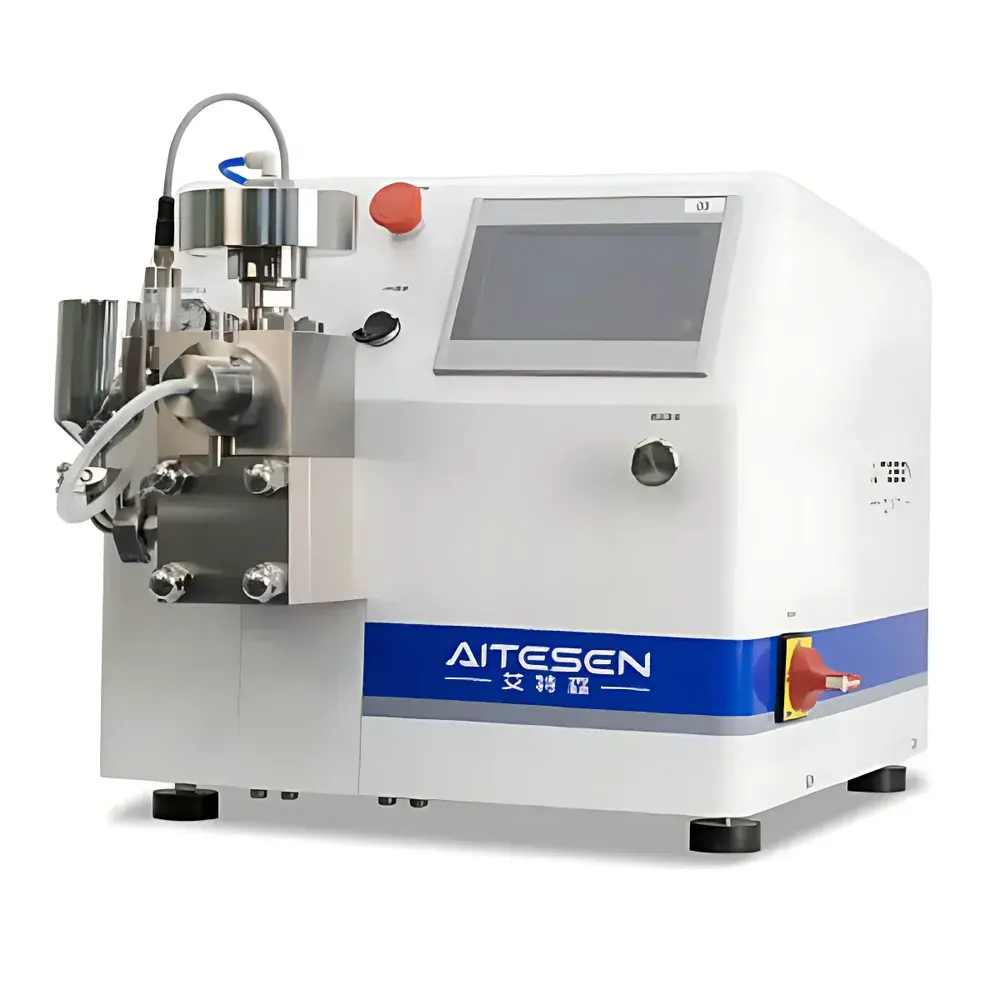
Aitesen HPH-L2 High-Pressure Homogenizer / Cell Disruptor
| Brand | Aitesen |
|---|---|
| Origin | Jiangsu, China |
| Manufacturer Type | Authorized Distributor |
| Product Category | Domestic |
| Model | HPH-L2 |
| Instrument Type | High-Pressure Cell Disruptor |
| Compliance | EU Machinery Directive 98/37/EC (MD) |
| Max Inlet Particle Size | 500 µm |
| Flow Rate | 5–15 L/h |
| Max Operating Pressure | 2000 bar |
| Minimum Sample Volume | 15 mL |
| Noise Level | 65 dB(A) |
| Power Rating | 1.5 kW |
| Cleaning & Sterilization | Yes |
| Dimensions (W×D×H) | 545 × 755 × 494 mm |
| Weight | 140 kg |
Overview
The Aitesen HPH-L2 is a benchtop high-pressure homogenizer engineered for precise, scalable, and repeatable cell disruption and nano-emulsification in regulated life science and pharmaceutical R&D environments. It operates on the principle of controlled hydrodynamic cavitation, shear, and impact forces generated when a pressurized sample stream is forced through a narrow, geometrically optimized homogenization valve. This mechanical lysis mechanism ensures consistent sub-micron particle size reduction without thermal degradation or chemical contamination—critical for preserving labile biomolecules such as proteins, nucleic acids, and membrane-bound receptors. Designed to meet European Machinery Directive 98/37/EC (MD), the HPH-L2 integrates a modular, split-head pump architecture constructed from SAF2507 super duplex stainless steel—providing exceptional corrosion resistance and long-term dimensional stability under extreme pressure cycling. Its nominal maximum pressure of 2000 bar enables efficient lysis of robust microbial strains (e.g., E. coli, Saccharomyces cerevisiae) and facilitates formulation development for lipid-based nanocarriers including liposomes, lipid nanoparticles (LNPs), and nanostructured lipid carriers (NLCs).
Key Features
- Split-head pump design with SAF2507 wetted components for high-pressure integrity and biocompatibility
- Manually adjustable homogenization valve with real-time pressure feedback and digital display
- Touchscreen control interface supporting pressure logging, data export (CSV), and user-defined safety thresholds with audible/visual alarm
- Integrated pressure regulation via handwheel or optional pneumatic actuation for fine-tuned process control
- Stable, low-pulsation drive system delivering consistent flow rates between 5–15 L/h at full pressure
- Full CIP/SIP compatibility: validated cleaning-in-place and steam-in-place readiness for GMP-aligned workflows
- Compact footprint (545 × 755 × 494 mm) and 140 kg mass enabling deployment in biosafety cabinets or ISO Class 5/7 cleanrooms
Sample Compatibility & Compliance
The HPH-L2 accommodates aqueous, viscous, and moderately particulate suspensions with inlet particles up to 500 µm—making it suitable for crude lysates, fermentation broths, and pre-filtered formulations. Its minimum sample volume of 15 mL supports early-stage feasibility studies while maintaining statistical reproducibility across replicates. The system complies with EU Machinery Directive 98/37/EC (MD) and incorporates dual redundant pressure sensors, emergency stop circuitry, and automatic pressure relief mechanisms aligned with ISO 13857 safety principles. For regulated environments, optional audit-trail-enabled firmware supports 21 CFR Part 11 compliance when integrated with validated LIMS or ELN platforms. All wetted surfaces are electropolished to Ra ≤ 0.4 µm and certified per ASTM A967 for passivation—ensuring minimal leachables and suitability for USP <661> and EP 3.2.1 applications.
Software & Data Management
The embedded control unit records pressure, time, and cycle count with timestamped resolution of ±0.1 s and ±1 bar. Exported datasets include raw pressure traces, hold-time profiles, and operator metadata—formatted for direct import into JMP, MATLAB, or Python-based process analytics pipelines. Optional PLC integration (Siemens S7-1200 or Allen-Bradley CompactLogix) enables synchronization with upstream/downstream modules such as feed pumps, temperature jackets, or inline particle sizers (e.g., Malvern Mastersizer). Firmware updates are performed via secure USB authentication, and configuration backups support GLP-compliant instrument qualification (IQ/OQ/PQ).
Applications
- Microbial cell disruption for recombinant protein recovery and inclusion body solubilization
- Lipid nanoparticle (LNP) formulation for mRNA vaccine development and nucleic acid delivery
- Preparation of sterility-assured fat emulsions (e.g., parenteral nutrition, drug-loaded lipid injectables)
- Nanosizing of poorly water-soluble APIs via top-down crystallization or amorphous dispersion stabilization
- Production of uniform liposomes for encapsulation of peptides, siRNA, or small-molecule therapeutics
- Dispersion of 2D nanomaterials (graphene oxide, nanocellulose) and carbon nanotubes in aqueous media
- Process development for continuous manufacturing of complex injectables under QbD frameworks
FAQ
What is the recommended maintenance interval for the homogenization valve?
Valve inspection is advised after every 200 operational hours or following processing of abrasive samples; replacement intervals depend on material hardness and pressure profile—typically 500–1000 hours under standard bio-pharma conditions.
Can the HPH-L2 be integrated into an automated aseptic processing line?
Yes—via optional PLC interface, 4–20 mA analog I/O, and Ethernet/IP communication; validation documentation (FAT/SAT templates) is provided for GMP commissioning.
Is the system compatible with organic solvents used in LNP formulation?
SAF2507 construction resists common LNP co-solvents (e.g., ethanol, isopropanol, chloroform); however, prolonged exposure to strong oxidizers or halogenated solvents requires prior compatibility assessment.
Does the device support multi-pass homogenization protocols?
Yes—user-programmable pressure ramping and dwell timing allow precise control over single- or multi-cycle processing, critical for optimizing lamellarity in liposomal systems.
How is temperature managed during extended operation?
While the base model relies on passive heat dissipation, optional jacketed homogenization chambers or external chillers (−5 °C to +40 °C range) are available for thermosensitive payloads.
Related Products